From 2008 March to 2014 September, the Dennis Rawlins page on Wikipedia was
trashed repeatedly by the sort of dirty-fighter censors which establishments
traditionally use to discourage exposure of what they're ever-hiding.
Threats — some repeatedly acted upon —
against anyone associated with Rawlins, as well as
a wide sampling of those Rawlins accomplishments persistently
censored (despite zero evidence of inaccuracy) can be found at
DIO 22
[2018] fn 109 [p.77].
A pre-ultravandalism 2008/10/2 Wiki-biography of DR
can be recovered by clicking on
archived (it includes for balance a DR-recommended list of
articles attacking him, two of the articles having been written by himself!
— to correct his 1/2-century career's only two serious prior mistakes).
The current (since 2014) vastly-shrunken page (a stub lacking any mention of
DR's central achievements regarding Neptune's discovery and ancient-astronomy)
await stable restoration in a hypothetical future age, when scholars
prefer refuting views they disagree with, instead of burning them.
For over a dozen latest 2pp DR chews of astronomical lore,
click on menu.
Contributions
Dennis Rawlins
Below are among the more important and-or interesting
of Dennis Rawlins' original
contributions
to high scholarship,
low ``humor'',
and central contemplative,
even transporting
analysis.
The famous University of Jena philosophy professor G.W.F.Hegel's
1st published academic paper ended with his attempt
to justify the supposed large gap between Mars & Jupiter
(which appeared to defy the already well-known Titius-Bode rule),
by drawing a series of 7 numbers out of Plato's Timaeus,
fiddling one of its members (Jupiter), taking each number to the 4/3 power,
then fiddling another planet's number (Mercury). [The resulting fit
to reality is poor, anyway — much worse than Titius'.]
(This unexceedably-bonkers scheme ended up
embarrassing
both Hegel and the almost-as-astronomically-talented Lord Hoskin and
His Journal for the History of Astronomy: see
DIO 1.2 [1991]
n.60 [p.110].)
Traditional popular accounts of the Hegel-Ceres farce had of course
tacitly assumed that Hegel had published before Ceres' discovery. But,
in fact,
Hegel published his theory on 1801/8/27 (his 31st birthday),
the better part of a year AFTER
Ceres had been discovered by the Palermo Observatory's Giuseppi Piazzi
(1801/1/1). Worse, DR found that Ceres' multiple sightings
by Piazzi had even been announced by J.Bode (1801/5/6)
in the local Jena Literary Gazette!
(News also published in Berlin 5/12 & Hamburg 5/13. All three notices
cited at Monatliche Correspondenz vol.3 p.607 [1801 June].)
In 1966, Dennis Rawlins became suspicious of
the standard British account of Cambridge University mathematician
John Couch Adams' allegedly pinpoint 1845 gravitational prediction of
as-yet-undiscovered Neptune's place. After presenting a detailed analysis
as a paper (to Johns Hopkins University's
History of Science Dep't 1966/5/11) challenging Adams' claim
and emphasizing
the oddity of Cantab secrecy prior to Frenchman
Leverrier's success,
DR continued intensive research
on the case throughout the late 1960s. Planning a book on the Neptune saga,
DR for over three years (starting 1967/4/1)
contacted the Royal Greenwich Observatory (RGO), trying to obtain access
to the long-private RGO file on the Neptune case. (Correspondence published at
DIO 4.2 [1994]
‡10 §E etc.) The RGO went through years of back&forth alibis
for not sending anything at all, while the Astronomer Royal's
chief confidante and chief appointed Neptune-affair defender
removed the file, taking it to Australia and then to Chile,
hiding it from researchers for over 30 years.
The reasons
for the file's long disappearance became clear when it finally surfaced
in 1998, after it was found in the home of the recently deceased concealer,
who (right to the end) had denied possessing it.
[Did Astronomer Royal Wooley's death unexpectedly
leave the concealer holding the bag?]
DIO's revolutionary conclusions from the file appeared in
DIO 9.1 [1999]
‡1 [pp.3-25]. A final finding — exact reconstruction of
Adams' erroneous final predicted position for Neptune —
1st appeared online here (2010/12/22) below:
a double-hit (longitude and mean distance), both on-the-nose.
In 1967, Dennis Rawlins recovered a long-lost pre-discovery 1714 observation
of Uranus, made by John Flamsteed, the first Astronomer Royal.
(PASP 80 pp.217-219 [1968];
Science News 95 p.96 [1969].
[Upon the 2011 death of Chas. Kowal
(Johns Hopkins Applied Physics Lab & DIO),
DR became the only living recoverer of
a pre-discovery observation of a major planet.
For CK's discovery
(Neptune 1613 — by Galileo!!), see any college astronomy textbook. Also
DIO 2.3 [1992]
p.98. Kowal's amazing and ever-unique find
made him a clear choice as the first Recipient [2004]
of DIO's R. R. Newton Award for Scientific History.
See under DIOPrizes.]
At the soon-after suggestion of DR and Sky&Telescope Editor
Joe Ashbrook, Joachim Schubart searched
the Mannheim Observatory records of Roger Barry, finding that
Barry's transit-work came close to recording
a place of Neptune in 1810 — but narrowly missed.
In 1967-1968, Dennis Rawlins used optical calculations to
eliminate
the theory that Pluto might be a reflecting-iceball,
a theory which had been proposed to explain
how Pluto could indeed be 0.91 Earth-masses
— then the official US Naval Observatory value —
yet still appear (like a crystal ball)
to have a tiny light-disk (as G.Kuiper had found
by observation through the Mt.Palomar 200-inch telescope).
This initiated DR's realization that Pluto's mass was tiny;
he ultimately put Pluto at about 1/40 of an Earth-mass
(300 times smaller than Lowell's predicted value, yet
actually too high, as we now know), effectively zero
as regards potential perturbation upon the orbits of Uranus or Neptune
(the bases of previous estimates of its mass). This rendered
utterly fortuitous
the Percival Lowell “prediction”
of Pluto's place & orbital elements,
even though these elements were remarkably near the truth.
(Sky&Telescope 35 [1968 March] pp.160-162;
Astronomical Journal 75 [1970 September] pp.856-857;
Mon. Not. Royal Astronomical Society 162 [1973] pp.261-270.)
Vindicated in 1976 Dale Cruikshank, when Pluto's high reflectivity
& (Charon 1978) minuscule mass were confirmed by direct observation.
Dennis Rawlins charged publicly
in 1969
that Britain's allegedly-pinpoint Neptune-“discoverer”,
Cantab John Couch Adams, had at the time of discovery (1846/9/23) actually
been directing Cantab searcher James Challis
way off the mark
(Sky&Telescope 38 pp.180-182 [1969]).
[Adams' final theoretical planet was south of all Berlin Starcharts
(DIO 9.1 [1999]
p.17), even while the real Neptune was retrograding
through stars on a Berlin map (Hour 22) in Challis' possession
(below).] Unambiguous confirmation
(Adams' explicit private 1846/10/15 alibi for the misdirection)
found in newly recovered RGO Neptune File.
(Details: DIO 9.1
[1999] p.16.)
In this connexion, it's enlighteningly worth recalling that
DR had been 1st to question (publicly since 1969)
the validity of Adams' claim on the basis of the enormity of the swings
in Adams' predicted longitudinal positions for Neptune, ranging over 35°!
— from 350° (1845 Spring)
down to 315°1/3 finally (1846/9/2)
— his ultimate prediction being 12° off the real Neptune
(vs Leverrier's partly fortunate hit to within less than 1°).
Such unsettling factors summarized at
DIO 9.1 [1999]
n.20 [pp.7-8].
Used vector calculus to devise formula for evaluating
a noon-Sun-aimed polar traveler's azimuthal divergence
from his intended meridian,
as a function of his unchecked lateral distance from it.
(U.S. Naval Institute Proceedings 1970 June p.36.)
D&B Rawlins visited Paris Observatory (1970/8/18) and spent most of a day
hunting down the original observation-books of Pierre Lemonnier
(who 12 times unwittingly saw Uranus & recorded its place)
and Michel Lefrançais Lalande (who similarly missed Neptune,
twice in 2 days: 1795/5/8&10).
Lemonnier's fifty-eight years of ms observations
(1734/12/23-1792/9/16) ran to sixteen volumes of dedicated labor.
Starting around the mid-19th-century,
Lemonnier's notorious 1750/10/14-1771/12/18 dozen recordings of Uranus' place
were increasingly sniggered-at by hand-me-down historians, as due to
the slovenly record-keeping of
a ditzy incompoop.
(The trend included the cute tale that he had recorded one of
the tragic Uranus dozen upon a bag formerly containing powder for his wig:
perhaps the sort of rumor which post-Revolution historians
enjoyed telling of royalists.) DR checked every one of the dozen,
finding that all 12 were entered completely properly:
in a continuous pre-bound register, in ink.
Beside the 1768/12/27 record was Lemonnier's
sad later scribbling: “It is the new planet discovered
in 1781 13th March by Herschell” [sic].
(Record photo-reproduced: Astronomy 9.9 [1981 Sept] p.26.)
Found that John Herschel had accidently seen Neptune the night of 1830/7/14
(during sweeps for his stellar researches),
but couldn't resolve its disk at such low altitude. (Idem.)
[In late 1846, JH openly stated he'd come close to bagging Neptune
on this date, believing it simply hadn't crossed his field of view
— but Dennis Rawlins wondered if JH's check had used an incorrect early
Neptune orbit, since the time was before the 1847/2/2-4 recovery of
Lalande's 1795 observation by USNO's Sears Walker, who immediately
used it to compute the first trustworthy orbit for Neptune.]
DR found that according to the planet's actual orbit,
Neptune passed within J.Herschel's 1830/7/14 field.
Had JH discovered Neptune, history would have credited
the only two Solar System giant-planet discoveries to father&son! —
a delightfully felicitous tale. Yet, as JH selflessly stated at the time,
we would have missed an even more powerful story:
the legendary Leverrier's
ever-unique mathematical inductive-chasing-down and publicly pinpointing
the place of an as-yet-undiscovered giant planet. See
DIO 9.1 [1999]
‡1 [pp.3ff].]
In 1970, showed that the two unrecognized 1795/5/8&10 observations
of Neptune by Lefrançais Lalande were incompatible
with the 1968 USNO orbit
(Astronomical Journal 75 [1970] pp.856-857),
whatever the cause.
Slightly contra
DIO 2.3 [1992]
p.98: the two Lalande sightings of Neptune can't be called entirely accidental
(as were Lemonnier's Uranus sightings), since Lalande's famous catalog
was accomplished partly to flush out a new planet “Lalande”.
(DIO 7.1 [1997]
p.27 & notes.) He unfailingly called Uranus “Herschel”.
DR even recovered a manuscript note by the observers
(Lefrançais Lalande & Johann Burckhardt)
— right in the original Lalande record-book (Paris Observatory) —
stating explicitly that their 2nd sweep of the sky
(starting in 1800 late Summer) was
“to discover a planet beyond Herschel,
if there exists one ….” (ibid n.7).
“Find a Way or Make One.” Up?
:
Spotlighted
(U.S. Naval Institute Proceedings 1970 June pp.36-37)
the incredibility of:
Then-universally-accepted 1909 North Pole-claimant Robert E. Peary's
alleged 10 mile jaunt beyond his “Pole” camp,
though he had still not yet sextant-confirmed his steering to it.
His sextant-shot (during this sally) at 70°W-midnight,
the one time during the 24 hours between noons when the Sun's altitude
would not tell him whether that steering had been valid.
[Note that Peary's 1909/4/6-7 alleged sextant data lack shots
in opposite directions from the same spot.
(The midnight shot was reported as having been taken
roughly 10 nmi beyond the point [Camp Jesup]
of all the other purported shots.)
This was superficially-clever in that it guarded against
his being tripped up by errors in his assumptions
regarding refraction or ice-drift-rate.
But there is no purpose for such a omission except to safeguard a hoax.
And the attendant unfalsifiability is so transparently manicured
and so typical of this phantom trip, that it helps
explain why genuine scientists do not take it seriously.]
The latter extreme oddity was part of Peary's previously-unremarked
cautious tactic of sticking strictly to observations at the day's
quarters
(12 o'clock or 6 o'clock on his alleged 70°W incoming meridian of
longitude), thereby only claiming “observations”
which could be faked by simple
arithmetic, not even requiring
plane trig, much less the sph trig of genuine navigation of a long trip.
(E.g., Amundsen & Scott 1911-1912,
who used sph trig even though not traveling over moving ice-cakes:
DIO 2.2 [1992].)
The badly
manufactured “N.Pole” data in Frederick Cook's 1911
My Attainment of the [North] Pole pp.292&302 were rigged
by exactly the same giveaway needlessly-rigid quarter-day schedule.
By contrast, the Amundsen expedition's 1911 South Pole observations
[for solar altitude & compass variation] were around the clock [and
shared], since that was a real trip.
Despite Peary's claim that he had only 2000 fathoms of sounding wire in 1909,
Dennis Rawlins found (Polar Notes 10 [1970] p.38
[Stefansson
Collection, Dartmouth College]) that the 1908-1909 Peary expedition
was supplied with 4000 fathoms of such line
— half of which (weighing merely 13 lbs [at most])
he'd found an excuse not to take — when heading poleward over
an ocean known to be deeper than 2000 fathoms in many regions. From the 1909 Peary Expedition's Bottom-less Pit of Anomalies:
Nonetheless, Peary (after losing 500 more fathoms on the way)
ended up at his “Pole” camp with merely 1500 fathoms of line,
and so got nothing more than a no-bottom sounding.
(Thus, as in the realm of magnetism, his “Ninety-Degree-North”
1909 alleged N.Pole expedition produced zero precise new scientific data
from anywhere north of 86°N latitude.)
This bottom-line or no-bottom-line of his 1909 expedition's
scientific sterility was summed up at idem endnote o [p.51]
As we have seen [above], over a half-dozen different tests
[of the 1909 claim] might have been possible: shared [sextant] observations,
witness to [own sextant] data, compass variation, ocean depth,
current, photo shadows, internally consistent [sextant] observations
at the Pole, or consistent data and journal [April 1-9].
Somehow, not one of these tests can be applied to the 1909 trip.
The kindest possible conclusion (not my own, I might add) is:
Peary's claim is completely unsubstantiated and thus should be completely
dropped (à la Copenhagen [regarding Cook]), for, even if he did
achieve the Pole, he might as well not have; and accepting
[such a scientifically profitless and unverifiable claim]
might later encourage those less upright than the Admiral to take advantage
of the precedent set by official allowance of the lights-out conditions
under which the feat was allegedly performed.
Dennis Rawlins Peary at the North Pole:
Fact or Fiction [1973] p.154 noted:
If one can navigate a trip from celestial data, one can fake
celestial data from an imagined trip; the math is the same type.
(The standard navigational method of Peary's day [the St.Hilaire method]
actually required faking celestial data en-route to
solving for position.)
It is easier to fake celestial data than to use it in genuine navigation.
[Except very near the poles, where the math in either direction
is such trivially simple
arithmetic
that there's little to choose:
“to say that [faking] near-polar [sextant] observations …
is trickier than using genuine data is tantamount to saying
that addition is more difficult than subtraction.”]
(Polar Notes 10 [1970] p.35. See also
DIO 10 [2000]
p.32 n.62.)
The easiest places on Earth for which to fake data are the poles.
(World expert E.M.Standish is appalled that any scientist doesn't know this.)
Dennis Rawlins showed how the fancy-looking (& expensive) pages&pages
of spherical trig determinations of Peary's alleged location near the Pole
(given in full at Wm.Hobbs Peary 1936 pp.466-475),
designed to impress Congress (& secretly funded by Peary:
Rawlins Peary … Fiction [1973] p.238)
could be accomplished in just a few lines of
gradeschool arithmetic.
The results agreed (with those Hobbs reproduces) to about 1 meter! —
a tiny fraction of a great-circle arcsec. (See this simple arithmetic
actually performed at Polar Notes 10 [1970] p.35.)
Revealed that Matthew Henson's account
(Boston American 1910/7/17) of Peary's 1909/4/6-7
activities near his “North Pole” camp confirm most explorers'
and navigators' longheld suspicions that it was far from the Pole:
Peary made no sextant observations during the last five marches, largely led
by non-navigator Henson. (Whom Peary was privately denouncing as a slacker
[DIO 1.1
[1991] p.25 & n.16] and whose recognition has always been violently
mis-estimated
in one direction or another.)
Henson's 1910 account included his reports that
Peary's 4/6-7 sextant shots triggered “disappointment”
and that he suddenly went effectively silent towards Henson
(who had faithfully served him for 22 years)
right from this allegedly glorious moment —
the very same moment when Peary (whose story was obviously still
in-flux)
also got silent to his diary for days of blank pages. (See
DIO 10 [2000]
§O15 and nn.141&142.
See also the long-suppressed 1910/4/1 note to Peary
from his beautiful secret ghostwriteress:
Rawlins Peary Fiction [1973] Appendix p.284 [& p.61].
And see Henshaw Ward's invaluable account
of the Bowdoin navigator secretly living at Peary's home
during the 1909 Autumn weeks when he was preparing to meet his NGS judges:
ibid pp.285f.) Peary henceforth avoided conversation with Henson.
For the rest of their lives.
(U.S. Naval Institute Proceedings 1970 June p.40;
Polar Notes 10 [1970] pp.42-43;
Rawlins Peary Fiction [1973];
DIO 1.1 [1991]
pp.23f [see below];
DIO 7.1 [1997]
pp.23-24 &
DIO 10 [2000]
p.5 n.)
First to bring modern magnetic science successfully to bear
upon the checking of historical polar reports.
(This was the empirical criterion
that initially caused DR to doubt the Peary 1909 claim.
See also Cagni
and Cook.)
Along the very 413 nautical mile route
(from 83°07'N to 90°N, along 70°W) which Peary said
he'd beeline-traveled straight to the North Pole
(allegedly steering within 1° of right-on),
we now know that the compass variation in 1909 changed (increasingly leftward)
by more than 10°, but Peary in 1909 admitted to Congress that he took no
compass-variation data (the only one of his 8 expeditions to omit such),
even though he said
(R.Peary The North Pole 1910 pp.211, 276, 294)
that his steering was accomplished by compass.
(U.S. Naval Institute Proceedings 1970 June.
Thorough citations supplied at:
Polar Notes 10 [1970] pp.36, 49, 52;
Rawlins Peary Fiction [1973]
pp.91, 137, 132, 226-228, 234;
DIO 1.1 [1991]
p.24;
DIO 7.1 [1997]
p.24 n.22.)
Explorers Frederick Cook (1908) &
Rob't Peary (1909) claimed that at their allegedly-conquered
North Geographical Pole, the compass pointed at or near
the North Magnetic Pole.
(From such pseudoscience followed Cook's fantastic
“magnetic meridian”.)
Dennis Rawlins determined that in 1908-1909 the compass
at the NGP actually pointed roughly 30° to the right of the NMP.
(Polar Notes 10 [1970] pp.36, 52;
Rawlins Peary Fiction [1973] pp.91, 226.)
Professional explorers' politely muted
but eventually wide doubts of Peary's claim presumably
arose directly out of his long-putoff 1911 congressional testimony,
when he was finally (after the huge profits his
N.Pole hoax had brought in
from lectures, magazine series, & book were safely in the bank)
forced to admit that he had in 1909 taken no compass data. One need not
speculate regarding what an independent scientific body would have made
of that item, given the reaction of the chief navigation expert
(longtime Copenhagen Navigationsdirektor, Commodore J. A. D. Jensen)
of the Danish commission that in 1909 rejected Cook's 1908 N.Pole hoax:
“There is nothing in Dr.Cook's [1908] records to show that
he made azimuth observations. In the arctic regions, where variations of
the compass are most important [being large and varying from place to place]
— the compass is of little use unless its variations are controlled
[checked by fresh determinations] at short intervals.
When one realizes that Dr.Cook
[nonetheless]
set his course to the pole by the compass,
the most fantastic suppositions as to his wanderings
are possible.” (Polar Notes 10 [1970] p.52;
Rawlins Peary Fiction [1973] p.132.)
[In 1909 September, Denmark trustingly elevated Cook,
but it destroyed him in December.
By an odd coincidence, Denmark's top composer Carl Nielsen
and Cook were born on consecutive days: 1865/6/9&10.
More precise and odder coincidences are cited at
DIO 8 [1998]
pp.48-50. Also: DR's father Lou was born on the very day Harry Thaw
(Harvard class of 1892) murdered top US architect Stanford White
(and got-off on “temporary-insanity”,
proving that temporarily-insane juries are not a novel blight),
which was exactly the 30th anniversary of Custer's end.
DR's critics may find significance in the fact that
his father's birth occurred in calendaric connexion
with a day of killings by Crazy Horse and Crazy Harry.]
Defended Russian explorers
Otto Schmidt
& Ivan Papanin from unjust US attack upon the veracity of their report
of & results from their 1937 flight to 89°1/2 N latitude.
(Rawlins Peary Fiction [1973] pp.276-277.)
Corrected a few serious errors in the otherwise excellent gravitational math
of the eminent astronomers Ernest Brown & Raymond Lyttleton.
(Mon. Not. Royal Astronomical Society 147 pp.177-186 [1970].)
Building upon Brown's brilliant transformation,
Dennis Rawlins discovered (idem)
circular-orbit perturbation-amplitude's dependence upon distance,
with precise expressions for asymptotic behavior at distance-extremes
(at p.185: for coefficient 11/3, read 11/4; typo was DR's, not RAS'):
[a] close-up: log times inverse-square;
[b] long-distance: inverse-cube.
Applied above two findings to
end
over a century of various uncomprehending astronomers' doubts
regarding the legitimacy
of Leverrier's uniquely wonderful 1846 predictive discovery
of Neptune, by demonstrating mathematically that his error
in Neptune's distance was balanced by his math's automatic adjustments of
the perturber's other orbital elements and mass. (See
Mon. Not. Royal Astronomical Society 147 pp.177-186 [1970]
pp.185-186;
DIO 7.1 [1997]
‡5 §A9 [p.26]).
[The 1847 attacks by Harvard's B.Pierce, based on
misunderstood resonance considerations were 1st
undone (see idem) privately by
George Airy.
and publicly by J.Adams.]
These researches also later proved useful
for showing the nonexistence of the sensational
“Brady Planet”,
and as a starting point for a staid, responsible
trans-Neptune planet perturbation-math search.
In 1971, Dennis Rawlins circulated a paper examining the recent USNO analysis
of post-discovery observations of Neptune,
which had re-estimated Pluto at 0.11 Earth-Moon masses (EM)
plus-or-minus 0.02EM (using a curious weighting scheme
that particularly emphasized the latest residuals).
DR noted that, if weighted evenly, the USNO residuals
actually indicated a Pluto mass that was exceeded
by its own uncertainty: 0.026EM plus-or-minus 0.043EM.
Thus, perturbation-theory told us nothing about Pluto's mass
except that it was perturbationally negligible. Such had been implied
at the conclusion of DR's 1970 paper on the 1795 Neptune residual
(Astronomical Journal 73 pp.856-857), where he compares
the over-high USNO value published in late 1968 (0.18 Earth masses)
not to his own tiny estimate (1/40 of Earth+Moon, a value
that was obviously extremely crude in relative terms)
but rather just to a mass of flat zero.
At DR's instigation, the American Geographical Society's archivist
Lynn Mullins examined (letter 1971/9/20) the 1860-1861 records of
US explorer and north latitude record-claimant
Isaac Israel Hayes — finding that a key leaf
(“Bearings” [HB] pp.29-30), right at his 1861/5/18
alleged Farthest-North-Land attained, has been
scissored
out of the book. (Hayes' 1860-1861 expedition
drew wider public US academic institution-support than any other, ever:
the list of eminent subscribers runs pages:
see I. I. Hayes Open Polar Sea [1867] pp.xi-xvi.)
Lynn found that Hayes' journal is blank for his whole trip northward
away from his Port Foulke base: between 1861/4/10 & 5/29.
She generously sent DR photocopies of the central portion of HB.
Historians have by now unanimously rejected
Hayes' claim
of having achieved a Farthest-North-Land record
on Canada's east coast at 81°35'N 70°30'W.
[As he proudly states (Hayes Open Polar Sear 1867 p.344),
the claimed latitude barely exceeds the also grossly (if less) exaggerated
E.Kane-W.Morton 1854 claim
of planting the US flag past 81°N — (Kane 1856 2:383),
an alleged farthest-north land, which is mapped by Hayes
(ibid p.72 opp) at 80°41' instead, almost a degree south of himself
on the same map. (So Hayes knew Kane had exaggerated.)
Given Kane's 1857 post-humous super-patriotic exaltation,
might Hayes have had reason to believe it was no bar to immortality
to stretch latitude for glory? — especially Old Glory.]
This geographical point is deep-inland, not coastal. The alleged attainment
was via sudden alleged high-speed last-leg sledging —
the first of four highly similar
and independently-suspicious Arctic claimed record-farthests,
where we note that, in all four cases,
the Farthest's sextant data were
unshared.
[The other cases:
Cagni 1900,
Peary 1906,
Peary 1909.
Note also that, though not alleging sudden speed-bursts
(unless we count Byrd's helpful wind from the North, allegedly appearing
just in time to whisk him swiftly homeward:
DIO 10 [2000]
Fig.11 [p.72]), the fake F.Cook 1908 &
R.Byrd 1926 N.Pole claims
were also based on unshared sextant data.
Needless to say, the Pole data of
Amundsen
1911&1926 and Scott 1912 were shared,
since their expeditions' paths were entirely genuine.]
In 1972 May, DR was 1st to declare
the nonexistence of Livermore Lab's much-publicized jovian-mass
“Brady Planet”.
(When phoned by the press the very day of the Jos. Brady announcement,
DR used [over the phone, via slide-rule] his
1970 Roy. Astr. Soc. paper's perturbational curves to find
that Brady's proposed mass was vastly too high, and this judgement
appeared immediately in the Baltimore Evening Sun (1972/5/1).
The overly huge (& secularly-unstable-orbit) Brady object
is now definitely known to be nonexistent.
In 1972, DR used microscopic needle-perforations through
the contents of an allegedly prediction-containing envelope,
to reveal that the crowning event in
the college-audience-circuit “psychic” act
of R.Burgess was merely a magic trick.
The press showed unaccustomed boldness in reportage on this
(Jon Franklin, Baltimore Evening Sun 1972/4/21 pp.C1-2);
but the dean of the college in question ducked involvement,
and a member of the faculty (who'd seen the unambiguous evidence)
was quoted as saying: all right, all right, that effect was fake,
but other parts of the same evening's act seemed real.
Such refinement of invincible credulity has been common to the ESP-brained
at least since the cases of Eusapia Palladino & Arthur Ford.
(Skeptical Inquirer 2.1 [1977] pp.74-75.)
DR showed that F.Cook's alleged 1908 sextant observations,
if treated seriously, put him on another planet: found that Cook's
unshared 1908 sextant data
were corrected for 9' refraction, a value copied from Peary —
a backfired theft,
since 9' refraction was correct for Peary's alleged 7° solar altitudes
but not for Cook's 12° solar altitudes, where 5' would be right.
This is why Cook's data [Cook 1911 p.302] “which he thought placed him
(with amazing precision) within about one mile of the Pole
for well over 24 hours straight, instead demand that he must have
hovered for that period, four miles sunward of the Pole,
while the Earth spun just beneath his feet.
The indication that Cook was riding a flying saucer is not to be taken lightly
— e.g., his only doublelimb solar altitudes ([1908] 4/8 and 4/14)
[Cook 1911 pp.258&274] make the Sun's apparent diameter 1°/4
(not 1°/2, as it appears from the Earth), thus placing him about
two Astronomical Units from the Sun, presumably on the planet Vesta.”
(Norsk Geografisk Tidsskrift 26 [1972] p.135
[Norwegian Geographical Society; Oslo University].)
In 1972, DR analysed the claims of Dr. I. Velikovsky,
who claimed to have explained the miracles of the Bible
by astronomical collisions & catastrophes,
and whose book Worlds in Collision [Macmillan 1950]
had been censored (via threatening a textbook boycott of Macmillan)
by some prominent astronomers, which helped V develop a cult following
— and sell a great many more books — by switching
WC to Doubleday, which had no textbook division.
[Never approving of such tactics, DR had openly defended
the loony V-crowd's right to advertise in Sky&Telescope.
But S&T refused the proposed ads.
And DR's name did not stain the pages of that
fair&impersonal journal for the next 1/3 of a century.
Even as late as 2002 (Feb p.40), S&T was still angry enough
to attack DR by publishing
the unchecked rumor of a DR enemy. (S&Tthen refused to retract
when it could not come up with the documentation of its abusive charge.)]
DR's 1972 ms (rev. 1974) was titled: “Freudian Astronomy, or
Do Planetary Orbits, Bristlecone Pines, and Velikovsky's Believers
Suffer from Collective Amnesia”? DR noted:
Delicate bristlecone pines predate V's last proposed
world-searing catastrophe but show no sign of its effect.
Orbits have better memories than bibles:
Planets involved in V's hypothesized planetary interactions
would most probably be thrown into durably-tilted orbits with
high inclination, but all of his colliding planets in fact
have orbits virtually in the plane of the Solar System.
If Venus was once at Jupiter's distance, it would keep returning there,
on an elliptical orbit. But Venus' orbit is the most circular
in the Solar System, and its mean distance from the Sun varies over centuries
by a distance so small that one could walk it in a few minutes.
Dr.Velikovsky was primarily a psychoanalyst,
whose most prominent paper (Psychoanalytic Review 1941)
in that pseudoscientific field had attempted to show from dream analysis
(which A.Salter rightly compared to playing poker with every card
wild)
that Sigmund Freud secretly longed to be a Christian!
(Curiously, astronomers had not previously been aware
of this delicious paper.)
[Barbara Rawlins notes that the paper conveniently appeared right after Freud
(born same day as mom-fixated Rob't Peary: 1856/5/6)
was safely dead (1939).]
Anyone still taking classic shrinkoanalysis seriously might usefully consult
Frederick Crews' Memory Wars [1995] p.37,
on Freud's shameless practice of letterwriting or even snoozing,
while a wealthy divorcée was traditionally-selfabsorbedly
babbling away on the traditional couch.
(Traditionally set so that the patient looks
in the opposite direction from the shrink.)
[See also Crews' sendup-collection book:
Pooh Perplex [1963] Chap.11,
esp. “A. A. Milne's Honey-Balloon-Pit-Gun-Tail-Bathtubcomplex”
by “Karl Anschauung, M. D.”]
In his Worlds in Collision's psychoanalysis
of early man's dreamy mythology
(deftly spoofed as “Worlds in Collusion”
in Ira Wallach Hopalong Freud [1951]),
Velikovsky claimed to be historically remedying primitive civilizations'
“collective amnesia”, his thinly veiled
marriage of psychoanalysis' “dissociative amnesia”
to C.Jung's “collective unconscious”.
Many years after DR had given “Freudian Astronomy”
to a few people, the world's leading expert on the Velikovsky ex-controversy,
C. Leroy Ellenberger, dug a copy out of his old files and found
that many of the most compelling and simple logical arguments against V
had appeared years earlier, right in that obscure unpublished 1970s DR ms.
(A former V-advocate, Ellenberger was gratuitously attacked for this recently
by Journal for the History of Astronomy Advisory Editor
Bradley Schaefer, who was protecting an earlier smear by launching another.)
So Ellenberger began distributing copies widely —
which hopefully did some good. (See Ellenberger's ironic and historic article
on the ever-complaining-of-censorship V-cult's crude censoring of him:
DIO 7.1 [1997]
pp.30-33.)
First to note that Peary's sole alleged 1909/4/5 zeroing-in observation
for navigating to “the Pole” was not among the data
submitted by him to the International Geographical Congress in 1913,
a submission accompanied by the statement
that all his 1909 data were included.
(For the credibility of his navigational story, the purported 4/5
sextant work was the most crucial of all his 1909 alleged data.)
Though mentioned in Peary's 1909 diary, the 4/5 record has never been found;
and at his 1911 congressional hearings, Peary denied its very existence.
(Rawlins Peary Fiction [1973] pp.143-144, 150, 231-232.)
First to reveal huge 1910 secret split in the Royal Geographical Society
board, on giving Peary its gold medal. Only 8 of 35 members voted
“For” — and at a nonquorum meeting, at that.
(Norsk Geografisk Tidsskrift 26 [1972] n.25;
Rawlins Peary Fiction [1973] p.237. Wisely & revealingly,
RGS declined to publish its own [curiously spiritualist: ibid p.61]
surveying instructor's credulous report.)
After his expedition's lightly-loaded lead-sledge
(Peary North Pole 1910 pp.204-205,
Rawlins Peary Fiction 1973 p.111) had made
only 13 nautical miles/day on the previous 5 marches, Peary with
all 5 sledges fully-loaded (Peary 1910 p.360,
Rawlins 1973 p.134) allegedly made astonishing 1909/4/1-9 speeds
over ocean ice full of high “pressure-ridges” and detours around
open water “leads” (Peary 1910 pp.194-196, Rawlins 1973
pp.112-113) from April Fool Camp (4/1, where he left the last other navigator
in the party, Bob Bartlett [who headed south from there]),
over 25 miles/day to his “North Pole” camp
(4/6-7, where sextant data were of course
unshared);
and back southward at over 50 miles/day to Bartlett Camp (4/9).
Unlike many analysts, DR carefully took the least fragile line of attack
upon these ridiculous claimed speeds by comparing them
primarily not to mortal explorers (& dogs!) but to Peary's own record.
(Note analogy to Cook-vs-Cook:
DIO 9.3 [1999]
p.122.) Theorizing that [i] the rest of the trip was real,
and [ii] Peary did not conspire with anyone,
DR emphasized that all Peary's suspect speeds are north
of April Fool Camp (which was at least 135 nautical miles from the N.Pole),
where
he had finally relieved himself entirely of
what was always his heaviest inertial burden
(whose superdrag-heft had similarly slowed progress in 1906), namely:
competent navigational companions who could check where the party really was.
The key new point (for which alibis vary, except in their incredibility):
Peary's speed not only doubles as he passes north
of this camp, his speed halves as he again passes
the same camp going south.
(Norsk Geografisk Tidsskrift 26 [1972] p.136.)
Added to Henry Helgesen's exposure of Peary's Cookian
(ibid n.11: sextant data)
finagling of his estimates of the miraculously speedy last 5 marches
to “the Pole”. (Thorough details at ibid n.26
or Rawlins Peary Fiction [1973] pp.144-145.)
Peary's & Cook's data-juggling had two glaring common features:
[a] Three stages. (See also Byrd's 1926 double
tripleness.)
[b] Seriously disparate input figures led to
identical computational bottom-lines
before&after — THE classic symptom
of backward calculation, which R.Byrd
has also been directly apprehended at.
As has W.Molett (modern defender of Peary & Byrd):
DIO 10 [2000]
p.55.
Peary denied he rode the sledges much,
but all five of his final 1909 companions agree that he did.
(Norsk Geografisk Tidsskrift 26 [1972] n.26.)
Thus, Rawlins Peary Fiction [1973] p.145
summed up Peary's 1909 navigational story:
he “sped over the ice for 27 marches without
knowing which way was
north,
pacing the distance of the last 130 miles from a sitting position.
[Detouring over drifting & obstructively pressure-ridged icecakes
all the while.] On [1909] 4/6-7, opining he was at his goal,
he chanced solar observations that showed him to be
only a mile and half short and four miles to the left,
the straightest, best-gauged dead reckoning feat of all time —
a veritable 413-mile
Pole-in-one!”
Demonstration (via novel hybrid general/special perturbation approach)
of very modest mass-upper-limits
for possible circular-orbit perturbing extra-Neptunian planets.
(Nature 240 p.457 [1972].
This paper [and that cited immediately following]
co-authored by Max Hammerton, Cambridge University.)
Full version of previous paper, noting
potential non-trivial planets' suspiciously Neptune-shy longitude-ranges.
Thus, first to propose
on empirical grounds that the major masses of the Solar System
may well end at Neptune — a now generally accepted proposition.
Mon. Not. Royal Astronomical Society 162 pp.261-270 [1973].)
Eliminated seriously discordant G. van Biesbrock 1957
Nereid-based mass for Neptune. (Ibid p.263.)
By accounting for diurnal terrestrial parallax, reduced by 1/3
the 1966 star-occultation upper-limit on Pluto's volume. (Idem.)
Highlighted several remarkable resemblances
(e.g., rotation-period) between unstably-orbiting
prime-Neptune-satellite Triton and Neptune-orbit-overlapping Pluto,
hinting at possible support for those who've (controversially)
proposed Pluto as a very-longago former-Neptune-satellite —
therefore perturbationally negligible
and not a genuine planet. (Idem.)
[Further speculation
(not in 1973 paper): did (hypothetical) Pluto-escape
occur from same (hypothetical) event that got Triton into its (unhypothetical)
ultra-gradual retrograde downward spiral towards Neptune?
— ensuring an (astronomically) abbreviated life for Triton.] Note: “this [1973] paper's proposed value for Pluto's
mass — 1/40th of the Earth+Moon mass — is now known to have
been the most accurate ever published — during the 4 1/2 decades
that passed after the planet's discovery (1930), until the Pluto
controversy was resolved in 1976-1978 by direct evidence.”
(DIO 1.1 [1991]
‡3 n.2 [p.19].)
[Note, too, that one will never read this undeniable fact
in the output of popular science reporters
(a number of whom have been directly informed of the fact,
in order to test the sociology and
the deliberateness),
not even in the midst of non-story after non-story on Pluto's
belated public demotion.
(Now that the 2006/1/19 Pluto mission is safely funded & en-route.)]
Found that in 1903 and even as late as 1907
(Rawlins Peary Fiction [1973] p.52),
Rob't Peary was retro-attempting to pretend
(below)
that he had on 1899/7/18 discovered Axel Heiberg Land.
(Actually discovered in 1900 by Otto Sverdrup's 1898-1902
Norwegian expedition. Heiberg Land was Sverdrup's greatest discovery.)
Peary even placed it on official US Hydrographic Office maps as
“Jesup Land”
(named for his biggest fiscal backer, Morris Jesup). DR's findings:
The USHO misplacement was influenced by Sverdrup's
erroneous 1902 crude preliminary chart
(Rawlins Peary Fiction [1973] p.30),
when Peary clumsily altered his original 1899 map
of Jesup Land (ibid p.57):
moving it westward towards Heiberg and re-shaping it.
(See ibid p.58: based on 1903 USHO map #2142.)
[Even if the Peary 1899 sketch-map's “Jesup Land” coast
were a real sighting, it would be pre-known Grant Land anyway
(not Sverdrup's new Heiberg Land).
Note: the handwritten 1899 label for “Jesup Land”
(ibid p.57) is in a different writing style
(that of the caption) than the other geographical features' labels,
a further
small hint that Jesup Land was a late addition
to his original sketch, placed upon it when the caption was
added to the sketch (later, as is obvious from the vertical fitting
of the words “Coast” and “Features”),
a very-last-minute add-on, to impress Peary Arctic Club
Sec'y Herbert Bridgman, when on 1899/8/12 Bridgman suddenly dropped into camp
(on the ship Diana), wondering what had been gained
during the 1st year of Peary's 4-year expedition.]
As with his later similarly-post-faked
Crocker Land sighting, Peary very exceptionally had no civilized witness
to this “discovery”, either.
Peary's 1899/8/28 handwritten report to the Peary Arctic Club makes no mention
of his later-ballyhooed alleged discovery of “Jesup Land”.
So, in his 1903 speech to the Royal Geographical Society,
Peary simply interpolated
the “discovery” of Jesup Land into the otherwise unrevised text
of the 1899 report. The 1899 original had referred only
to looking northwest down upon Cannon Bay on 1899/7/18.
The 1903 version unsubtly
extended the sentence to read:
“beyond which appeared yet more distant land.” (Ibid p.52.)
After the Peary Papers became available many years later,
DR examined Peary's 1899/7/18 theodolite data:
none of the northwest bearings fix any points beyond Cannon Bay.
[Note below
that such a surveying-data-vacuum applies to both of
the only alleged separate-new-land discoveries of Peary's career.]
(DIO 9.3 [1999]
p.120 n.4.)
The real Axel Heiberg Land is nothing like either Peary map of
“Jesup Land”. And “Crocker Land” doesn't even exist.
Vindication of
William Herschel's claimed 1801/4/17
discovery of Uranus' satellite Umbriel
(Astronomy & Space 3 [1973] pp.26-40),
a discovery which is still widely (and falsely) credited to William Lassell.
Reprint [rectifying A&S' omission of critical table]
distributed at International Astronomical Union-Royal Astronomical Society
1981 Uranus-bicentenary meeting [in connexion with DR talk there],
Bath, England; see published proceedings:
Uranus & the Outer Planets
[1982] p.194 [Dale Cruikshank].
See also Science News 111 p.259 [1977]
and Science News 112 p.83 [1977].)
Confirmation by Charles Kowal's direct photographic examination
(at Mt.Palomar) of the 1801/4/17 place of Umbriel,
finding there no star remotely comparable to Umbriel's brightness.
[It is only fair
to observe that: A&S's screwup
was of the type which the Journal for the History of Astronomy
is not known for making.]
The key instructive aspect of the WH discovery of Umbriel is horribly ironic:
the 1851-1973 misassignment of precedence in this now-certain WH discovery
occurred precisely because of said precedence's enormity.
WH's telescopes were so far ahead of his time that it took
a half-century for Umbriel to be re-discovered — during which time
the satellite had travelled so far that to track it back to 1801/4/17
required many post-1851 years of Umbriel-orbit-refinement before
WH's sighting could be confirmed! Meantime, the assignment of
Umbriel to W.Lassell had been on-the-books for so long that WL had become
the undislodgeable Discoverer. It's hard to find
injustice
more extreme-perverse than the Umbriel case.
DR highlighted and explained in part the huge 1807-1845 gap
in discovery of Solar System planets, satellites, & asteroids:
zero new bodies found during that 38 year period,
followed by the deluge: not a single year since Karl Hencke's 1845 discovery
(of the 5th asteroid, Astraea) has passed without such a capture.
(Astronomy & Space 3 [1973] pp.26-40;
DIO 2.3 [1992]
p.98 repeated and expanded causes for the gap & noted an earlier gap
lasting over twice as long, 97 years: 1684-1781.)
[An inexcusably-neglected partial explanation (in the above DR sources)
for the gap's persistence: William Herschel's retirement and passing.]
Recovered exact position of 1854/6/24 northernmost sextant observations
by William Morton of the Elish Kent Kane expedition,
upon the west coast of Greenland: 80°25'N, 67°.1 W
(good to ordmag 1' or 1 naut.mi) —
slightly short of actual Cape Constitution, the farthest-north attained
(just past 80°1/2 N). The expedition's
claim, of reaching beyond 81°N
on that day is based upon averaging a worthless dead-reckoning position
with the astronomically indicated (sextant-measured) position, 80°41'N
(E.Kane Arctic Explorations 1856 vol.2 p.383.)
Even the 80°41' has rightly been disbelieved for over a century.
(Rawlins Peary Fiction [1973] p.22.)
There are several possible sources of the 1°/4 error here,
and it is difficult to say whether the responsibility is primarily
Morton's or Kane's — though the latter's gift for exaggeration
is not a matter of speculation (idem).
It is certainly suspicious that the sole defective Morton observation-set
(two consistent data) is the very one which stretches the highest latitude
the expedition would later falsely claim to have attained.
Possible innocent
sources of 6/24 observations' defectiveness
(delaying shot past noon?): sickness
(Morton was ill that day from eating polar bear liver), spotty weather.
Also (noted 2004/6/28): it is an odd coincidence that
the latitude error is very near what would have resulted had
a lower-limb shot been treated without correction for solar semi-diameter.
(Full analysis in prep for an upcoming DIO.)]
Restored two key scribal errors in the 10s-place
(where R.Byrd also had an innocent
weakness)
which infect Morton's sextant single-limb double-altitudes of the Sun
for longitude, at Kane 1856 2;383&388.
The 2nd 6/26 sight (Cape Jefferson):
for 67°26'.8 read 57°26'.8 (Rawlins op cit p.295).
The 2nd 6/24 sight: for 59°35' read 59°45'.
(Chronometer error nearly steady at 6m1/2 slow.)
The data are thereby rendered consistent with Morton's account,
the geography of the area, and the Sun's motion —
establishing the reality (and historical utility)
of data hitherto discarded as irretrievably muddled.
[The official astronomical computer of the Kane Expedition's data,
Charles Schott (USCS, later USC&GS) just dropped the longitude data
(the only valid material near Morton's farthest-north)
in favor of the defective supposed-meridian shot — and put
the valid 6/26 Cape Jefferson noon-shot at Cape Madison, while assuming
the 6/24 shot (which was at neither noon nor a cape) was at Cape Jefferson.
(See Smithsonian Contributions to Knowledge 129
“Physical Observations in the Arctic Seas by Elish Kent Kane,
M.D., U.S.N. … Reduced and Discussed by
Charles A. Schott, Assistant U.S. Coast Survey.” [1860]
(Part 3 of full Kane Exped. scientif. data: SCK 198) p.43.
Note: it must be kept in mind that Schott did not have
DR's advantage of much-later access to reliable maps of the relevant region,
for comparison! Schott (like DR) worked just from
the popular Kane book's data, indicating that no scientist ever saw
original data-sheets on Kane's return, though expedition-astronomer
August Sonntag presumably had, in the north.]
From the remains of Isaac Israel Hayes'
survey-records (“Bearings” vol.8 [AGS archives]),
DR estimated
his actual farthest-north
as Cape Collinson: 80°03'N, 70°3/4 W.
(Rawlins Peary Fiction [1973] p.25.)
[Full analysis in prep for an upcoming DIO.
Meantime, our posting
on Hayes has found that according to modern maps of the Cape Collinson region
(which was put a few miles too far S and W on the 1960s Canadian topos),
his farthest point was at 80°07'N, 70°1/2 W.]
In 1965, Oscar Villarejo (George Washington University) produced
a remarkable new (long-deepsixed) manuscript by Kane Expedition
chief assistant Johan Carl Petersen,
showing that Petersen & Hayes had in 1854 co-led perhaps the only mutiny
in the history of the U.S. Navy.
(H.Wouk's novel, Caine Mutiny [1951],
concerning a fictional WW2 mutiny,
claimed there'd been no US mutinies in at least decades.
By an aural irony, the real one can be called: the Kane Mutiny.)
In 1972, Villarejo's conclusion was surprise-attacked
as bungled research by George Corner,
head of the venerable and preeminent American Philosophical Society
(and cooperative suppressor of material embarrassing to National Geographic).
With the archival assistance of Stanford University librarian Patricia Palmer,
DR confirmed that
Villarejo
was completely correct and that the bungler was instead the APS chief himself.
(See Rawlins Peary Fiction [1973] pp.23&294.)
And, completely typical
for establishment screwups: Corner
never acknowledged
the slightest error — nor did he express regret (publicly or privately)
at having nationally circulated a provably false charge
against fellow Kane-scholar Villarejo.
Lucky that sort of lordly archonal rigidity doesn't exist
anymore.
First challenge to Austrian Julius Payer's 1874 claim to
a Farthest North Land record at 82°05'N (barely ahead of Hayes' false
1861 claim of 81°35'N),
though no part of his newfound Franz Josef Land is north of 81°51'.
(Rawlins Peary Fiction [1973] pp.27 & 296.)
First challenge to Umberto Cagni's 1900 claim to a Farthest North
(86°35'N, barely ahead of F.Nansen-H.Johansen's
heroic 1895 achievement of 86°12'N),
noting suddenness of high last-leg unverified sledging speeds
(final sextant data unshared),
plus the oddity that the sole (large) error in compass-variation
is at the alleged “Farthest”.
(Rawlins Peary Fiction [1973] p.65.
See above.)
Revealed that Peary's highly suspicious alleged
1906/4/21 “Farthest North”
(below),
supposedly at 87°N06'N, was surely a genuine first
in one vital respect (for modern polar farthests):
he stated no explicit longitude; nor compass variation.
Peary initially mapped the “Farthest”
at 45°W longitude, then altered
that to 50°W. No academic society said a word.
(See Rawlins Peary Fiction [1973] Chap.5 p.69.)
The unshared
sextant data for the alleged 1906 Farthest
have never been found. The 1906 April diary has evidently been
eliminated by the family,
but Sir Wally Herbert's remarkable 1988 recovery of a
typescript of it
(which conveniently stops 1 day short of the “Farthest”!)
reveals that Peary was at 86°30'N
(assuming his solar altitude was at apparent noon;
if not: latitude even less) —
before the final 4/21 dash to his “Farthest” point
& right back from there to camp: 72 beeline nautical miles
(more than 100 zigzag statute miles) between sleeps, over rough sea-ice
where he'd formerly found it difficult to exceed 10 miles/day. (See also
DIO 1.1 [1991]
pp.22-23 on Peary's publicly-claimed speeds vs his diary.)
[Peary modestly never
even told the public of this record-breaking run!]
National Geographic Society's gold medal
(1906/12/15 NGS dinner) for such unverified heroics
(never bemedalled by the previously admiring genuine geographical societies:
American & Royal) obviously triggered the followup North Pole frauds
of 1908 (Cook [whose McKinley fake was credulously hailed
at the same 1906 NGS soirée]) and 1909 (Peary).
Despite being barred
from the Peary Papers, DR established
in 1973 by examination of all other then-available
Peary 1906 documents (cairn records left in the north, 1st telegram,
1st public speech, etc) that it took
until 1907 for Peary to finally
discover that he had discovered
— way back there in mid-1906 — what might be part of
the northern-most
land on Earth, which he placed on his 1907 book's map
as “Crocker Land”, allegedly 1st sighted
from the top of Cape Colgate on Ellesmere Island, Canada.
(Rawlins Peary Fiction [1973] Chap.5,
“Faster, Farther, & Crocker”.)
E.g., p.73: “Typically, the society [American Museum of Natural History]
which expensively sponsored the later [1914] search for Crocker Land
simply assumed without checking that Peary's mapping of it was based
on scientific data (triangulation from [theodolite] azimuths taken at
the [alleged 1906/6/24&28] sightings).
No such measurements ever existed.”
.
This unqualified speculation was thoroughly confirmed 15 years later,
when Dennis Rawlins examined the relevant diary and discerned that
the entry for the very time (1906/6/24) and place (atop Cape Colgate)
of the supposed Crocker Land discovery
(hyped in 1907 as the 2nd most important achievement of the expedition:
Peary Nearest the Pole [1907] p.280;
Rawlins Peary Fiction [1973] p.74)
reads:
“No land visible”.
(Washington Post 1989/4/20;
DIO 1.1 [1991]
p.22.)
Peary Diary 1906/6/24 [U.S. National Archives], obverse of leaves
37&39:
Red-bracketed text and conclusion of 6/24 entry:
No land visible west of Jesup
[Axel Heiberg]
Land.
No water visible anywhere.
The glacier in the largest couloir has
caved in with a small avalanche of
snow.
Thus ends any argument that Peary was too honest to have faked
his 1909 sextant data, his sole data-proof,
trivially
easy to fabricate.
In 1973, the Peary papers were still sealed.
(DR was specifically banned from them by Peary's daughter Marie, mom of
predictably
still-fuming&vindictively-slandering-DR-for-life
Peary-grandkid Ed Stafford.) This constituted
a typical
(though unsuccessful) attempt
to prevent DR from investigating Peary's then-sacrosanct fake claims.
Nonetheless, Dennis Rawlins
Peary at the North Pole: Fact or Fiction?
(Luce, Washington DC) was published on 1973/6/29.
Despite clumsily faked reviews by C.Lehmann-Haupt
(DIO 10 [2000]
p.70 n.155) and family-certified Peary-biographer
J.E.Weems,
the book was widely (and generally very positively) covered:
Time, Atlantic, New Yorker,
and dozens of leading newspapers.
The Arctic Institute of North America's Arcticpredicted
that Fiction would be read by the Peary klan
“on the verge of apoplexy”; and the AINA's chief
deemed it convincing (Choice 1973 November),
complaining only that the book made insufficient distinction between
genuine scientific societies and the “pseudoscientific”
National Geographic Society. (During a 1982/7/6 videotaped conversation
with Sir Edward Shackleton [Leader of the House of Lords,
& son of the immortal Antarctic explorer],
Shackleton laughed at “pseudoscientific”, joking:
“I wouldn't have called it [NGS] scientific at all.”
[DIO 10 [2000]
p.6.)
In 1975 a lengthy & appreciative review
from the heights of genuine US geography
(Annals of the Association of American Geographers 65:79-82)
made it clear that the Peary claim was
sliding into the academic world's dumpster.
Peary Fiction evaluated six Peary
claims of pioneering achievement.
These are listed below, with evaluation at right.
Discovery of Jesup Land 1899/7/18
(above). Fake.
Discovery of Earth's farthest-north coast 1900/5/13
(Fiction p.46). Genuine.
Western-hemisphere farthest-north 1902/4/21
(Fiction p.48). Genuine.
Farthest-North 1906/4/21
(above). Fake.
Discovery of Crocker Land
1906/6/24&28. Fake.
North Pole 1909/4/6-7
(above). Fake.
A decade after Fiction's publication, “when the Peary
Papers were finally opened to the public, the continuous diary
records exhibited blanks (at the moment of [later-alleged] discovery)
for all 4 DR-doubted claims, but contained full documentation
for the 2 DR-accepted claims.
Most scientists would regard such a 6-fold one-to-one
correlation
as something of a confirmation for the skeptical side.
Not the wealthy & diehard publishing outfit run (for 5 generations)
by the Hubbard-Bell-Grosvenor family under the ambitious title:
the ‘National’ Geographic Society.”
(DIO 1.1 [1991]
p.28.)
Though the US press continues intermittently to pretend Peary succeeded,
the exploring community has long since near-unanimously adopted
Peary … Fiction's conservative general interpretation
of all the evidence in the Polar Controversy (now pseudo-controversy).
The 2005 Smithsonian book Explorers
(Richard Sale & Madeleine Lewis) deftly sums up the present
situation (p.34):
“Today Peary is credited with being first [to the N.Pole] by all except
the experts in the field, most of whom consider his case fraudulent.”
First to point out
(Norsk Geografisk Tidsskrift 26 [1972] pp.136-137;
Rawlins Peary Fiction [1973] pp.263-264;
DIO 10 [2000]
p.82f) the obvious potential significance
of an amazing omission by Richard Byrd & Floyd Bennett
during their 1926/5/9 “North Pole” flight, an item which
(since it doesn't require technical expertise to understand)
all sides now agree is raaather odd: Byrd's airplane had carried
hundreds of US flags but neglected to drop any at “the Pole”
— even when filming the monotonous ice there.
(The oncoming dirigible Norge might've seen them 3 days later.)
This (now widely-discussed) item alone makes Byrd's 1926 flight unique
in the annals of allegedly serious nationalist exploration.
A previously un-noted irony:
the reason Byrd couldn't drop his flags
was fear that the oncoming (embarking just two days later) Amundsen expedition
might see where they were dropped — but that temporal
confluence was due to Byrd-US-establishment rush to beat Amundsen to
the N.Pole (to prevent Amundsen from challenging Peary's fraud),
frantically taking off JUST ahead of the Norge.
Had the Byrd flight been pretty much any other time in 1926,
the flag-sighting fear wouldn't have applied.
Also first to detect that National Geographic Magazine's
1926 September issue had bowdlerized its own experts' report
on Byrd's “North Pole” flight, carefully eliminating
(in two quite separate places) the report's date —
to hide the embarrassing fact that the report was completed on 1926/6/28,
well after Byrd had already received NGS' gold medal (6/23).
Using such deliberate deception
to rob genuine 1st N.Pole attainer Roald Amundsen
(whose career's uniformly unimpeachable polar firsts
top the combined records
of all other explorers) followed shameful 1926 January harassment
of Amundsen by NGS & New York Times,
for his crime of publicly hinting that Peary's claim was suspect.
(Rawlins Peary Fiction [1973] Chap.21;
DIO 10 [2000]:
“Amundsen: Cheated & Uncheated” pp.55f, 82f.
Note: the uncensored version of the NGS report was fortunately 1st published
honestly by the New York Times on 1926/6/30 p.5.)
For the flight, Byrd received an NGS gold medal.
Also, the Congressional Medal of Honor:
the only one in history which we know was fraudulently obtained.
Later, he was even more highly honored by elevation
onto the Board of the National Geographic Society.
Dennis Rawlins proposed that the FOURTH claim
to the North Pole was the 1st solid one:
1926/5/12, led by Roald Amundsen (Norway) &
Lincoln Ellsworth
(US) — as well as the remarkable engineer and explorer
Umberto Nobile
(Italy), who designed the dirigible.
This is one of the most a-priori-improbable historical outcomes ever.
Seemingly outlandish when first proposed
(Rawlins Peary Fiction [1973] pp.274&280),
it is by now
overwhelmingly majority opinion among independent polar specialists.
[Given all of National Geographic's huge contributions
to public education and entertainment, one would think that
it could exhibit some generosity if not humility —
and finally acknowledge the Pole-via-surface-travel priorities of
Ralph Plaisted
(1968) and
Wally Herbert
(1969) while they still live.
(DIO 10 [2000]
p.5 & p.61 or §N7. [Herbert died in 2007.])
In 1988, NGS' then-Editor Wilbur E. Garrett's interview on the Peary case
with Boyce Rensberger of the Washington Post (1988/9/18 p.A22)
stated that NGS had become increasingly
aware
that the Peary claim was one of those legendary “old wives tales
that don't hold water”.
Yet a personal factor lingers, perhaps related to the historical reality
that NGS owes its initial rise to dominance under G. Grosvenor the 1st
to its promotion of the Peary N.Pole claim. (See GG1's open boast of this,
quoted at Rawlins Peary Fiction [1973] p.190.)
Note that DR has no difficulty publicly appreciating
NGS' considerable positives. Nor in promptly acknowledging and retracting
when he's erred — even for a major foulup under public glare.
Sadly, NGS (like DR's other politician-detractors)
cannot bring itself to do either.
Given the size-ratio of NGS and DR, it is strange and revealing to observe
which side is committed to staying rigidly
locked into smallness.)
Instead, unqualified public-media repetition of
National Geographic's Peary N.Pole lie has been increasing
in the new millennium,
presumably prelude to yet another blitz of prole Pole fantasy.
Evidently, the Peary Defense team has
— perfectly understandably — decided
to follow other churches by dodging reasoned debate
and simply swamping the media with proclamations, e.g.,
U.S. News & World Report 2004/2/22-3/1 cover;
Peary's hoax has even been injected into a history of early baseball!
(ESPN Classic 2004/6/14), complete with
part of an old audio record of Peary recounting his N.Pole yarn.
Such ill-informed, inertial, and-or well-funded propaganda
will doubtless continue.
It proves nothing about geography but a great deal about what
dishonestly obtained money
can accomplish towards perpetual-coverup of the originating sin.
(Most of a century later, DR is still
the subject of attacks funded by the hefty proceeds
from no less than five grandly remunerative exploration-lies.)
But what classically-total waste and intellectual death
such war-cycles represent: ever more angry defense-clique armies,
ever more uninterested in rational balance,
ever more artfully juggling evidence,
leashed Experts, & far-fetched alibis
(e.g., below),
ever more hyper-expensively marshalling their ever more tangled
webs
of dissent-hating Farces of Dorkness, ever more cleverly-designed
to forge reality by ever more professionally-produced propaganda-waves.
The effort alone, required to maintain — for generations —
such orthodoxy-crusades, is toadily awesome.
By contrast, DR need only issue his intermittent findings
(adjusting his views to incoming new evidence from all parties,
& frankly owning up to his very occasional misses)
and these spread among good people — as original truths will —
with relatively modest effort on his part.]
The elimination of Peary's
transparently clumsy N.Pole hoax
has numerous consequences in the history of polar records:
The first party which certainly stood at the North Pole
was the 6-man expedition of Pavel Gordyenko (USSR) on 1948/4/23.
(DIO 4.3 [1994]
‡11 §B [p.109].) The next expedition (USAF) to do so was
that of Lt. Col. Wm.P.Benedict and scientist Jos.Fletcher, 1952/5/3.
The first over-the-ice attainment of the Pole was
by Minnesota's Ralph Plaisted in 1968.
His experiences with the moving, buckled Arctic Ocean ice
convinced him that Peary hadn't made it.
For his openness, he risked National Geographic vengeance.
(NGS indeed denigrated him: Rawlins Peary Fiction [1973] p.293.)
But Plaisted enjoys seraphically expressing his most profound gratitude
to National Geographic for fooling or scaring everybody else off
the North Pole for nearly 60 years — Plaisted rightly figures that,
otherwise, the achievement he's now lifetime-famous for
would long since have already been accomplished by someone else.
In 1969, Wally Herbert succeeded in being the 1st to reach the North Pole
by dog-sledge — and even more remarkably: his team of explorers
became the 1st to make a surface crossing of the Arctic Ocean.
Sir Wally has celebrated the 4/6 anniversary of Peary's alleged success
by sending NGS congratulations on
Peary's 1909/4/6 attainment of a Farthest North.
Giving credit where it's due.
In 1974, the world's self-proclaimed top precognition-expert
was shocked by finding that his own handpicked colleague had been hoaxing him.
W.Levy (the legendary Joseph Rhine's specially-deputed successor, to head
one of Rhine's “Duke University” ESP-labs) was caught cheating
on experiments that were supposedly showing progress in finding ESP in rats.
Since Rhine covered up the scandal week after week, DR was the scientist who
(after a weird cross-exam phonechat with Rhine's by-then-near-catatonic lab)
finally informed (ratted to?) the press.
(Story 1st appeared in Baltimore Evening Sun 1974/7/24.)
DR in Skeptical Inquirer 2.1 [1977] p.74 lamented
the Levy-jettisoned edge which ESP research normally has over astrology:
“when examining human subjects instead of stars, you need only
be naïve or careless and they will do the cheating.
[Rhine-lab] Director Levy's downfall was due to his attempts
to show ESP in rats, who haven't the smarts or motivation to fix scores;
so he had to do it all himself, and got caught in the act.…
One wonders: Did animal parapsychology have its origins in jest?
Did a real psychologist once tell Rhine contemptuously that,
given the quality of his laboratory's research, even mice-testing
would doubtless result in impressive extra-chance scores?
Only perhaps Rhine doesn't always know when his leg is being pulled.
What next? Pet-rock ESP? [Well, the] 1976 January
American Society for Psychical Research Newsletter
offers the nonpareil straightman line:
‘There is no empirical evidence that ESP operates to
a greater extent in brainless organisms.’ ”
Contacted seemingly-lost alleged witness
to the most remarkably unambiguous prediction (allegedly a year in advance)
by then-top-pop astrologer-psychic “Jeane Dixon”
(alias Lydia Pinckert): the date of the partition of India.
The reply (from Pakistan's Indonesian embassy)
stated that he was suing her. (Ibid p.73.)
Further: “As any professional [astrologer] will tell you
(especially come alibi-time), an error of only ten minutes
in the recorded moment of birth [can foulup]
the interpretation of a horoscope.…
[Yet] the most famous astrologer on Earth, Jeane Dixon,
lies about her birthtime by over ten years.” (Ibid p.63.)
Jeane simply dropped 14 years out of her biography
evidently because a suppressed prior marriage would clash with her
Catholic-saint image.
See our admiration of her whole-hog-or-nun other-worldliness at
DIO 16 [2009]
‡4 §A5 [p.39])
Even before becoming a member of the board of
the “Committee for Scientific Investigation
of Claims of the Paranormal” (CSICOP),
DR (in reaction to reams of documents sent him by Paul Kurtz,
regarding Kurtz' Gauquelin neoastrology obsession) repeatedly
warned several eminent Keystone-CSICOPs
(1975/11/15, 12/6, 1976/3/8)
not to run their much-ballyhooed but preordained-disastrous proposed test
on neoastrologer Michel Gauquelin's claim
that Martian celestial positions correlated to high sports ability.
DR instead proposed (1975/11/15 ms &
Skeptical Inquirer 2.1 [1977] p.82) a simple, surefire test:
just challenge G to use his alleged discovery
to beat the posted odds on sports events.
CSICOP ignored (and still ignores) this idea, choosing instead
to waste years of laborious wrangling over its 1st test, accomplishing
little besides squandering public trust in rationalist testing &
institutions. (See below.)
In 1976, DR's cat — Admiral
Purry — became
a full Member of the American Federation of Astrologers.
DR arranged invitation for retiring
Science News Editor Ken Frazier
to take over Editorship of CSICOP's Skeptical Inquirer.
In 1976, produced elementary evidence supporting knowledgeable astronomers'
longtime suspicions that astrologer Claudius Indoors Ptolemy was a plagiarist:
in Almajest 7.3,
he claims to have observed the declinations of 18 stars;
yet, any computation of declination from observation
(zenith distance or altitude) is additively affected
by the observer's error in his own latitude-estimate. Since Ptolemy's
asymmetric-gnomon-based
latitude
for his hometown is wrong by −14'
(same error for his Canopus temple or for the city of Alexandria),
it is curious that the mean error of “his” 18 declinations
(mean single-star error: merely ordmag 0°.1)
is virtually null ± ordmag 1'.
Similarly (excepting single-star error's smallness)
for the Ancient Star Catalog.
(PASP 94 [1982] pp.359-373 Table 5 column 2;
DIO 2.3 [1992]
p.110 item [f].)
[The moment this occurred to DR, he knew that Ptolemy's pose as a regular
observer of the sky could not possibly be true. There is nothing
more basic to a star-position researcher than knowing his own latitude.
The actual observer of the cited 18 star declinations obviously did. See
DIO 4.1 [1994]
‡3 Table 3 [p.45] & §§F5-F9 [pp.44-45].]
DR developed (1976) a startlingly simple proof of
Hipparchos' long-suspected authorship of the Ancient Star Catalog.
(PASP 94 [1982] pp.359-373 Fig.2.)
This has since become known as the “Absent-Error-Waves-Test”,
and it is apparently no longer controversial.
[Even Bradley Schaefer is reported to have finally agreed to it.
But neither he nor any of the cultists defeated by it will say so publicly.
BS still does not fully comprehend the math of the rest of this paper —
the very part which he has denigrated for about 50pp in JHA (see
DIO 12 [2002]
p.14) and S&T.]
The AEW-Test was 1st sent to the Letters Editor of Science
(a friend of Harvard's gifted teacher Owen Gingerich) on 1976/11/1.
The only substantial reaction was
“a unique anonymous 1976/11/12 phonecall from Cambridge, MA,
inquiring of my wife — in my absence — regarding my academic
background, researches, & projected publications. [Owen]
Gingerich claims to know absolutely nothing of the incident.”
(DIO 1.2 [1991]
p.127).]
Following the dropping of two unexpected bombs, DR's AEW-test
and the fractional-endings
revelation of Johns Hopkins University APL Space Sciences Supervisor
Rob't R. Newton (Crime of Claudius Ptolemy [1977] pp.245f),
Ptolemists' alibis then for years
oscillated
wildly between [i] denying the Catalog theft,
vs [ii] admitting it while alibi-cheerleading
“but-that'th-OK” better
than Al Franken's ultra-mellow Stuart-Smalley, on Saturday-Night-Live.
DR eventually summed up the entertainment provided by
the cornered Ptolemy-defense's evidence-proof cosa-nostra — the
“Muffia”
— as follows (some of the prelude to these remarks
resides elsewhere here):
“So, the Muffia line on whether Ptolemy stole lots of the
[Ancient Star] Catalog [has
evolved thusly]:
Is this a community of scholars honestly seeking a credible, consistent
vision of the truth? — or are we instead enjoying:
Jekyll&Hyde go vaudeville?…
But …. the foregoing seemingly inconsistent
positions [a]-[e] have one glorious factor in common:
all five of these analyses are as one in swearing
that Ptolemy was wise and honest.…
when a cult's sacred conclusion
remains the same — regardless of 180° flipflops in
cult-perception of the evidential situation
— then observers are justified in supposing that:
the conclusion was established
before the evidence was examined.
Just the way Ptolemy operated.”
(DIO 2.3 [1992]
p.113.)
Can
[R.Newton & D.Rawlins] be accused of cruelty to dumb animals,
given the tightness of the evidential vise they've closed on
the poor [Ptolemy defense-corps]?
To watch prominent scholars thrashing about in such
pathetic credibility-death agonies
is akin to viewing Animal-Rights films of stoats
caught in spring traps — trying to
weasel out.
Scholars who wish never to find themselves
in the excruciating & logic-bending
position of Believers who've spent decades cornering themselves
into having to keep forever alibiing Ptolemy's Venus
[DIO 11.3 [2002]
entire], stellar [foregoing list], & etc pretensions
[excellent summary by H.Thurston:
DIO 8 [1998]
pp.3f], are urged to ponder
DIO 10 [2000]
endnote 2 [pp.83-84].
Watching Muffiosi forgive sin after Ptolemy sin, [Barbara] Rawlins
recalls [the 1959 film] Some Like It Hot's
finale:
in-love Osgood [proposes to] in-drag “Daphne”,
who reluctantly protests that “she”
smokes, dyes, is barren, etc, etc.
But Osgood forgives all. Desperate, Daphne finally [rips off his wig &]
bellows the ultimate impedimentum-crucis-bomb:
I'M A MAN!!!
The experienced astronomer J.Delambre had commented with suspicious irony
(History of Ancient Astronomy 1817 vol.2 p.284)
that in the 5° band of sky visible from Ptolemy's Alexandria
but not from Hipparchos' Rhodos (5° north of Alexandria),
there are “several lovely stars”, yet not a one is found
in the Ancient Star Catalog, of whose 1025 stars
Ptolemy explicitly and unambiguously claimed (Almajest 7.4)
he observed every star. Inspired by Delambre's perceptiveness, DR devised
a statistical test
(using his new atmospheric extinction formula:
below) to determine simultaneously
the latitude L and epoch E of the observer of the Catalog:
locate the extremum of a probability-log Gaussian paraboloid
mapped over L and E. The result was strongly pro-Hipparchos,
with Ptolemy ruled out at odds of millions to one.
The DR paper ran just 15pp. (It was delayed for five years, following
Journal for the History of Astronomy #2 Owen Gingerich's
slanderous secret referee report; text:
DIO 4.3 [1994]
pp.133-134.) After competent refereeing, the paper was finally published:
(PASP 94 [1982]
pp.359-373. Then, suppression having failed, the JHA
repeatedly attacked the paper during 14 seething years
to the extent of over a hundred pages of
astonishingly goofy [invariably Pb] articles
(by Gingerich-clony-JHA-editors-boardmembers
James Evans & Bradley Schaefer).
But, when the smoke cleared, the skeptics' position was utterly vindicated.
JHA's Catalog-fantasyship was sent to the academic bottom
by the combined heavy shells of Gerd Graßhoff, Keith Pickering,
and Dennis Duke. See
DIO 12 [2002],
especially Pickering p.4 & Fig.1 and Duke pp.33-34 & Table 2.
See also 2004/5/14 International Herald Tribune p.2
on the huge increase in terrestrial atmospheric turbidity since
pre-industrial times
(Kenneth Chang, New York Times): precisely the DIOposition
and precisely the opposite of the prime foundation-position of
persistent DIO-denigrator B.Schaefer
(Journal for the History of Astronomy 32:1-42 [2001];
Sky&Telescope 103.2:38-44 [2002] p.40).
A shockingly-overkill victory for the truth.
From DIO 10
[2000] n.177 [p.79]:
Hipparchos' only extant star collection
(his Commentary, never even cited in Schaefer's
[2001 JHA] megapaper)
has a southern horizon identical to the Catalog's!
Had Ptolemy observed the Catalog, there'd be a 5° gap
between its south bound and the Commentary's. There is no gap.
(Incredibly, this simple joint KP-DR discovery has never previously
been explicitly stated by either side of the lengthy Catalog debate.)
I.e., the entire Catalog-authorship “controversy” has been
needless all along.
(The Catalog debate was critical to the former Ptolemy Controversy because
Ptolemy's stellar plagiarisms gutted defenders' then-standard alibi
[that his fakes were pedagogical], since over 90% of Catalog stars
were never used in any Almajest example.
This is why for decades the apologist-clique went extra-nuts,
launching a not-overly-consistent macro-kaleidoscope of laborious attacks
& denigrations, in a doomed-from-the-outset crusade
to repulse ever-mounting, ultra-damning Catalog evidence.)
No serious question remains that Hipparchos was indeed the Catalog's observer.
Gingerich to his credit has recently indicated
Duke's analyses look convincing.
[Which they certainly are.
OG's attitude
is that the earlier R.Newton & DR arguments
were not convincing enough to the judicious OG.
DR's view: the more open-minded party usually discerns the truth earlier.
But scholars of that apolitical sort seem
mysteriously barred from the top-trinity editorship of OG's
Journal for the History of Astronomy,
whose idea of meritocracy increasingly resembles
a Gilbert & Sullivan operetta.]
But Evans
& Schaefer have exceeded their own mentor, displaying
typical establishment
cult-loyalty by hiding from publicly admitting the now-undeniable truth.
(This, despite repeated reminder-suggestions
that honesty here could help soften some of the schisms in the field.
Which points up which side thrives on schisms.)
But, then, as we all know: certain kinds of people are NEVER wrong.
(See also below,
& “Germs”.)
[The following is based upon
DIO 4.3 [1994]
‡15 §G9 [p.132]:
I hope that a lasting achievement of DIO will be
the establishment of a forceful public reminder that:
those who banish scholars are GAMBLING —
they are gluing their reputations unremovably to the inevitably risky
evaluation-prediction that the exile is utterly worthless
and will forever remain so
— that is, he will never make a single valuable discovery
throughout his entire career. [Thus, if he does, the banishers
must
[then start faking] its worthlessness.
And for a deceit-ETERNITY — of Sisyphan proportions & dreariness.
[Those careerists who are (publicly) so imprisoned,
and thereby reduced to pathetically karioki-lipsynching their
(past or present) gurus' pretzelian logical-farce alibis
for hero Ptolemy, include: O.Gingerich & J.Evans.
The weirdest part is that, simply because DR has been banished
(on the basis of a fantasy)
for 1/3 century from a journal which is so corrupt and whose alleged
standards are so arbitrary (depending upon the author's personal relations
with its mathematically original Editor-for-Life),
this gaggle actually thinks that it's jolly-free imp DR who is locked up.
(The rest of the AAS-HAD asylum has become grovelingly devoted
to putting on enough airtight-nondissent pantomime theatre
to keep the illusion alive.
And the media keep complaining that the arts are dying….)] See
DIO 4.2 [1994]
‡9 §T [p.91];
DIO 6 [1996]
‡1 preface [p.4] & ‡3 §B2 [p.37].]
In 1978, DR received (unsolicited) CSICOP cheques,
to perform all the math analyses
of the Committee's 2nd neoastrology test, the one which
(after the earlier catastrophe)
unsurprisingly disconfirmed occultism.
[DR insisted upon having no part whatever in CSICOP's sample-gathering,
which was (contra certain parties' suggestions or implications)
certainly unbiassed — since, to bias it, one must know
how to compute the problem — but CSICOP's bigname-institution Experts
(Gingerich & a now-deceased UCLA astronomy professor)
couldn't, throughout the years during which
the Committee had previously struggled to do so.]
There are considerable errors in Erathosthenes'
Summer Solstice noon Zenith Distance,
his obliquity, and his latitude for Alexandria:
−16', +8', +8'. All three errors virtually vanish
simultaneously if we merely adopt the reasonable theory that
his legendary S.Solst measurement of ZD was observed via gnomon.
(Isis 73:259-265 [1982] Tables 1-3.)
A textbook example of fruitfulness (see also
below):
one simple theory solving a multiplicity of mysteries.
Also:
the parallax-sign-slip theory which reduces ordmag 1° errors
to ordmag 1' errors for no less than 4 prominent cases:
3 ancient, 1 modern.
Proposed that Eratosthenes' obliquity, 11/83 of a semi-circle
(23°51'20", later adopted by Ptolemy) was a
crude-looking expression
that actually implied 1' precision,
since 9/68, 11/83, & 13/98 of a semi-circle are spaced about 1' apart.
(The cont'd-fraction explanation of 11/83 had earlier [1943] been
proposed by Neugebauer, but [a] was later abandoned
[uncited anywhere even in his massive 1975 HAMA], and
[b] was not related by him to the result's 1' precision (just explained
above, as also in DR's 1982 Isis paper). Details:
DIO 2.1 [1992]
‡3 n.26 [p.29].)
DR's 1982 paper,
“Aristyllos'
Date With Vindication”,
showed that the supposedly slipshod
ancient Hellenistic astronomer Aristyllos had simply been misdated previously.
Once correctly dated (to c.260 BC
[by two-unknown least-squares analysis of his stellar declinations]: see
Isis 73:259-265
[1982] p.263; and see
DIO 4.1 [1994]
‡3 Table 3 [p.45]), his 6 extant stellar declinations
are uniformly flawless. (Too cautiously so: see lesson discussed at
DIO 7.1 [1997]
p.13.)
[Aristyllos thus appears to have been the best (not as
previously thought, the worst) of the ancient star-declination observers.
But, as van der Waerden stressed to DR, application of the t-test
shows that the number of data are too few to be sure of that.]
[On 1982/6/14, DR gave the “Aristyllos' Date”
paper
to a scholar (K.Moesgaard) close to Centaurus Editor O.Pedersen,
and by 1982/7/14 letter asked for Centaurus publication.
Centaurus kindly published the paper's results in 1984
(incl. Aristyllos' new date: c.260BC), with DR's name spelled
“Maeyama” — and the statistics an amateurish mess
— including accomplishment of least-squares solution via
trial&error instead of calculus.
Luckily, DR had already (2yrs earlier) published the main new result
(Aristyllos redated to c.260BC) in the world's leading
history of science journal —
which naturally has not prevented
the ever-generous JHA clique from citing exclusively
the later & mathematically-bungled publication in a lesser journal.
(Details of politics & Centaurus' statistical problems:
DIO 1.2 [1991]
n.126 [p.125].)
Despite general modern presumption of 1° roughness in ancient geography
(misimpression due to taking Ptolemy too seriously),
DR compiled consistent evidence that ancient astronomers
knew their observatories'
latitudes
to 1' accuracy.
(Isis 73:259-265 [1982] p.263 n.17):
“All 5 extant Hellenistic precise starplace lists
show a [geographical latitude] error at about 1',
although these lists are from 4 different observers
[over a span of] 4 centuries, and are expressed
in 2 different coordinate frames.”
[Point repeated in detail in Rawlins
Vistas in Astronomy 28:255-268 (1985) p.257,
noting the contrast to non-observer Ptolemy's
inaccuracy and his dead-giveaway
−14' error of his own latitude
(likely due almost entirely to typical systematic −16' error
in solar observations by asymmetric vertical gnomon).]
Noted that the Ptolemy Tetrabiblos 1.12-13 astrological
mate-pairing rules
contain an obvious contradiction at celestial opposition
(curiously unnoted for nearly two millennia), and
are pairing heterosexuals using a
homosexual rule.
(See Skeptical Inquirer 2.1 pp.62-83 [1977] p.69
and Queen's Quarterly 91.4 [1984] p.974.)
Found that the President of the
American Association for the Advancement of Science (AAAS),
the esteemed but gullible (see Derek Freeman's exposures)
Margaret Mead, had jimmied the occultist
Parapsychological Association into the AAAS
by claiming (1973/2/22 letter to DR)
that the PA uses statistics just like other scientific bodies
— but then (when nothing came of PA “research”)
pulled a classic Bait&Switch by claiming
that psi was not subject to normal statistics after all.
DR: “Tophole BS it is — but science it assuredly is not”
and so is utterly inappropriate to the AAAS.
(Skeptical Inquirer 2.1 pp.62-83 [1977 Fall/Winter] p.83.)
[The AAAS did nothing, evidently (according to behind-the-scenes information)
placing a higher priority on subdivision-dues income, than on principle. Last
DR heard, the PA still belonged, along with some other dues-paying churches!]
In late 1970s, inspired by a device imparted by
James Randi, during a short train trip,
DR produced two nearly impenetrable number-illusions: apparent
7×7 or 8×8 multiplications, requiring a nimble mathematician
only ordmag a minute each to accomplish.
[A couple of DR's 8×8 demonstration experiences are mentioned at
DIO 1.1 [1991]
‡3 §A3 [p.17].
One was before the Physics Dep't of San Diego State University.
The other was at Sky&Telescope,
for Editor Joe Ashbrook (ordmag a year before he died).
Since Joe had in 1973 banished DR from S&T
(and he & DR had never met), DR got into his office by pretending
to be a thickly-hickly-accented Oklahoma idiot-savant named
Adonis (“Don”) Purry.
(Joe's warmly human reaction to the prank
evaporated
the breach between us.)
Joe clocked the math process at under 2m. DR then revealed his true identity.
Norman Sperling [among others] still recalls Joe's reaction to the shock.]
A couple of examples (each done in about 3m by a rusty DR on 2005/1/21):
9712587 x 5882353 = 57132865277211
26785198 x 52631579 = 1409747264567642
Produced
elementary airtight refutation of Ptolemy-worshipping Mennonite
and astronomical historian Owen Gingerich's initial (1978/6/2) far-fetched
Laplacian alibi-attempt
to explain-away R.Newton's brilliant and entirely original
fractional-endings demonstration
that Ptolemy had plagiarized the 1025-star Ancient Star Catalog
by simply indoor-adding 2°40' to all the stars' longitudes
(R.R.Newton The Crime of Claudius Ptolemy
Johns Hopkins Univ 1977 Chap.9 pp.245-254):
while the Catalog stars' unaltered latitudes showed a statistical excess
of 00' endings (caused by the observer's ocular or computational rounding),
the Catalog's longitudes instead had an excess of 40' endings.
In reaction, Gingerich had proposed that Ptolemy could've observed
the Catalog using a dozen unprecessed Hipparchos fundamental stars,
and then later precessed all 1025 stars. (Instead of merely precessing
the dozen at the outset: ordmag 1% of the labor!).
After publicly promoting Ptolemy's authorship of the Catalog
(Science 1976/8/6) and
calling him
“The Greatest Astronomer of Antiquity” (idem),
a cornered Gingerich was desperately attempting to defend
his ill-considered original position via this weird ad-hoc ploy.
DR announced the alibi's hitherto-unperceived side-effect consequence:
OG's scenario would produce gross error-waves
— with amplitude almost two degrees —
which are in fact not found in the Ancient Star Catalog,
whose mean single-star error is merely about 0°.4.
(R.Newton Quarterly Journal of the Royal Astronomical Society 20
[1979] pp.387-389 & Fig.2;
DIO 1.2 [1991]
p.131.)
Appended Note: though OG soon realized (at least temporarily)
the force of such analyses and for awhile creditably agreed
that Ptolemy had indeed taken the Catalog from Hipparchos,
he ineducablyexcused this unacknowledged appropriation anyway.
(Quarterly Journal of the Royal Astronomical Society 22 [1981]
pp.42-43;
DIO 2.3 [1992]
p.113 or ‡8 §§C31-C33.)
And, incredibly, James Evans, the present professionally Gingerich-pleasing
Editor of OG's Journal for the History of Astronomy,
in his generally useful and helpfully-explanatory textbook
(Evans History & Practice of Ancient Astronomy [1998]),
too-loyally and too-blindly relayed
this same old longago 1981-OG-rejected alibi.
Evidently, when Evans cobbled this book together,
he copied its pp.270-271 proposal of this obsolete alibi from
Journal for the History of Astronomy 18 (1987) p.239,
where (in virtually identical words) he had temporarily
entertained OG's theory as a possibility.
But by 1998 he had forgotten that he himself had
realized the invalidity of said alibi, just 12pp later
in the same 1987 paper, using his excellent Fig.7 on its p.250.
(Similarly remarkable Evans
internal contradictions are admired at
DIO 2.1 [1992]
pp.47f.) One can see what it takes (and consult items listed under Evans at
DIO 4.1 [1994]
‡4 §A [p.48]) to become
#3&climbing
at the Journal for the History of Astronomy.
Note: a
considerable fraction
of the editorial rulership of
the JHA is now comprised of persons who
advanced
themselves by fanatically (over 100pp of JHA Pb-paper junk,
1987-2001) attacking the Newton-Rawlins case for Hipparchos
as true author of the Ancient Star Catalog.
Now that all sides realize who was right, we find that the JHA
has permanently saddled itself with scholars of the breed that sycs up
to the politically powerful by feeding their delusions regarding
[a] truth and [b] archons' naturally-superior ability
to perceive it. In this case, successive brain-kissers,
through decades of persistent articles, prominently constructed
one of the most awesomely massive fallacious-argument compost-heaps
in all the dreary history of careerist lawyering.
What this legacy (in the JHA board's present composition)
portends for the future of that self-described
“premier” journal
(thus grovelingly flattered by
very-soon-to-be JHA-Ed.Brd.-member B.Schaefer
at Sky&Telescope 103.2:38-44 [2002] p.40)
is truly sad to contemplate.
[The S&T article also called the controversy
over the authorship of the Ancient Star Catalog the hottest in the field
throughout recent decades. The debate was won by roughly a dozen modern
analyses by R.Newton, D.Rawlins, G.Graßhoff, K.Pickering, & D.Duke.
Not one of these analyses debuted
in the centrist JHA. That's how “premier”
the obsessively political rulership of this journal actually is. I.e., one
mustn't confuse socialite-centrality with intelligence, fairness, integrity,
judiciousness, creativity, competence, or open-mindedness.]
Showed
that ancient stellar declinations cannot tell us
the secular behavior of the obliquity of the ecliptic.
(R.Newton
Mon. Not. Royal Astronomical Society 186 p.231 [1979].)
Designed a combo-sleight card-illusion apt to a group.
(Ordinary playing-card deck. No confederates.)
Card chosen by person#1 & and written on hidden paper.
Card reinserted into pack.
Person#2 writes digit n on piece of paper,
which is then torn-up and the fragments burned.
Person#3 shuffles pack. Person#2 announces digit n.
Person#1 unfolds hidden paper to reveal chosen card.
Person#4 finds that this card is the nth card in the deck.
Discovered that the Hipparchos-Strabo
klimata
(indoor-computed longest-day zones [clumps] of cities near
the same latitude parallel: see the Ptolemy
Geographical Directory Book 8,
& Vistas in Astronomy vol.28 pp.255-268 [1985] pp.260f)
could be solved by assuming Hipparchos'
use
of rigorous sph trig, using accurate obliquity
23°2/3.
A search of the literature found that classicist Aubrey Diller had made
and published the same discovery in 1934,
but it had been cast aside by the Otto Neugebauer
Muffia —
abusively attacked by Neugebauer
himself both privately (in an arrogant 1934 letter to Diller) and publicly,
in Neugebauer's 1975 Hist Anc Math Astron p.734 n.14:
“absurd” and not to be “taken seriously”).
[Neugebauer was ired because he himself had a feeble solution:
6-hits-of-13-klimata: see Muffia hype, hyper, & hypest irony and brass at
DIO 5 [2009]
n.22 [p.8]. This longtime cult-fave theory (finally abandoned only in 2002)
attempted to show a connection of Hipparchos to Babylonian mathematical
techniques — and Neugebauer thought
his life's prime achievement was
establishing that Babylonians had been behind Greek math astronomy. From
DIO 5 [2009]
n.22 [p.8]:
“The cementality
of the Neugebauer cult, known here as the ‘Muffia’ —
with due respect for the well-foundedness
of its perceptions — is shown by the fact that Diller & DR could
independently on our own discover the system behind
the Hipparchos-Strabo data of
DIO 4.2 [1994]
p.56's Table 1: yet, when the Diller discovery's 13-for-13 consistency
is placed as a gift before any Muffioso,
he ashcans as an impossibly opaque
back-to-square-one enigma.
These are THE SAME PEOPLE who for decades
(up to JHA 33:15-19 [2002])
accepted as gospel Neugebauer's
hilariously ill-fitting Princetitute
theory
(6-for-13: 2nd column from right in
DIO 5 [2009]
Table 0) enthroning it even in the
Dictionary of Scientific Biography.
(Full history of its eminent promos:
DIO 4.2 [1994]
p.55.)” Understand: DR blames no single scholar for this spectacular
never-say-die Muffia refusal to face the evidence Occamly. (Reminiscent of
1945 Berlin & Tokyo: fight to the last bunker & kamikaze.)
It is the Muffia's mass-rigidity — permitting not one scholar to dissent
— that should be of interest to students of Shintoesque cults.]
DR immediately (1979/11/26) contacted Diller, whom he did not then know.
“One of
my most cherished memories
is Diller's expression of gratitude for, as he later put it,
having a long-suppressed theory
rescued 45 years later ‘by a phone call
from a stranger in San Diego’.”
(DIO 4.2 [1994]
p.56 n.7.)
Diller's 1934 paper had found fits for 8 of 11 klimata.
DR pointed out a klima (not noted by Diller) for longest-day = 19h.
It fit the Diller theory perfectly:
42800 stades vs predicted 42800.
This raised Diller's score to 9-out-of-12.
By assuming Hipparchos had rounded his klimata to the nearest 5'
(same precision as all klimata,
latitudes & longitudes in Ptolemy's Geographical Directory)
DR then found that the Diller
sph-trig theory's rate
of perfect fits to the ancient klimata-data went
from 9-out-of-12 to 11-out-of-12: ibid n.10 & Table 1.
[This, vs merely 6-out-of-12 for
the Neugebauer theory
of HAMA p.305. Neugebauer's argument has three key flaws:
[a] He falsely counts a city (Alexandria) as a klima.
[b] His scheme's failure at the 15h1/2 klima is not mentioned.
[c] In arguing (HAMA p.305)
for a constant 3rd-difference arithmetic scheme as the klimata's basis,
he did not realize that such schemes obviously can always be found
which will track trig-based functions
over a limited range. The fact that his theory departed
consistently & monotonically from the data,
as one went south of his Alexandria sleight,
should have clued him to the inadequacy of his theory.
In the 15y since the Diller-DR tight-fitting solution
was published in clearly tabulated form in Table 1 at
DIO 4.2 [1994]
p.56, the Journal for the History of Astronomy (details at
DIO 11.1 [2002]
p.26 n.1) has yet to cite Table 1.
(What is the JHA cult so afraid of?)]
Further confirmatory yet: amazingly, an extra Hipparchos-Strabo
klima-datum
was discovered by DR in 2002 — and it too on-nose-precisely
backs up Diller-DR: 8800 stades
recorded at Strabo 2.5.35 vs 8800
predicted by the sph trig AD-DR theory.
And it contradicts the Neugebauer theory more than any other klima.
Centrists should have been ready for this, not vulnerable to it.
(SeeDIO 10 [2000]
end-note 21 [p.105].)
The latest shockers
on this front were discovered by DR on 2009/3/24&4/1 and appear
in DIO 5 [2009]
§D3 n.25 [p.9]: the sole supposedly non-fitting klima, Meroë at
11800 stades, ISN'T A KLIMA. The Meroë Island KLIMA is at 11600 stades,
just as Diller predicted
at op cit p.267, 3/4 of a century ago.
[If these points are ever mentioned at all
in JHA, look for classically-Muffiose try-anything
weasel-alibis
(in the tradition of 1987's JHA 18:155-195 & 233-278, vainly
defending Ptolemy's collapsing claim of Ancient Star Catalog authorship),
which will end up with nothing coherent beyond the sociological.
The Muffia
(a fanatically intolerant clique of technically semi-competent
Princetitooters & Ptolemy-tooters) is simply too deeply-in
(75 years as of 2009!) to EVER admit the perfectly
obvious truth of the Diller-DR theory;
likewise for the Journal for the History of Astronomy,
since no confirmation of anything DR achieves is permitted to be welcome
at that obsessively
vindictive journal — which actually thinks it's hurting others
by thus unmistakably impressing upon astonished genuine scholars
its pathetic predictability (and perfectly-understandable) insecurities. See
DIO 6 [1996]
‡1 §J6 [p.25]: “in any [history-of-astronomy] controversy,
the scholar who does business (and soirées) with the most archons,
is the one who's right. No exceptions to this rule can be
admitted
without implicitly defiling
archonal majesty,
most dangerously by creating impious infirmity
(even skepticism) about whether academe
REALLY NEEDS ARCHONS.
Remember On the Waterfront's
entrenched
labor-gangster-boss, Johnny Friendly,
reacting to the horror of just one person's defiance of his fiscal control
of commerce on the docks: ‘First, [this guy] crosses me in public
and gets away with it, then the next joker — pretty soon,
I'm just another fella around here.’ ”]
Designed and distributed (starting 1979/6/15: to
the editors of Griffith Observer [Ed Krupp]
& Observatory [Roger Griffin])
the first accurate zenith-to-horizon compact (non-series)
atmospheric-refraction-calculation format (altered cotangent-argument), for
both apparent & true celestial altitudes. Format now adopted world-wide
in standard astronomy-by-pocket-calculator manuals.
(First published by DR
in PASP 94 p.363 eqs.8&8a [1982 April]. Refinements:
DIO 2.1 [1992]
[in notes to Tycho paper]. Further refinements by Keith Pickering:
DIO 12 [2002].
And see below.
[After Sky&Telescope in 1986 credited the format
— for both apparent & true altitudes —
to two late-comers, DR pointed out to S&T's author
(Roger Sinnott) that DR's PASP publication was first with both.
Finding that (after weeks) it unfortunately could not find
any earlier publication of either,
S&T naturally published no correction whatever.
In 2000, DR again reminded S&T of this situation,
but again no correction was made. DR must thank Brad Schaefer
for (after a few DR reminders) finally publishing the truth
(actually getting this past the alert Editor-for-Life) at
Journal for the History of Astronomy 32:1-42 [2001] n.32).
In 1980, Dennis Rawlins recovered the
oldest data that
survive in continued-fraction format.
(DIO 9.1 [1999]
‡3 §D1 [p.35].)
This discovery (which has never been seriously controversial)
was accomplished via decipherment of long-puzzling
[see O.Neugebauer HAMA 1975 pp.601-602] Vatican Collection
tables of Greek yearlengths.
(DIO 9.1 [1999]
‡3 Tables 1 & 2 [p.31].
Lingering dissent is merely over minor details —
the cont'd-fraction interpretation itself seems tacitly accepted:
DIO 11.1 [2002]
‡1 n.13 [p.8].)
The numbers emerging from the above-cited discovery
led to DR's realization that Aristarchos
is the first astronomer we know was aware of
precession
(establishing a crude too-low value [1°/century], later widely copied),
1 1/2 centuries before the up-to-now-credited astronomer,
Hipparchos — who, incidentally, used the very-same very-wrong value.
(This analysis and the preceding one were multiply-refereed & accepted
[see 1982 March Isis advertisement]
in 1981 by Journal for the History of Astronomy,
then were long suppressed by the JHA's esteamed Editor-for-Life.
Details of discovery & of JHA censorship:
DIO 9.1 [1999]
pp.30f.)
[Note 2019.
Since the following was posted in 2007, DR has realized that there is not only
a coherent case for Earth-gauging by odometer-measuring a huge north-south arc
on the Earth's surface (never crossing mountains or Nile) c.300 BC, but:
it is indicated that the result was correct to within 1% !
See DIO 21 [2017]
‡9 §F [pp.101-102]. This astonishing sudden advance in estimation
of Earth-circumference — from 1-significant-digit accuracy to
3-significant-digits accuracy — was perhaps accomplished under
the supervision of one demonstrably far more empirical than beta-Eratosthenes,
namely Timocharis, who gauged Alexandria's geographical latitude
more accurately (ibid §F2 [p.101];
DIO 22 [2018]
‡4 §C16 [p.100]) than either of the two later Alexandrian
astronomers whose star-declination measures survive.]
DR challenged longtime acceptance of the famous but patently fishy legend that
Eratosthenes (academic-pol-polymath & as energetic
a kisser of the regal Arsinoë as his modern counterparts)
measured the Earth's size by having royal pacers
step off the 5000 stades (500 nautical miles) from Alexandria to Aswan,
a literally incredible
tale, allegedly involving laborious and dangerous
north-south desert travel, since the Nile isn't straight.
[The myth could be just a linguistic mangling of an original account which
expressed the distance as not only 5000 stades but perhaps 3 million
royal paces, thus setting up transformation (in the retelling)
of a length-unit “royal pace” into the act of royal-pacing.]
DR revealed three physically-much-easier techniques (one by Joseph Gerver;
the others by DR, who computed the refraction-caused errors for all three),
each
of which would lead to one of the two hugely disparate
but multiply-attested standard ancient Earthsize values
(disagreeing by a factor of over 7-to-5): those of Eratosthenes
(1/5 high)
& Poseidonios (1/6 low).
[Mean is almost exactly correct but is unattested in antiquity.]
Each's value
is explained virtually on-the-nose by a common single theory
(analogous situations above and below):
the effect (upon two easy non-travel,
stay-at-home methods) of atmospheric refraction,
which gives horizontal lightrays a curvature 1/6 of the Earth's curvature.
(American Journal of Physics 1979 February;
Scientific American 1979 May;
Archive for History of Exact Sciences 1982;
DIO 6 [1996]
‡1 n.47 [p.11]. And see Chap.1's sunset-frontispiece &
4th boxed Sample-Problem [scrupulously cited to DR]
in 1990s editions of long-standard college physics textbook,
Fundamentals of Physics by Halliday, Resnick, & Walker,
explaining the double-sunset method,
which on average will find an Earth-size too low by 1/6,
due to the same light-ray curvature just cited above.)
Found that, contrary to Ptolemy's claims & modern orthodoxy
(details: ibid n.30), the Almajest's mean motions
of the planets were founded upon period-relations.
(First announced in 1980/4/13 letter to Owen Gingerich,
recently recovered by OG — letter confirmed via Dennis Duke's
uniquely fearless inquiries of Gingerich.) Full math details:
DIO 11.2 [2003];
note Alex Jones' brilliant correcting
clinchers, which doubly won
DIO's 1st B. L. van der Waerden Award
for Historical Induction].) For Mercury, DR's fit is better
than one part in a trillion.
(Ibid
‡4 §D2 [p.37].)
[More recently, DR has
proposed the novel theory that all ancient lunar periods were also based upon
integral (or in 1 case: half-integral)
period-relations (eclipse-cycles).
The analogy is obvious.
Except to a few hardy Babylonianists.]
DR discovered the debate-snuffer implications of
Ptolemy's large mid-career alterations to three elements of his Mercury orbit
(changed between the 146-147AD Canobic Inscription and
the later Almajest), while Ptolemy simultaneously did not
change by so much as 1 part in ordmag a trillion Mercury's mean motion
n nor change by even 1' Mercury's mean-longitude-at-epoch ε.
(Taking for convenience the epoch to be the time of Ptolemy's
own alleged observation, 139/5/17. Note that Ptolemy's precisions
are 6 sexagesimal places and 1', respectively.)
The insuperable problem here for his modern apologists is
that his elaborate mathematical Almajest 9.10
“proof” of n & ε from alleged
pre-Canobic Inscription observations
uses his NEW Almajest elements.
But, compared to a parallel derivation using the three
Canobic Inscription values for these elements,
the Almajest 9.10 math produces
drastically different n, as well as shifting ε by 5°13',
that is three hundred and thirteen arcminutes.
The latter is rather a sensational circumstance, given that Ptolemy
isn't changing ε even by one arcminute. Therefore,
said Almajest “proof” is fraudulent,
since Ptolemy (earlier, in the Canobic Inscription) had already
written that he had adopted the IDENTICAL n & ε values
he later “proves” at Almajest 9.10.
As just seen above, the n had anyway been
rigorously computed not from the alleged observations
Ptolemy put on display in his “proof”, but instead
(DIO 11.2 [2003]
eq.14 [p.37]) from a period-relation — a no longer controversial
DR 1980 discovery, since it matches Ptolemy's n to
the full overkill precision he expresses. (As already noted:
ordmag 1 part in a trillion.)
[DIO 11.2 [2003]
n.37 [p.49]. The Mercury revelation is what convinced van der Waerden that
there was no longer a serious controversy over whether Ptolemy was a liar: see
DIO 1.1 [1991]
‡6 n.37 [p.65]. It was originally published (thanks to C.Wilson) at
Rawlins Amer J. Physics 55:235-239 1987 pp.236-237
item (5).
We see that the top establishment gods of ancient astronomy history
— O.Pedersen, O.Neugebauer, O.Gingerich — had completely
screwed up this area (sources at ibid n.30
[note that DR solved just 3 of the planets]),
sometimes by alleged computation which was never in fact performed.
(Known to Neugebauer's able and appalled associate Olaf Schmidt.)
Thus, for years, the ancient astronomy establishment stubbornly promoted what
a friend of Rob't Newton used to call
a subtraction
from the sum of human knowledge. Again, no surprises.]
First to point out (1980/4/13 letter to O.Gingerich p.Q2;
publ. at Queen's Quarterly 91.4 [1984] p.984, and
American Journal of Physics 55 pp.235-239 [1987] p.237)
that the Almajest 2nd century AD tables for Mars'
mean synodic motion
were so well-founded that they still TODAY
provide a mean synodic position accurate to 0°.4,
which is more accurate than the forged “observations”
Ptolemy claims he based his Mars theory upon! — a disjunct
strongly hinting that he was not the creator of these excellent tables.
Similarly first to note (Queen's Quarterly 91.4 [1984] p.984)
that the ancient (incl. Almajest) value for the Moon's
synodic motion was also extremely accurate. (Full details in 1981 DR paper,
finally published after 18 yrs of JHA suppression at
DIO 9.1 [1999]
‡3 n.24 [p.37].)
Likewise (double-idem) for solar sidereal motion. Later noted:
“Aristarchos' sidereal yearlength was ordmag 100 times
more accurate than his tropical yearlength”.
(DIO 6 [1996]
‡1 n.38 [p.10].)
Published much-resented
“sTARBABY” (Fate [1981]), detailing
how the Committee for Scientific Investigation of Claims
of the Paranormal ineptly ignored warnings and bungled its biggest
Scientific Investigation (its middle name) —
then used threats, invention, censorship, and slander
to try (just as ineptly) to cover up its bungle.
And then to coverup the coverup. And then….
Showed that Galileo's observation of Neptune gave little
indication of a meaningful residual.
(Nature 290 p.164 [1981/3/12].
Conclusion supported by independent analysis of
CalTech-JPL's Myles Standish at idem and ultimately even by C.Kowal at
DIO 15 [2008]
‡1.)
Brought together for the 1st time all 8 unwitting pre-discovery observations
of Neptune, in 1981/1/12 letter to Scientific American,
a list which extends from the Kowal-recovered, now-famous Galileo observation
(1613/1/28 Florence) through Johann von Lamont's
two now-nearly-forgotten recordings (1846/9/7&11 Munich,
only a few days before Neptune's 9/23 Berlin discovery).
Not published. (Until
DIO 2.3 [1992]
‡7 §B2 [p.98].)
Showed that Pierre Lemonnier's
long-denigrated
twelve misses of Uranus
had nothing to do with “paradigms” (as Thos.Kuhn had proposed)
or incompetence (astronomers'
durable myth) — but merely to the fact that the standard low power
of his transit instrument couldn't reveal Uranus' disk.
The long-superchuckled-at circumstance that he recorded Uranus' place
on four consecutive nights (1769/1/20-23) without recognizing its motion
turns out to be due to the unfortunate coincidence that Uranus was
at a stationary point. So: Lemonnier got lampooned for two centuries
for not observing the motion of a planet — that virtually wasn't moving.
See Astronomy 9.9 [1981] pp.24-28:
“The Unslandering of Sloppy Pierre”.
[The present posting corrects an occasional typo.]
DR conclusion [p.26]: “If an academic ever takes leave to draw lessons
from a consideration of your life, hie thee to a libel lawyer
or (the budget option) seek sanctuary on an undiscovered planet.”
Produced
1st accurate zenith-to-horizon compact expression
for computing aerosol extinction: altered cosecant argument.
(First publication anywhere:
same as above [eq.6].
[See refinements of constants by Pickering at
DIO 12 [2002]
‡1 n.39 [p.22].] All three altered-argument equations sent to
PASP in 1980 during revisions of
PASP 94 [1982] pp.359-373: see eqs.6, 8, & 8a.)
In 1980, Dennis Rawlins detected and throughly analysed
the earliest extant map
(3rd century BC) rendered in
spherical
coordinates.
(Archive for History of Exact Sciences 26.3:211-219 [1982].
Transmitted by B.L.van der Waerden.)
This paper also showed
(argument simplified by H.Thurston Isis 93.1:58-69 [2002] p.66)
that Eratosthenes' empirically measured Earth circumference C was
(before rounding) equal to 256000 stades, not the more famous values
(250000 or 252000).
(DR & Thurston note that this C is almost exactly
the 20%-high result one would expect from
the lighthouse technique
of measuring the Earth's size.)
In 2008, the finding of Eusebius' Earth radius
precisely vindicated this assessment
by showing that 256000 stades derived
from his Eusebius-attested Earth radius of 40800 stades.
Proposed (ibid p.216)
that this “Nile Map” might well have been
the father [or uncle] of Eratosthenes' famous
5000 stades
distance from Aswan to Alexandria, implying unwitting
circularity
in his legendary Earth-measure experiment. If the Nile Map's scale was
based upon an Earth-size measure derived from
the Pharos flame-visibilty method, then
Eratosthenes' otherwise inexplicable
Earth-measure may in truth have ultimately been based upon
the flame-method, which, after all,
closely (within 1%) explains
the large positive error in his result.
Showed that the tidal effect upon humans of the greatest planetary line-up
in centuries (which was being heavily pre-hyped by astrologers) was so weak
that one could counter its net effect by just getting a little closer
to the Earth — merely sitting would do the trick.
(New York Times 1982/3/10 editorial page:
“Sit Down”.)
Created and programmed now-standard method
for finding tidal ellipsoid of spherical body
affected by multiple gravitating point-masses in three dimensions.
The extremum problem's spherical-constraint Lagrange-multipliers
are eigenvalues (directly provided by the cubic secular equation
[whose 1st-order term (the invariant trace) is conveniently null]),
each proportional to an extremal tide (maximum, saddle-point, minimum)
along one of the three axes of symmetry (of the disturbed body's
equipotential surface), which are the three associated eigenvectors.
(Geophysical J. Royal
Astronomical Society 69 pp.265-271 [1982];
program at p.271; p.268 Table 1 displays
its rigorously predicted 1964-1991 solar tides,
due to the combined tidal influence of all Solar System planets.)
High-precision confirmation: Sky&Telescope 2000 May,
and letter 2000 Sept pp.14-16.
[Previous investigators needlessly (as in
other problems)
used trial&error (or worse); by contrast, DR's program
instantly and analytically finds the principal axes & extremal tides.]
In 1983 ms (widely circulated & submitted to QJRAS) p.h13,
noted that though Venus' Almajest mean motion is dreadful
as it stands, it may hold a clue to competent ancients'
appropriately very accurate sidereal period-relation
for Venus: 299 synodic revs = 478 sidereal years.
Standard ancient sidereal→tropical
transformation
(numerous examples computed out at
DIO 11.2 [2003];
DIO 6 [1996]
‡1 §§I5-I13 eqs.21&27-31 [pp.22-24])
of this via ancients' 1°/cy precession (ibid eq.26),
would produce 309 synodic revs = 494 tropical years
(taking Metonic years as tropical — normal ancient presumption).
[Since the spectacular reconstructive success of
eq.31 of
DIO 6 [1996]
‡1, ancient use of such transformations
can no longer be regarded as merely conjectural.]
DR speculates that Ptolemy (or his source) simply misidentified
this excellent tropical relation and mis-expressed it as
309 synodic revs = 494 sidereal years — which is in fact
the computational basis of the Almajest
Venus mean motion tables (as shown in
DIO 11.2 [2003]
§E [pp.37-38]).
Venus' periodic return in 309 synodic revs is also anciently attested.
(See O.Neugebauer HAMA 1975 p.605 n.11's miscontruing.)
The foregoing remarkably neat explanation of
the (seemingly) terrible period-relation underlying
Venus' Almajest mean motion: cited at, e.g.,
Bulletin of the American Astronomical Society 17.4 [1985] p.852;
DIO 11.3 [2002]
‡6 §C3 [p.76].
By DR's interpretation of the Almajest Venus motion,
ancients chose the very best sub-millennial period-relations
for both Mars' & Venus'
mean synodic motions —
both admirably accurate (to ordmag 1'/century).
This was perfectly possible anciently via careful use of
stationary-point data for integral-returns centuries apart.
Announced at the 1983/6/4 Aarhus University astronomy-history conference that
whether Ptolemy faked observations was no longer a legitimate controversy,
since in Almajest 10.1&2
he had faked greatest elongations of Venus
so carelessly as to date the 136 AD Venus greatest evening elongation
37 days before&after itself! In brief,
Muffia-hero Ptolemy gives the very same event
two different dates (136/12/25 vs 136/11/18),
two different positions (longitude 319°3/5 vs longitude 282°5/6),
& two different elongations (47°8/15 vs 47°1/3):
astronomical history's clumsiest fake by far. (Reported for DR by
R.Newton Origins of Ptolemy's Astronomical Tables [1985]
(Univ. Maryland) pp.9-13.)
Unsurprisingly, Gingerich (whose warm personal generosity
towards the numerous fellow researchers he assists
[occasionally including even DR]
perhaps initially helped him be rather too generous towards Ptolemy)
has kept right on adoring and defending his fave faker
as a pioneering scientist, never at any point
responding to avalanches of damning evidence with
the slightest diminution
of the admiration he came in with,
even while increasingly acknowledging that Ptolemy did indeed
fake lots of data. (Again: see under
those who are neverreally wrong.)
Brought forth the “puzzle” that since TV-ad
revenue began providing prime income for televised baseball
in the early 1950s, the frequency of 7-game World Series doubled from 1-in-4
(Boysball: 1903-1954) to 1-in-2 (Bizball: 1955-1984);
and previously unheard-of comebacks from 0-2 deficits
(in games [best-of-7 Series]) became so common
that teams behind 0-2 were winning more often than not!
(DR in Baltimore
Evening Sun
1984/11/14 editorial section.)
As if on cue: the next two World Series were both 0-2 comebacks,
making the 1955-1986 record: 10 comebacks out of 17 such 0-2 situations.
[The 1984 article did not specify catch-up mechanism; but,
ump-strikezone-massaging bears watching.
Note well: neither MLB nor comeback-showbiz-obsessed network television
show the slightest interest in having
the strikezone determined by automatic electronic means.
Note added 2014: The foregoing sentence was posted here over 10y ago.
Yet, three decades after the scandal of 1985 World Series Game 6, when
MLB is now finally going over to allowing video replays of umpcalls on
the bases, it STILL won't adopt
an electronic strike-zone (akin to tennis' Hawkeye).
From the foregoing discussion, it's easy to see why.
Big-Sports are showbiz, and Dramatic Comebacks sell.]
MLB was long ago cautiously suspicious enough to rule that
the players' share of World Series profits come only out of the first 4 games.
But MLB is touchingly naïve when it comes to its advertisers:
if the Series just-happens to go 7 games instead of 4, then
[accounting for finale's enhanced ratings]
they get about twice the profits.…
[Just as Boysball was replaced by TV-era Bizball,
so the latter has now given way to steroid-era Beastball —
the artificial records of which are not even counted here. (See
DIO 8 [1998]
‡5 n.15 [p.49].)]
Though British alibiing for its Neptune-miss disaster had always claimed
that Cantab James Challis was a fool
who also lacked the German advantage of access
to crucial Berlin Starchart Hour 21, DR found that
Challis possessed the Berlin chart for Hour 22 — a starmap covering
a sky-chunk in which Neptune was moving during the early weeks
of his infamous failed search for the planet. (DR's abstract at
Bulletin of the American Astronomical Society 16.3 [1984] p.734
undid the century-old myth that blamed England's Neptune-miss upon
“the disbelief, incompetence, haplessness, or maplessness of
Astron. Royal G. Airy & J. Challis”. See also
DIO 2.3 [1992]
p.136 n.72.)
But the more germaine problem (already mentioned in passing
earlier,
though unrecognized before DIO):
Challis' mathematical advisor J. C. Adams was pointing him south
of all Berlin Starcharts.
Pointed out that, though Brit-mythology attempts to credit Adams with an 1845
firm mathematical “discovery” of Neptune,
Adams & Airy exhibited the taciturnity of a Cantab clique
whose researches are still flexibly-in-progress.
(An obvious point
— once we consider it. Even one of DR-hater O.Gingerich's
top protégés has privately emphasized this to DR.)
The leading celestial mechanics expert of the world, Peter Hansen,
stayed in Airy's home for weeks during 1846 Summer, and on 7/2 the two
met Adams
(who was using Hansen's equations [cited by name] in his work on Neptune),
but no mention of the project was made to Hansen.
Which explains why even the (non-Cantab) Brit astronomer John R. Hind
was appalled at the clique's post-discovery discovery-grab;
Hind's 1846/11/12 condemnation (recovered by DR in 1974)
established at last the essential truth of the Neptune scandal
(Bulletin of the American Astronomical Society 16.3
[1984] p.734): “the inexcusable secrecy observed by
… those acquainted with Mr.Adams' results …
[is a] secrecy which [deprives him] of all share”
in the discovery of Neptune. (DR's summing up of his Neptune findings:
DIO 9.1 [1999]
pp.3f.)
Reduced astrology
to its naked philosophical essentials:
“a brand of ego- and geo-centric paranoia which presumes
that the whole starry universe radiates or exhibits ingeniously encoded
messages (requiring expensive professional deciphering) meant
for oneself — a
philosophical
vision of the external world
which is at the level (in credibility and risibility)
of a Batman-vs-Riddler videofarce.”
(Queen's Quarterly 91.4 p.969 [1984].)
Reconstruction of origin of homosexual asterism
Antinoüs
as upshot of lovelorn Hadrian's 130 AD visit to Ptolemy's miracle-cure Serapic
temple at Canopus (see Gibbon Chap.28 for details of
Serapic-temple
frauds), right after the Emperor's Bithynian teen-boyfriend
Antinoüs had drowned in the Nile.
[Not Hellenistic Ptolemy's only association with
homosexuality.
Along with his mathematical and encyclopedic bents, Ptolemy's celestial
kissing-up to
imperial homosexual passion is likely related to his immortality. (His
empirical-science ability surely provides no explanation of it.)]
We quote again from Queen's Quarterly 91.4 [1984],
this time more extensively (from p.973):
Hadrian was emotionally shattered: he established a cult and named towns
(including Antinoë at the drowning spot) in the dead boy's honor
and littered the [Roman] Empire with statues of him.
[Excellent original at København Glyptotek shown above
(click on it for finer image): Antinoüs as the god Dionysos.
DR photo 2007/8/12.] Immediately after the death, still in his grief, Hadrian
visited the Canopus [Serapic] temple and probably met Ptolemy in person.
A copy of the temple was soon erected in the ‘Canopic Vale’
of Hadrian's Villa.
[Photo by DR 2005/7/26.
The temple is seen at the end of a pool whose bounds
are populated by a Nile crocodile in the foreground and a colonnade
of statues in the right-background (4 of which are based upon those of
the Acropolis' Erechtheion). Clicking on the photo brings up a closer
view of the temple.]
A group of stars in the constellation Aquila were named
for Antinoüs. The earliest extant reference to this controversial
asterism is the [Almajest]'s.
[Later rather ignored, Antinoüs was resurrected by Tycho c.1600: see
DIO 3 [1993]
n.144 [p.41].] (Some 20th century star-guides — e.g., Olcott's
— have carried Antinoüs as a minor constellation,
an apt memorial for an Asia Minor minor.)
(The foregoing is from Queen's Quarterly 91.4 [1984] p.973.
See also its discussion of the sudden international rise of Ptolemy's
religious cult of Serapis from this very time.)
[See antique illustration here (relayed in S.Engelbrekston's
star-guide [1975] p.43), which depicts Aquila as Zeus
(Hadrian as predator?) & Antinoüs as Ganymede.]
Noted that astrologers, mystically obsessed
with moments of celestial conjunction,
routinely miscompute the most spectacular of all celestial conjunctions:
solar eclipses. This, because, though
Ptolemy (2nd century AD) used excellent lunar parallax tables,
these have fallen into disuse among most modern astrologers.
(Ibid pp.975-976.)
Speculated (ibid pp.976-977)
that the Matthew Chap.2 Christmas-Star-in-the-east was
just a mangled account of the Ascendant of a horoscope
cast by Herod's three occultist “Wise Men”,
which the Greek text of Matthew called “magoi”
(“magi” is an occultist term, now widely understood
to refer to astrologers — which makes sense, given the stellar context).
Certainly the Xmas-star story makes
little sense as it appears to stand:
if wise men from-the-east followed a star in the east,
they would hardly travel (from the east) westward to Bethlehem.
(Some translations interpolate words to eliminate the contradiction.)
Assuming the story is a corrupt 2nd or 3rd hand account,
DR noted that a common ancient term for astrologers was
“Chaldaeans”. (See, e.g.,
Liddell-Scott-Jones Greek-English Lexicon Oxford 1958 p.1971.)
This refers to Chaldaea, a region east of Judea,
notorious for its astrological inclinations.
Which suggests that the Matthew reference to men-from-the-east
meant Chaldaeans = astrologers —
i.e., a professional not geographical description of the magi.
(This theory eliminates the above-cited east-vs-west
travel-contradiction:
if Herod's three wiseacres were local quacks
[perhaps even already part of his court] when the Xmas-Star issue arose
[presumably due to the trio's own machinations],
then they did not travel much if at all.)
Further: a standard ancient word for Ascendant was “anatole”
(Liddell-Scott-Jones p.123), which is the Greek word
for east that's used in Matthew Chap.2.
The indoor-tabularly-computed Ascendant was by this era a long-established
obsession of astrologers. (Still is.)
Its outdoor invisibility could help explain
why Herod required professional advice to locate it.
The star eventually stood in the zenith (Matt 2.9), the sky's middle.
The “Mid-heaven” is astrologers' other hyped ecliptic point.
(Queen's Quarterly 91.4 [1984] pp.976-977.)
Matthew Chap.2 “contains more references to dreams than
all the rest of the New Testament combined” (ibid p.976)
— again suggesting an occultist source for the entire incredible legend.
Explained why
our leavings from ancient astronomy are so intertwined with superstition
and other fraud (Queen's Quarterly 91.4 [1984] p.984):
It is ironic that [Ptolemy-hustling Otto] Neugebauer himself should so clearly
pinpoint [HAMA p.943] the most useful rôle ancient astrology has
played in the history of astronomy, namely,
preservation by wide distribution… and yet he [ON] does not see
that [such] conveyance is precisely his hero-genius'
only worthwhile contribution — however much Ptolemy evidently
intended otherwise.
First to discover Babylonian use of
Greek astronomical observations or elements based thereon:
the Babylonian yearlength-estimate on
the precious 100 BC Babylonian cuneiform tablet BM55555 is precisely based
(to 1 part in a billion) upon the famous Summer Solstice observations
of Meton (432 BC) & Hipparchos (135 BC). (Ibid p.989;
DIO 1.1 [1991]
pp.49-51.) Subsequently, this discovery of the cuneiform text's Hipparchan
origin has become universally accepted
(though that is one of many realities which will never stain the pages
of other-worldly Hoskin-Gingerich-Evans' JHA),
and BM55555 has since been on permanent display at the British Museum
(Room 52), with tag citing the Greek-connexion proposal,
as well as our pioneer demonstration
that the “Babylonian” month
was discovered earlier by Aristarchos.
[The tag is photo-reproduced here, and photos of both sides of
the clay tablet itself appear just beneath.]
This realization was soon perceived as the 1st step in our recovery
(below)
of Hipparchos' final solar orbit.
Showed
that (within ±1'/2 human ocular error)
the three Giza pyramids' latitudes are all as far south
of exactly 1/12 of the Earth's circumference as would be expected
from (anciently-unknown) atmospheric refraction's 1'.7 effect
upon polestar celestial altitude,
had numerologically-inclined Egyptians competently aimed at
placing these pyramids upon a latitude of exactly 1/12 of a circle.
(Assuming deliberateness of placement: that Thuban was the likely polestar
used for this purpose was later discovered, during 2001 research noted
below.)
This theory was very speculatively extended by noting
that the major ancient Egyptian monuments were
placed at the
following
fractions (of the Earth's circumference) north of the Equator.
1/12 (Giza),
1/13 (Amarna),
1/14 (Karnak),
1/15 (Biga)
[Note: David Lightbody of Scotland, recent independent
discoverer of this pattern, believes
that yet another site at 1/16 could be of significance.]
DR's fits were excellent, but no written context survives
relating to the theory that ancient Egyptians placed their greatest monuments
at unit-fraction latitudes; thus, DR conservatively concluded that
the “hypothesis is
not disconfirmed”
by the evidence considered.
(See Vistas in Astronomy vol.28 pp.255-268 [1985]:
text of 1984/7/12 DR talk at National Maritime Museum [Greenwich, England]
as part of commemoration of the 100th anniversary
of international agreement [at Washington DC 1884]
upon the Greenwich meridian as the world's zero longitude.)
Added that since the very concept of latitude implies a spherical Earth,
the foregoing theory is consistent with Old Kingdom Egypt's awareness
that the Earth was round — hardly surprising for a nation
that grew up on the banks of (and for centuries navigated along)
a very long north-south river. (Idem.)
Noted (ibid p.258) that all ancient lunar-orbit elements potentially
dependent
upon eclipses were admirably accurate,
while the others were an ordmag less so. A glaring
indicator
of the empirical foundation of the ancient lunar theory,
and refutation of the curiously infectious myth that Greek astronomy
was largely just dreamy theoretical speculation.
Revealed a flock of examples of indiscriminate-plagiarizer Ptolemy giving
two contradictory latitudes for the same place, including humorous
misplacements of sites even around his own city of Alexandria.
(Ibid pp.260&266, n.6.)
Produced 1st coherent hypothesis
permitting explanation of the odd circumstance
that, despite consistent ancient-astronomer 1'
accuracy in their observatory latitudes
(Isis 73:259-265 [1982] n.17;
DIO 4.1 [1994]
‡3 Table 3 [p.45]),
the mean latitude error
in Ptolemy's famous Geographical Directory (GD)
is ordmag 1°. (Rawlins op.cit p.261.)
[Latitudes from transit data ought to be 30 times more accurate
than longitudes based on pairs of lunar eclipse data.
Yet the accuracy of GD latitudes and longitudes
are roughly the same: ordmag 1°. DR's theory is the 1st to
resolve
that screaming oddity.]
Found that Greek astrologers' value
L = 29°50'N (GD 4.5.54)
for the latitude of Heliopolis (“SunCity” in Greek:
actual L = 30°08'N) was
— like Ptolemy's latitudes for his own Alexandria & Canopus —
(also Thebes, Elephantine, the 1st Cataract; as well as Rome & Marseilles)
undone by a negative error nearly equal to the 16' solar semidiameter
(plainly due to amateurish astrologers' measurement via
asymmetric-gnomon),
and thus notably inferior
to the 30°10'N latitude (GD 4.5.53)
Ptolemy gives for what he didn't know was the
same sun-priest city,
recorded by him under its early Egyptian name
“On” (see also Genesis 41.45).
[GD latitudes from uncompleted Müller edition;
chapter-numbering from inferior but completed Nobbe edition.]
Indeed, the prominent Old Kingdom sites
of Lower Egypt were the only
group of ancient latitudes
in the GD that were accurate to within their 5'
rounding:
Memphis, fortress “Babylon” (now Cairo), & On.
(Ibid p.260; also
Queen's Quarterly 91.4 [1984] p.985.)
[This should not be surprising,
given the precision with which the Giza pyramids were
[a] built, [b] oriented, &
(perhaps deliberately)
[c] set upon a latitude equal to 1/12 of a circle.
By contrast, the Greek city-latitudes of the GD
seem largely to have been astrologer-based, thus rather poor —
for reasons set forth in the present paragraph
and the previous one's cited source.]
In this connexion, solved (Rawlins Vistas pp.263)
the latitude scheme of the Roman architect Vitruvius (c.30 BC).
Vitruvius's table of cities' equinoctial-noon gnomon-shadow ratios
is a masked klimata table (interval 1°), therefore based upon sph trig.
Given the table's superficial crudity,
the theory's fit is astonishingly close a classic (almost) regular-interval
klimata-table most of the 5 listed klimata-names,
the absolute-magnitude errors (in longest-day, in degree-measure) being merely
Alexandria 0', Rhodes 3', Athens 0', Tarentum 8', Rome 1'.
Thus, in time-units, the Vitruvius klimata-table's largest error (Tarentum)
was merely 1 time-minute.
Also solved (ibid p.262-263) the “circuli” latitude scheme
published by Roman admiral and Vesuvius-investigation martyr Pliny:
a linear fit to a spherical trig function.
(Which used the mature Hipparchos' correct [non-Ptolemaic] obliquity.)
[The original circuli-scheme had been bungle-“corrected”
by a later scholar who did not realize it was just a fit of
a trivial polynomial (1st-degree) to a trig-functional relationship.
(The bungler dropped the additive constant
[i.e., the 0th-degree coefficient of the original 1st-degree polynomial],
converting the function
into a simple proportionality that produced the false geography —
which had convinced most pre-DR analysts that Pliny's table was junk.
The welcome exception was Neugebauer, who commented partially wrongly but
partially perceptively at HAMA p.744 (emph added) that
the data “are too few to detect or deny the existence
of some underlying common pattern.”
Did these comments inspire DR's eventual discovery of the pattern?
If so, Neugebauer deserves partial credit.)
By fitting to a polynomial of sufficiently high degree,
one can often get a good approximation to a trig function —
but that should not mislead one into thinking the relation is arithmetical.
Neugebauer was similarly
misled (HAMA 1975 p.305) —
as was Ptolemy when he (like the two characters just cited)
tried applying a polynomial-approximation (to a trig function)
outside its range of applicability — a sham
which may've cost him pre-Snell discovery of Snell's Law.]
Solving
the Pliny 6.39 table (his “circuli” or klimata)
involved an inductor's-honeypot item: in his table,
all ratios are given in feet — except the Rhodos entry
which lists 100 inches (disparate both in number and unit).
DR's hypothetical solution for the whole table
(that it was ultimately based upon a neat linear
arithmetic fit
to just the Mediterranean portion of the standard Greek sph trig curve
for klimata, relating longest-day to latitude)
predicted 105 feet. DR resolution (op cit n.15):
the Roman abbreviation for inches
[“unciae”] would be “u”,
which the Romans wrote as “v”.
So the Roman-numeral expression for 105, namely “cv”
had gotten inadvertently split into “c” and “v”,
thereby degenerating into: 100 inches.
Once this was settled, the Pliny circuli were then found to be a neat-fit
linear approximation (admirably accurate over the Mediterranean range
of latitudes Pliny lists: Alexandria→Venice) to klimata computed via
sph trig using the A.Diller-discovered final Hipparchos obliquity
23°2/3.
The original version of the scheme reported by Pliny was: equinoctial
shadow/gnomon ratio s/g = (30M - 358)/105 where M =
the klima's longest day in hours. (The scheme's originator is identified at
DIO 16 [2009]
‡3 §I & n.46 [p.32].)
All that went wrong was that (during the time between the inventor
and Pliny) a “helpful” relayer, noting that the equation
did not accord with M = 12h at the Equator
(and
not realizing that the Equator was way outside the range of
applicability of the scheme's Mediterranean-based linear approximation),
altered the 358 to 360, thereby converting the equation
to 2(M − 12)/7, which is the precise basis of
the s/g values reported by Pliny for each of the seven klimata.
Showed that Hipparchos' gross 4°
error
in Carthage's latitude (Strabo 2.5.38),
which hugely fouled-up maps of Africa's north coast for over a millennium, was
due
to the same error that had mangled the report of
Eratosthenes' Alexandria latitude, in the very same Strabo passage
(ibid pp.263-264 & n.17): mistaking longest-day-ratio
(in a 20m-interval klimata table) for equinoctial-shadow-ratio.
[JHA 33:15-19:15-19 (2002) n.10 is curiously oblivious to this neat solution
(precisely parallel to that for the Alexandria emendation-confusion
cited in the same n.10) of a hitherto-inexplicably gross mismap-mishap,
though the paper makes a welcome contribution
by recognizing that the Strabo 2.5.39
latitude for Syracuse (25800 stades) is based on a shadow/gnomon ratio of 3/4.
(Unfortunately, the computation is messed up by 200 stades
— and mythic JHA referees typically did not notice this
any more than the curiosity at p.15 line 6
[similarly at p.16 line 4], 1st remarked by H.Thurston.)]
Yet another lovely case (see also above or below)
where
a single theory solves multiple mysteries.
Presented evidence (ibid p.265)
that London was placed 30° west of Alexandria
in competent ancient astronomers' maps. (Correct value: 29°.9.)
Had a chuckle (Ibid p.264) at Neugebauer's ad hocclaim
that no scientific organization existed in antiquity —
a patently desperate ploy (HAMA pp.367, 667, 748, 938)
dreamed-up specifically to alibi why Ptolemy
(who saw 3 lunar eclipses in 3 years in Alexandria:
Almajest 4.6)
needed to go back 5 centuries (to −330/9/20!)
to find reports of the same eclipse seen in two places
(to illustrate the use of such data for establishing longitudes).
[He couldn't write letters to colleagues in other cities?
The competent 160AD Anonymous astronomer of
DIO 4.1 [1994]
(‡3 §F8 & Table 3 [pp.44-45]) could supply eclipse data
or (if he too worked in nearby) could write such letters.
No clearer proof can be desired for showing that astrologer Ptolemy
was isolated from the real world of ancient science.]
Showed (ibid p.265) that Ptolemy's reported
3 hour longitude difference
(Geographical Directory 1.4.2) between
the −330/9/20 lunar eclipse's onset at Arbela and Carthage
was found just by secretly adjusting competent prior geographers'
longitude difference (2h1/4, which is in fact correct)
by a multiplicative factor F = 4/3 or F = 7/5, an expansion
of hours (15 degrees-per) which he similarly applied
throughout the east Mediterranean (at least).
[The eclipse was 11 days before the fateful −330/10/1 battle
at Gaugamela, near Arbela: Alexander vs Darius 3.
During the US-UK oil-cartel's 2003 invasion of Iraq,
one occasionally saw televised scenes from the northern Iraq city of
“Irbil” or “Erbil” — which is Arbela.]
Such a disastrous
proportional-adjustment (earlier proposed by P.Gosselin & van der Waerden)
of previously-reliable longitudes was brought on by Ptolemy's
switch
(between the Almajest and the GD)
to a considerably smaller Earth-circumference:
from 240000 or 252000 stades
to 180000 stades. (See ibid p.264: “adjustment
by [such a] factor [F]
in the number of longitude degrees between places separated (longitudinally)
by a number of stades which was taken as fixed ([the adjustment was required]
since n stades now covered F times
as many great circle degrees as before the switch”.)
The effect is clearly shown (see Rawlins op cit p.265's table)
to have been embedded in the entire network-fabric of the GD.
Such procedure relies squarely upon
trying
to give primacy to non-astronomical data.
Went on to make the general observation (idem)
that Ptolemy's fraudulence is frequently
much cruder than computation from his tables:
in the cases of his solar & Venusian “observations”,
and the Arbela eclipse,
he instead just used high-school-level math — in most cases
mere addition & subtraction
(the same way he plagiarized the Ancient Star Catalog) —
resulting in figures that disagreed with his own tables,
grossly so in the cases of Venus and the −330/9/20
eclipse.
(Regarding Venus, see DR's & Hugh Thurston's comments at:
DIO 11.3 [2002]
‡6 §B3 [p.74] & n.24 [p.76], resp.)
On 1985/5/30-31, discovered
(DIO 1.2 [1991]
n.123 [p.124]) that Pliny's
whole-degree values
for Mercury's & Venus' maximum angular distances from the Sun,
were the unstated basis
for the respective radii of those planets' Almajest epicycles.
(This finding 1st published by N.Swerdlow in 1989.)
The item's main import may not have previously been noted:
both these radii were expressed by Ptolemy with the equivalence
of an ordmag greater precision than their (unstated) crude bases.
This was closely analogous to his Almajest 3.1 rendering
of all 4 of his solar “observations”
to 1-hour precision, though all were arithmetically
founded upon earlier astronomers' quarter-day-precision data.
Suggested simple systematic-error partial explanation
(Bulletin of the American Astronomical Society 17.2 [1985]
p.583) for persistent ancient overestimates of tropical yearlength, namely
calendaric truncation
(of observations) to hour-epoch. (See also
DIO 9.1
[1999] p.31 Tables 1&2.)
Rest of explanation known since Tobias Mayer.
(DIO 9.1 [1999]
p.36 n.20.)
As part of the 1985 paper just cited, Dennis Rawlins found that Kallippos had
(mistakenly) believed on empirical grounds that a year-length of 365d1/4
was not just a calendaric convenience but an exact figure: he simply divided
102 into the number of days between Meton's 432BC/6/26 3/4 solstice
(error −16h) and his own calendar-cycle-anchor
330BC/6/28 1/4 solstice (error +3h). [See
DIO 1.1 [1991]
‡6 n.1 [p.49].]
Among DIO's more important discoveries-from-long-experience
is Greeks' preference for round numbers, both empirically (as R.Newton found)
and computationally. Several examples cited at
DIO 20 [2012]
‡3 §G2 [p.26]. There was also a related tendency to
precise use of pseudo-round numbers for theories and elements. See:
D.Rawlins Isis 73:259-265 [1982] p.262; and
DIO 11.1 [2002]
‡1 n.5 [p.6].
Showed that Pliny's aphelions for Venus & Mars were heliocentrist
— and that both were impossible for the geocentric system. (D.Rawlins
American Journal of Physics 55 pp.235-239 [1987] p.238 item c.)
Showed (ibid n.24) that the long-mysterious error in Ptolemy's
description of his −264/11/15 Almajest 9.10
position of Mercury is simply explained by assuming
that the original position was forged from
his prior disparate Canobic Inscriptiontheory of Mercury.
Unscrambled prominent and censorial Royal Astronomical Society
Vice President David Hughes':
botched, never-corrected attempt
(Journal for the History of Astronomy 1984)
to reassign (from France) to England
the honor of 1st sighting of the comet's 1682 appearance, &
hilariously bungled Comet Halley classification-scheme
(Quarterly Journal of the Royal Astronomical Society
[which Hughes then “edited”] 1985).
(Both cases are detailed, not over-respectfully, at
DIO-Journal for Hysterical
Astronomy 1.1 [1991] pp.75-88: “Royal Cometians”.)
Pure-pol archon Hughes has neither responded,
nor [to DR's knowledge] corrected either article,
nor publicly admitted any mistake whatever. (Comment:
DIO 2.1 [1992]
p.12.)
See under Evans for comparison and
for similar integrity at Journal for the History of Astronomy.
See also the Star Catalog ex-controversy
and “Germs”.
Examining the central legendary Neptune-case document, upon which
John Couch Adams' claim of discovery-priority has long been entirely based,
Dennis Rawlins on 1988/7/27 discovered
(DIO 2.3 [1992]
‡9 §C7 [p.125]) that the date written upon this Brit-sacred
Neptune document was added later —
and by another hand.
Noted 1988/7/31 that the Adams “Hypothesis 1” document's
reference to “the new planet” was printed as just
“the planet”.
(DIO 2.3 [1992]
‡9 §I1 [p.138]. On the speculative theory broached there, see also
DIO 9.1 [1999]
p.4 item [2].)
On 1988/8/2-3,
Dennis Rawlins discerned unambiguous proof that Leverrier
must receive sole credit for the 1846 discovery of Neptune
(DIO 2.3 [1992]
‡9 [“The Neptune Conspiracy”] §B4 & n.19
[pp.120-121]), contra the long-dominant standard Brit-legend
of J.Adams as mythically-confident 1st-predictor of Neptune (and cause of
Cambridge's too-late-noted 1846/8/4&12 unconscious recordings
of positions of Neptune: unrecognized as such until 1846 Oct)
by a sophisticated 1845 perturbation-math-based,
refined elliptical orbit
(“Hypothesis 1”: unpublished [until 1846 Nov]).
DR showed instead that the famous 1846 July ephemeris guiding
Cantab J.Challis' secret 1846 Summer sky-search for Neptune
(at Cambridge Observatory), an ephemeris computed for Challis by J.Adams,
is actually based upon U.Leverrier's (1846/6/1-published)
simple preliminary circular orbit.
This central finding (alone utterly fatal to Adams' claim of priority)
is graciously cited to DR in the recent bold article
by Wm.Sheehan, Nicholas Kollerstrom, & Craig Waff [henceforth SKW]
(who add yet further welcome new evidence to the Neptune saga),
in Scientific American 291.6 [2004/12] pp.92-99:
“The Case of the Pilfered Planet:
Did the British Steal Neptune?” (See p.98.)
Note: this point renders superfluous all psychologizing regarding
Adams' 1845-1846 silence while Leverrier published paper after paper:
Adams simply hadn't finished the math of the
complete solution he needed.
The apparent
paralysis
of Adams was caused not by nerd-weirdness but by: uncertainty
as to what his various widely disparate solutions were telling him
(DIO 1.3 [1991]
‡9 §F3 [p.132]),
by the enormity of his challenge (esp. for one so new to astronomy),
and by perfectly understandable bewilderment and fear caused by
the sign-error
he made in the perturbational math analysis which he tried (in 1845 Sept)
by-chance-unsuccessfully to hand to the Astronomer Royal
(ibid §F2 [p.131]).
Common-sense point: if we ad-hoc assume
a mental malady
to explain Adams' silence, then
how will we explain
the silence of Airy & Challis? Were they similarly afflicted?
(Has Scientific American discovered that autism is contagious?)
Or do we defy Occam and posit separate silence-exculpatory hypotheses
for all those in on the secret?
Clarifying note regarding SKW p.94's mention of DR's early suspicions
of institutional coverup: though DR was indeed (decades ago)
the first 20th century scholar to [a] challenge Adams' priority-claim,
[b] accent the Adams-Airy-Challis circle's careful months-long
preservation of their secret that two mathematicians
had pointed to the same section of the sky for an unknown planet; and
[c] decide in favor of Leverrier's right to sole Neptune-discovery credit
(facts unclear from p.94's unchronological citations,
and its mention of Wm.Smart & A.Chapman, who never challenged the
myth of Adams' primacy), DR's early writings were relatively naïve
regarding Brit distortion of the record, concentrating primarily
upon the outrage that the very Cantab clique that had kept Adams' work secret
then had the brass to (only just after Leverrier's success)
attempt a planet-claimjump. It was not until certain direct 1980s experiences
with plain fabrication by a prominent Cambridge politician-historian
(& mathematical nit) that DR was inspired in 1988
to re-examine the Neptune-affair documents more carefully, leading
to the remarkable results cited here in the immediate vicinity —
and to DR's awareness of
systematically convenient lacunae in surviving continuous records.
[DR has consistently felt that it is only fair to express his gratitude
to the contemporary Cantab liar who woke him up to the extent of
the ethical depths to which even the most eminent supposedly-reputable
academic institutions
are capable of sinking, when biggie reps are in peril.
For a happy contrast, DR prefers to point to Cantab astronomer David Dewhirst,
who was always — even while loyally defending Adams&co —
open and crucially helpful with the documentary records of the case.
And it should be ever remembered that David (not DR) was the very first person
to prove (1966/12/21) beyond any doubt that the Neptune documentary record
had been non-trivially tampered with:
DIO 2.3 [1992]
‡9 §B2 [p.119].]
Further, it was only in the later 1980s that DR became fully certain that
the prime cause of Adams' hitherto-mysterious prediscovery silence was
merely his own unsurety regarding the
reliability and
completeness of his inductions. (See
DIO 2.3 [1992],
‡1 §K2.)
On 1988/8/7-8, Dennis Rawlins realized that the incongruent handwriting
of the date post-appended to
Britain's key Adams-Neptune document
(Hyp 1), was that of the recipient, Geo.Airy (Astr. Royal).
On 1988/8/8, DR noticed that Airy's 1845/11/5 reply
to Adams' supposed 1845/10 submission of Hyp 1 refers to
its having supplied “perturbations” by an unknown planet,
though the allegedly 1845/10 Hyp 1 document on the record
provided only residuals.
(DIO 2.3 [1992]
‡9 §G6 [pp.135-136].)
[Confusion of residuals with perturbations occurs in this connexion
(and another) at SKW p.97.]
In 1973, Dennis Rawlins had shown
(see analysis at Peary Fiction pp.72-75,
plus illustrations: Peary's cairn-record [p.77] & map [p.78])
that Crocker Land was the clumsiest of the frauds
Peary had sprinkled among his several genuinely great achievements.
(Which included his & Henson's immortal 1900/5/13
discovery
of the northernmost coastal land on Earth, the north tip of Greenland.)
This judgement was unambiguously confirmed in the 1980s
by U.S. National Archives' surprise restoration of the Peary 1906 June diary,
previously inaccessible.
It was then found (by Pierre Berton:
Arctic Grail 1988 pp.563-564) that the diary
never mentions Peary's later-alleged discovery of Crocker Land.
Peary-1909-expedition member Donald MacMillan averred
(R.Bryce Cook & Peary: the Polar Controversy Resolved 1997 p.545)
in 1912 that showing Cook-reported Bradley Land's non-existence would
end Cook's North Pole claim. So what must we conclude from Peary-reported
Crocker Land's non-existence? (Ironically, the explorer who in 1914
found 1st-hand that Crocker Land was a fantasy was no other than MacMillan.
Who later inserted into his diary a pretense that he saw
a similar weather-illusion of the sort that musta misled innocent Peary.)
[DR had in 1988 fallaciously produced
a non-smoking-gun on the Peary 1909 trip.
(He was sorta-flattered when seething National Geographic chief GG2 spread
the rumor that the mistake was deliberate.)
So it might be fair to note (NGS surely never will) that the following year
DR produced the foregoing solid, SIMPLE
(no need to understand navigation or sph trig), and utterly lethal
1906 Crocker Land smoking-gun.
(And followed that in 1996-2000 with a whole
armory of smoking-guns
[documentary, navigational, & mathematical]
on National Geographic's 1926 Byrd N.Pole fake:
DIO 10 [2000].
Not that such lucky finds should ever have been required
to pass polite not-proved judgement upon both the Peary and Byrd
North Pole claims, immediately when they were lodged —
which of course fantasy-assumes a balanced public-science environment.)
Peary's 1909 claim depends totally upon his word
(that his 1909/4/6-7 sights were genuine and not faked by grade school
arithmetic), but his 1906 Crocker Land
lie destroys both his word
and (thus) his 1909 claim. By contrast, a researcher's solitary dumb error
(e.g., DR 1988) does not destroy — or even weaken —
his next documentary or scientific find,
since the new instance's math, mss, etc
can be checked.
Generalizing: an explorer's solitary proven lie differs in that
any other equally unsupported claim can no longer be accepted.
The skulking, childishly-pouting Peary-Byrd-NGS forces of darkness
(ultimately backed by vindictive smearmeister-billionaire Grosvenor
et ilk) still try mightily to invert (pervert) this self-evident
dichotomy (well, doing so is a propagandist's dream-challenge),
as they continue diverting from Peary's 1906 lie
in order to kiddy-level-obsess on DR's single substantial polar mistake.
See, e.g., the crude-religiously unbalanced presentations
at the Pearyites' hilariously enraged & frustrated
Farces-of-Dorkness linkfarm
whose transparently odd-hominem tactics
attempt to persuade researchers never even to
look
at the scholarly work of Peary-N.Pole-disbelievers R.Bryce & DR
(among other well-known skeptics) a ploy which honors both of us
in betraying completely understandable fear
that anyone who does so will quickly discern who's right,
who's reasoning from the weight of evidence, who's playing fair,
and who's not afraid of open debate, error-acknowledgement,
or of steering readers to
the other side's literature, kiddy-literature, and even
linkfarm-kittylitterature.]
Again: it has been known since 1914
from Peary-adorer Donald MacMillan's expensive (in treasure and life)
“Crocker Land Expedition” that Crocker Land is nonexistent.
Peary's 1906 June Eskimo companions had told
a disappointed Frederick Cook
years earlier that the 1906 Peary party had actually seen no Crocker Land.
(DIO 1.1 [1991]
p.23. Note that the US science establishment rightly trusted Eskimo-companion
testimony when it showed that Cook's “N.Pole” trek of 1908 never
left sight of land — but showed no interest in obtaining and reporting
detailed interviews of Peary's 1906 June Eskimos regarding Crocker Land.)
Both these claimed Crock sightings (1906/6/24&28) are absent
from Peary's diary. In Peary's 1907 book Nearest the Pole,
he had simply post-inserted
at its pp.202&207 his two Crocker Land “sightings”
into what is otherwise mostly a near-verbatim copy of
his 1906 diary for those two dates: e.g., compare p.201 to diary leaf#37.)
(DIO 1.1 [1991]
p.22.)
[Bank&railroad millionaire Geo.Crocker
had given $50,000 (a million in today's inflated dollars)
towards Peary's 1905-1906 expedition, so Peary named this invented land
for him and (1907/4/16) tried troweling him again
for the Peary Arctic Club's next expedition.
Ironically, it was all in vain: Crocker explained
by letter [4/17: NARS, Peary Papers, Box 70 as of 1989]
that his finances were now too fragile, due to the 'Frisco 'Quake.
Peary's reply (4/24: ibid Box 24) laid it on like an expert,
affecting admiration & sympathy for a victim whom we now know Peary was
consciously swindling by selling him non-existent goods:
“A man of your bigness and breadth deserves to have everything
go well with him….”
But in this same (hitherto-uncited) letter Peary reveals
a new key detail about his Crocker Land fantasy. Its smallness.
Now that the Crocker well had gone dry,
he explains that Crocker Land is just an island:
“I regret that the land to which I attached your name in the north,
is not a continent instead of an island. Only a continent would
would be proper recognition of your magnificent action
in connection with the last expedition.”
Comment: Back before DR revealed in 1989 that Peary's 1906/6/24 diary says
“No land visible”,
for the exact moment of discovery, some used to argue
(Newsweek 1975/12/1 p.116;
Scientific American 234.1 pp.102-111 [cover story];
Ripley's Believe It or Not 1976/5/2)
that Peary's “Crocker Land” was just an innocent mistake
caused by a mirage (allegedly seen in the same place
on two occasions, 4 days apart?! — 1906/6/24&28).
But, at a Peary-estimated distance of well over 100 nmi
(see map for Nearest the Pole [1907 Apr],
reproduced at Rawlins Peary Fiction [1973] p.78;
or official US gov't map USHO #2560 [1913 Feb]),
it would obviously have been impossible to tell
whether the supposed land was a large landmass' shore
or peninsula, or was an island
— unless the sightings were extremely definite.
So the very precision of Peary's statement to Crocker
only makes the lie starker.
When Peary needed to pay a $5000 debt (just before sailing in 1908),
the aging Crocker's troubles didn't stop our irrepressibly-buttbuttering
explorer from begging to touch him again anyway, fiscally & physically.
Peary shamelessly adduced his 1907 fraudulent Crocker Land
as a sympathy-lever for re-picking the Crocker pocket;
from Peary's last-minute 1908/7/3 letter (ibid Box 26):
“Mr. Bridgman [Peary Arctic Club Pres] has told me that he talked
with you over the phone recently.… Should you feel sufficient interest
and see your way clear to help on [our $5000] balance, it would be very kind.
If you do not, it will in no slightest degree affect
my feeling of deepest regard and admiration for you.
You have already acted royally, and I have endeavored,
as far as lay in my power, to show my appreciation
of your magnificient generosity [$50,000 in 1905]
by writing your name where it will last until the natural features
of the earth shrivel up and disappear. [DR: At epoch
1914?
(Crocker was mercifully dead by then. His passing occurred in 1909 —
I think not long after Peary's “triumphant” return.)]
I hope you may find it convenient and agreeable to be present
on the [ship] ‘Roosevelt’ when she sails next Monday.
I want to take you by the hand again before we go.…
P.S. Your magnificent check of three years ago was sent directly
to Mr. Jesup [then-Pres, Peary Arctic Club, since deceased].
You may not be aware that
the New York Life Insurance & Trust Co. 52 Wall St. is the depository
for the funds of the club and … all checks are deposited there
at once….”]
DR's entirely original evidences, for Peary's 1907 invention
of his 1906 “discovery” of a land he demonstrably never saw,
provide the plainest of all proofs that Peary
— even while (at his best) the greatest of US arctic explorers —
was perfectly capable of lying for glory and riches.
Also, do not overlook the unevadably relevant parallelism here:
Peary & the Peary Arctic Club used F.Cook's own 1906 fraud
(Mt.McKinley: below) to kill
his Pole-claim by destroying his word's credibility. See
Rob't M. Bryce [1994]
and Cook & Peary: the Polar Controversy Resolved (1997)
(a book unique in all Polar-Controversy literature for its meticulous
insistence upon accuracy and upon imaginative and fair-minded examination
of all sides and all hypotheses). Its p.433 quotes a lethally intelligent
1909/10/14 N.Y.Globe editorial by Peary Arctic Club President
Herbert Bridgman (emphasis added): “The similarities between
[Cook's] Mt.McKinley hoax and the North Pole hoax are readily discernable.
In one case as in the other there was a dissipation of the party
& a reduction of the number of witnesses.…
The Mt.McKinley revelation means the exit of Cook”.
Of course these comments apply precisely as well to the similarities
in Peary's own 1906 & 1909 hoaxes.
Note that both
of Peary's fake discoveries of separate new land in the Arctic
(Jesup Land 1899 & Crocker Land 1906) have common threads
(similar to other inductions hereabouts: above or below):
They were made on the only two sallies of Peary's career when
he was unaccompanied by civilized witnesses,
not even his faithful companion Matt Henson, remarkably.
(Rawlins Peary Fiction [1973] Chap.5 pp.73-74.)
No supporting theodolite data have ever been found for either
alleged sighting. (The 1899/7/18 Jesup Land case is particularly indicting,
since all the other key features Peary mapped as seen 1899/7/18
are fixed by theodolite sightings taken on that date.)
Found that (see also below),
when Peary read his “North Pole” diary to Congress
in 1911, his sole substantial omission was:
the only seven words in it which
(crudely, desperately) attempted to explain how he allegedly plopped down
smack on the Pole without having
taken a single sextant observation for steering during
the whole 27 march frequently-detoured trip
(allegedly over 400 nautical miles, total, even idealizing as bee-line):
“setting course by moon, our shadows etc”.
(Washington Post 1989/4/20;
DIO 1.1 [1991]
p.24.) Compare Peary diary 1909/4/2 (National Archives microfilm
frame 0051) to 1911/1/7 session of the Peary Hearings ("Statement of Robert E.
Peary…." Gov't Printing Office Wash DC 1911) p.38
(very rare original copies at GPO Libary Wash DC & Roy Geogr Soc London)
or p.302 of the verbatim copy at Congressional Record
Vol.53 Appendix pp.293-327 (1916) p.302.
Peary ended up claiming he'd succeeded
without observations for longitude.
For DR's simple (and, in this area, refreshingly non-conspiratorial)
explanation
of the awful vise-on-the-ice that necessitated Peary's resorting
to such a wild navigational hilarity regarding a trip over moving ice,
see Rawlins Peary Fiction [1973] pp.114, 149, 153.
[Note the key private post-return Peary document
found by Rob't Bryce (op cit p.420),
showing that Peary was in 1909 October thinking of asking the navigator
he was then secreting at his home (before meeting his NGS pal-judges)
about using culmination-observations for poleward steering — a method
which NGS' NavFou insists he'd already confidently used to get there
6 months ago! The nakedly partial NavFou's method
(for which no 1909 April calculations survive of course —
not even an on-the-ice
diary-mention) would require
much more time spent at frigid observing, to accomplish what a longitude shot
would get-done better in minimal time outdoors.
Culmination-sights were “just another passing shade in Peary's
chameleonic spectrum of pathetically-transparent-afterthought stabs
at explaining his steering.”
(DIO 7.1 [1997]
p.24 n.22. Other hues' citations provided there.)]
Little-known fact regarding National Geographic's
“Navigation Foundation” (which DR has abbreviated
to “NavFou” — rhymes with Snafu): NavFou chief
Adm. Tom Davies spent more years defending the merchant and dubious
“explorer” Amerigo Vespucci than in alibiing Rob't Peary.
Davies' Vespucci paper was the basis of his 1984/10/17 lecture
at the Fels Planetarium in Philadelphia, and National Geographic
was considering (as late as 1989/12/11) publishing Davies' Vespucci findings.
However, upon seeing Davies' Vespucci analysis, DR found:
[a] Davies had hugely miscomputed Vespucci's
1499/8/23 Mars&Moon “observation”
(omitting lunar parallax — as Vespucci also had when faking it).
[b] Davies so misunderstood Almajest 7.3
(in his paper's reference to that Ptolemy chapter — on which
DR had earlier published several studies, having no relation to Davies),
that he [i] misplaced by about 1600 miles where Vespucci's alleged data
put him (a conclusion confirmed by the immortal astronomer Chas. Kowal:
see Washington Post's 1989/12/12 p.1 story),
and [ii] inadvertently implied that continental drift's speed exceeds that
of light. (DR “Incontinental Drift” 1989-1990. Unpublished.
[Shortly after it was sent to the U. S. Naval Institute for refereeing,
prior to the 1991/4/19 USNI debate, Davies expired.] The NavFou chief
never
owned up to the slightest error, in response to 1990 Feb press
questioning on his Vespucci analyses.)
[Davies' Vespucci paper additionally confused the name of astronomer
Regiomontanus (Latin for Königsberg, R's native city in Franconia)
with his tables' prime meridian! — which was actually Nürnberg.]
Dennis Rawlins showed that geocentrist-lawyer-astrologer Claudius Ptolemy's
unperceptive celestial model was
pseudo-science
not just for today but for his own 2nd century AD.
(Evidence that the universe was millions of times
larger
than state-religion-employee Ptolemy's
gov't-pleasing anthrocentric little contraption, had been known
at least since the daring pioneer heliocentrist scholar
Aristarchos of Samos — four centuries earlier.)
DR's invited American Astronomical Society talk (University of Virginia
1990/10/22) demonstrated exactly how Ptolemy would've evaded being converted
to heliocentricity by either Galileo's 17th century announcement of
Jupiter's satellites or Bessel's 19th century discovery of stellar parallax.
An Occamite analysis (by extreme example) of evidence's relation to theory.
The following is excerpted from the 1990 AAS talk. (These sections may
be found at DIO-Journal
for Hysterical Astronomy 1.1 [1991]
‡7 [“Figleaf Salad”] §§F2-G4 [pp.72-73].)
To see the truth of the matter, let us
start by supposing that Ptolemy had lived long enough
for Bessel to face him with the reality of
the stars' tiny annual loops [parallax]: would Ptolemy have
suddenly given up and converted to heliocentrism? (Just as easy
a question: how often do lawyers convert each other in the courtroom?)
The visible effect of parallax is merely a looping motion of period
1 year. Add this oscillation to the star's transverse “proper
motion”, and (as a little doodling will quickly show) the net motion is:
a zig-zag-zig path
— direct then retrograde then direct — that is,
essentially the very same path a planet describes.
How could this discovery possibly discomfit Ptolemy?
— hell, he lived to alibi such effects. I have asked two
1990 audiences what he would have said to stellar parallax, and
(within a few seconds) both figured it out … namely: stellar epicycles.
Quoting from [a 1976 DR analysis], one sees that Ptolemy himself purveyed
the common misunderstanding that
[certain eminent historians, quoted earlier:
DIO 1.1 [1991]
‡7 n.13 [p.72] ] share:
Ptolemy asserts (Almajest 9.1])
that the planets have no detectable parallax
… — meaning, of course, diurnal parallax. But, in fact,
the planets exhibit huge annual parallax [the planets'
familiar retrograde loops]…. Indeed, Ptolemaic planetary
astronomy can be seen as largely a design for
converting the parallactic effect, of the Earth's annual
revolution, into “epicycles” (deferents, for the inferior planets)
allegedly inherent in the planets' own motion….
the hypothetical 19th century Ptolemy, confronted
[via Bessel's stellar parallax data]
with this familiar [annual] motion, would therefore have concluded,
not for geomobility, but [instead for] a new Triumph of Ptolemaic astronomy:
even the stars have our [Almajest]'s annual epicycles!
Planetary parallax is as real as (essentially the same as!)
stellar parallax — indeed, it even
looks like it…. We saw
(DIO 1.1 [1991]
‡7 §E [pp.70-71])
the noneccentricity of Ptolemy's epicycles was [simply] a figleaf
(hiding Sun-planet [orbital] element identities).
But we now find that Ptolemy's epicycles were themselves figleaves,
hiding the most crucial phenomenon of the
helio-vs.-geo-centric debate: planetary parallax. I.e., a proof of
heliocentricity which is just as powerful as stellar parallax
(namely, planetary parallax: planets' retrograde loops)
had always been grossly visible (requiring no telescope
or heliometer) — even while geocentrists were denying
that the Earth circuited the Sun….
Thus, it is an utter misconception to suppose (with Hist.sci)
that the long dominance of geocentricity was primarily based
upon intellectual considerations (evidence or “paradigms”).
When Aristarchos first broached the heliocentric theory publicly,
he was not crushed by logic or lack of crucial experiments.
He was simply threatened.
From Plutarch's Moralia 923, we learn that Cleanthes
(the leader of the Stoics) recommended “an action for impiety against
Aristarchus the Samian on the ground
that he was disturbing the hearth of the universe because
he sought to save <the> phenomena by assuming that the heaven is
at rest while the earth is revolving along the ecliptic and at the
same time is rotating about its own axis.”
What killed ancient heliocentrism was not evidence. It was force. From the
hemlockian fate of Socrates, we know what a charge of “impiety”
led to. Had heliocentrists persisted, armed policemen attached to
the prevailing theocratic dictatorship would have removed the offenders to
prison — perhaps en route to execution. What has this brutal fact
got to do with: mythical “decisive” new evidence (for which
good-skeptical-scientists allegedly
waited), “paradigms”,
“whiggism” — and all the other highflown alibis &
cult-fads that [historians] have for decades hauled out to try to pretend
that there is something of genius in Ptolemy's geocentric contraption?
Ptolemy's real genius was political. He made himself the advocate — the
paid lawyer — for the dominant government view, which was effectively:
popular realization that the Earth is not the universe's center could be
corrupting to public morals. (Given the course of history since Copernicus:
I won't take a firm position against that viewpoint. However, the truth and
the beneficence of an idea are two
separate issues.)
The NavFou's 1989 report slyly held-back its
‘Secret-Weapon’ for later unleashing:
a Peary 1909/4/7 “North Pole” photo of an ice-pinnacle,
with the glimmering-from-behind Sun's altitude just-right for the Pole —
which of course doesn't begin to prove that Peary was at the N.Pole point,
since the Sun hits that altitude (about 7°) twice every day
in temperate zones. Anyway, thanks to Ted Heckathorn and Tom Kelly,
DR ended up publishing (1990/2/22 Washington Times)
the NavFou's secret weapon well before the NavFou!
— noting that such photos (taken at just one time) merely
provided the equivalent of a single sextant shot, which all navigators know
establishes one's position on a Sumner line.
Since a line is not a point, the photo would only raise the question
(as Scientific American also noted: 1990 June):
where's the other Sun-photo, taken at a cross-bearing
(required in order to fix position by the Sumner lines' intersection).
Since Peary couldn't take such a photo (not being at the Pole),
the ice-Sun-photo idea stayed deep-sixed —
until the NavFou raised it, thereby helpfully
damaging Peary's case almost as much as its central false contention
that Amundsen used culmination observations for steering at the S.Pole,
which Ted also exocet-executed.
(DIO 2.2 [1992]
§§A3 [p.56] & F2 [p.67];
DIO 2.3 [1992]
‡8 §B [pp.100-102].)
Founded DIO (1991/1/14),
the first academic journal devoted to “scientific history” —
coining the term itself to describe doing history by science
— as against just of science. DIO is also:
Totally independent.
Utterly non-commercial.
Uninterested in trading favors for political prominence,
since no DIO person seeks any academic office.
By far the world's most technically competent astronomical-history journal.
The first scholarly journal which reports original
and solid frontline technically-effected researches, while also
publishing (simultaneously & adjacently) commentary in the areas of,
e.g., demography, psychology, philosophy, politics, &
(mostly atrocious) humor.
Occasionally adorned with satirical supplement,
The Journal for Hysterical Astronomy.
Dennis Rawlins revealed a Solar System
peculiarity
which may hint at the origin of the system.
(DR believes that this is the only instance in his life
when he made a discovery while talking — a classic exception
proving the general
rule.)
The Solar System has
two pairs of twin-planets (each twin similar to its mate, in size & mass):
Venus-Earth & Uranus-Neptune. Remarkably, for both twin-planet sets,
each of the following statements is true:
The twins are contiguous.
Of the traditional 8 planets, these are the closest pairings in their group
(4 terrestrial & 4 jovian, respectively), in relative distance.
The inner members are the only ones of the 8 planets
that rotate in retrograde.
Achieved first probable-identification of the hitherto-mysterious
“Dionysios”
for whom the 3rd century BC Dionysios calendar was named:
Dionysios the Renegade, schismatic Stoic, philosophical hedonist,
and likely among the very earliest heliocentrists.
(DIO 1.1 [1991]
p.10 n.23.) He is one of the inspirers of the name of
DR's journal DIO.
(Of course, “Dionysios” is Greek for “Dennis”.)
Note: the Kallippic
(below)
and Dionysian calendars were using a 365d1/4 year,
centuries before Julius Caesar & Sosigenes.
DR showed that, in a few centuries of present population growth-rates,
humans will — shoulder-to-shoulder —
cover
all the land on Earth.
Made explicit some obvious contradictions in Christian theology
(which clarify why “Limbo” had to be invented),
arguing that religions emphasizing absolute, cloistered sinlessness
as the path to heaven inadvertently make abortioners into ethical heroes.
(DIO 1.1 [1991]
p.15. Parallel analysis below.)
Revealed the simple method privately
used by shady Harvard astronomer Truman Safford,
in the oft-retold account of his allegedly doing superlightning-calculation.
Suppressed by Safford-promoting Harvard Magazine.
(DIO 1.1 [1991]
p.17.)
Showed that Babylonian text BM55555
(above) reveals the hour of
Hipparchos' 135 BC Summer Solstice, making possible our reconstruction
(DIO 1.1 [1991]
pp.55-58) of the elements of his Ultimate Solar Orbit,
the best of his dedicated career's three attempts,
with an annual error-wave amplitude of merely 0°.2.
This orbit then enabled us to explain the hitherto-strangely-low amplitude
(0°.2) of the solar-phase error-wave in the zodiacal stars of
the 1025-star Ancient Star Catalog (whose stars' longitudes were solar-based),
providing yet another new evidence in favor of Hipparchos' authorship of it:
the Catalog's plagiarizer C.Ptolemy always used Hipparchos' prior orbit
(error-wave-amplitude: 0°.4), so if Ptolemy had actually
outdoor-observed the Catalog's stars with reference to the Sun
(as he elaborately claims in Almajest 7.2&4),
the Catalog's error-wave amplitude would have been 0°.4.
(DIO 1.1 [1991]
pp.61f.)
Found that a typically careless Ptolemy slip reveals his unwitting
plagiarism of a Hipparchos calculation's mean solar longitude.
(DIO 1.1 [1991]
‡6 §H5 [p.64].) [NYU classicist Alex Jones
regards this as Evidence #1 for realizing that the idea of
mean
orbital motion goes back at least to Hipparchos' era.]
Proposed that Aristarchos' famous claim, that
half-Moons occurred
at 87° elongation from the Sun, actually reflected
his estimate of a lower bound, not an exact observational estimate.
(DIO 1.1 [1991]
‡7 §C1 [p.69].) This novel theory is far more consistent
(than the traditional interpretation)
with the limit of human vision (i.e., about 1/10000 radians) —
a subject upon which Aristarchos is also known to have theorized.
Regarding photo at right:
Is this a right-on half-Moon? Or slightly crescent? Or slightly gibbous?
Try estimating which — and then check the truth,
at this paragraph's conclusion.
The photo was frozen from zoomed-camcorder video,
taken via 5-inch RFT,
2004/10/6 9:45 EDT, Baltimore, by Barbara & Dennis Rawlins.
Note: one rarely sees daytime photos of the Moon;
but (during an era when reliable luni-solar tables were either
non-existent or nascent), Aristarchos probably would've
(as Keith Pickering was 1st to emphasize) determined
the lunar elongation from the Sun by direct angular measurement.
Thus, both Sun & Moon had to be above the horizon.
At quadrature, both are simultaneously visible only about 1/4 of the time
on average (a bothersome but unavoidable restriction).
All right, so … what is
the phase of the Moon in our photo here?
Answer: almost exactly 1° on the crescent side of
precise topocentric half-Moon. Yet one cannot tell so
from direct naked-eye observation.
(I.e., the 1°-precision implicit in historians'
preDIO understanding of Aristarchos' famous 87° figure
requires the impossible.) Only when
the Earth-Moon-Sun angle is short of 90° by more than about 3°
can the eye begin to sense a crescent Moon.
Which brings us back to
the proposal which opened this entry, a common type of DIO
discovery (startlingly novel when broached — but even more startlingly
[a] simple and
[b] self-evident
once contemplated): Aristarchos' famous 87° figure was meant by him
to signify a lower limit, not an exact value.
Realized
(DIO 1.1 [1991]
‡7 n.6 [p.]) that Aristarchos' supposed sole surviving work,
“On the Sizes & Distances” was not a genuine Aristarchos work
but was likely a botched analysis by a later commentator. (Eratosthenes?
DIO 14 [2008]
‡2 §C5 [p.21].) A raft of confirmatory evidences are
provided at ibid §C [pp.18-24].
[By making the reasonable assumption that A's
87° was not (just) empirical but was
mathematically calculated or checked by applying the limit of human vision
to analysis of the lunar terminator, an independent 2011
paper
(at its p.23) overturns T.Heath's hitherto-widely-held contention that
the pseudo-Aristarchos work was a genuine but very early Aristarchos effort.
The paper is the first to discern
that calculations upon a 2°-wide Moon would
not lead to Aristarchos' famous 87° half-Moon elongation-limit,
though 87° was indeed the value for pseudo & real Aristarchos.
The same page recovers the long-forgotten fact that Voltaire agrees with
the paper (& with DR) that the pseudo-Aristarchos work is not really A's.
This paper (and-or the correspondence connected with its transmission)
also non-confrontationally questions several DIO analyses:
double-sunset Earth-size method,
half-Moon visibility argument,
& Aristarchus universe-size reconstruction.
DIO does not agree that any correction need be made;
but, above (and on Wikipedia), we have directed the reader to the paper, since
we try to ensure that all our critics get a hearing. With the same thought
in mind, we have additionally sent it to a referee-boardmember (A.Jones) of
the JHA (also of
the Archive for History of Exact Sciences)
and urged its submission there — inexplicably vainly so far.]
In 2010, it occurred to DR that
there is an alternate interpretation of Aristarchos' finding of 87°,
namely: it was triggered by a null experiment.
That is, Aristarchos found no way observationally to distinguish
whether or not the half-Moon occurred at exactly 90° elongation.
He then simply did the math we find at, e.g.,
DIO 14 [2008]
‡2 n.17 [p.17] and found that the 1/10000 radian limit of human vision
(an empirical estimate) corresponded mathematically
to a lower lunisolar elongation limit of 87° for the half-Moon.
Dennis Rawlins proposed
(DIO 14 [2008]
‡2 §F9 [p.28]) that the Aristarchos half-Moon experiment's 87°
(half-Moon lower limit lunisolar elongation) was based upon
the same 1/10000 radian estimate of the limit of human vision upon which
(given that solar parallax and stellar parallax were not visible in antiquity)
the Aristarchos-Archimedes (and the Poseidonios) 10000-Earth-radii distance
to the Sun, and the Aristarchos-Archimedes 10000-AU distance to the stars
(the minimum size of the universe) were based. I.e., DR proposed another
Occamite-delight General Theory:
all 3 Aristarchan celestial distances
were based upon the same 1/10000 radian limit.
Noting the factor-of-4 disjunct between
Aristarchos' supposed lone extant work (“Sizes & Distances”)
vs the report of Archimedes' Sandreckoner
on Aristarchos' solar diameter (2 degrees vs 1/2 degree
— the latter being the correct value), Dennis Rawlins pointed out
the insane eclipse implications of a 2 degree wide Sun & Moon, and
then resolved the whole long-standing mess in the following simple fashion
(DIO 1.1 [1991]
‡7 n.6 [p.69]
DIO 1.3 [1991]
n.220 [p.151]):
[a] S&D isn't Aristarchos' work, just a bungled commentary on it.
[b] Aristarchos' reference to the Sun as being 1/15 of
a “meros” (part) of the zodiac was mis-construed by
the commentator on the assumption that “part” meant
a 30° zodiacal sign. (Implications: the bungler was an astrologer;
however, contra historians' common assumption that ancient astronomers were
astrologers, there is no evidence that the best ones were, e.g., Kallippos,
Aristarchos, Archimedes.) But “meros” was a common ancient
astronomers' term for 7°1/2, a 4-times-smaller unit than a 30° sign.
(See O.Neugebauer Hist. Anc. Math. Astron. [HAMA]
1975 pp.652 & 671.) Thus, 1/15 of a meros is 1/2 degree,
and the contradiction vanishes.
Found that explorer Rob't Peary had purposefully altered
a key march-speed-related number when reading his diary to Congress:
where the 1909/4/1 diary entry says it will take “Nine”
average-speed marches to reach the Pole, he read it to Congress as
“Eight” (Peary Hearings p.301).
This glitch and his embarrassing navigational seven-word suppression
(above)
were both censored with razor-sharp precision
by Peary-family-approved pseudo-comeclean 1967-biographer J.E.Weems.
(Equally precise details of Peary's & Weems' censorial doings:
DIO 1.1 [1991]
pp.24-25.)
First to apply 3-D photogrammetric
analysis
to Peary's photographs (22-unknown least-squares fit to 17 points
common to two of the clearest Camp Jesup photos),
finding that his 1909/4/6-7 position was about 100 nmi
(3 standard deviations) from his claimed N.Pole.
(Scientific American 1990 June;
American Astronomical Society 1990/10/22 meeting, University of Virginia;
DIO 1.1 [1991]
p.7 n.14.) Still: an amazing achievement by Peary,
given the conditions & dangers he faced. [From
DIO 1.1 [1991]
‡4 Note [p.29]: “On the day [1989/12/11]
NGS announced the [NavFou] Report, DR was quoted nationally as charging
that [its photogrammetry] contained
‘more fiddle factors than the NY Philharmonic’, pointing, e.g.,
to [NGMagazine] 1990 [January] p.45, where NGS had unwittingly
reproduced key photo E5 with 2 successive (& seriously) discrepant
NF-drawn ice-horizons visible!” The following is based upon
DIO 2.2 [1992]
n.97 [p.83]:
After NF-Chief Davies' death, all the windowdressing Navy guys who'd
allegedly co-authored Davies' NGS-NavFou Peary-whitewash,
ducked the USNavInst's projected 1991/4/19 debate, thereby revealing that
apparent 8-man NavFou unanimity (on its Report) represented little more than
the former chief's strong persona. Such shyness may spawn a suspicion
that the NavFou was essentially: Snowjob & the Seven Dwarfs.]
Provided 1st coherent documentary
refutations
of long & widely rumored charges that R.Byrd
hadn't even tried to reach the North Pole in 1926,
showing that a Bennett “confession” (though real)
had been rather exaggerated
and that Byrd had genuinely & courageously gone most of the way
to the Pole, evidently steering accurately
along his intended 11°E meridian.
(DIO 1.1 [1991]
p.2;
DIO 4.2 [1994]
p.110;
DIO 10 [2000]
pp.13-14.)
Highlighted and fully explained Byrd's fine navigation-plan:
“Byrd's navigational scheme — admirably novel —
was designed to fix his position at the Pole by the intersection of
two quite differently determined lines (actually circles, the former great,
the latter not quite): [i] the meridian (11°E, Amsterdam Island)
he adhered to (by sun-compass) as a line-of-flight, and
[ii] a nearly-transverse sextant-shot-based Sumner line.
Note that Byrd's takeoff time would, for a flight
whose nmi/hr speed was in the low 70s, have gotten him to the Pole
only about an hour before local noon on the 11°E meridian.…
I doubt that this coincidence is accidental.
It reflects excellent navigation-logic.”
(DIO 10 [2000]
p.16.)
[I.e., if he'd arrived at the Pole near 6AM or 6PM of 11°E time,
his two lines would have been virtually parallel and thus
provided no position-fix.]
Also noted Byrd's intelligent preparation for sextant shots of
the Moon, which unfortunately were impossible on the day of flight.
(loc cit n.21.) Had the Moon been available at azimuth not near
the Sun's, then Byrd's sun-compass-based line (of the forgoing analysis)
would have been secondary: helpful, but not as reliable
a basis of precise navigation as a lunar line-of-position.
Established that
Aristarchos of Samos
(1st public heliocentrist, 280 BC)
possessed the equivalent of the “Babylonian” month,
decades before its appearance on Babylonian cuneiform texts. (And,
though a possible slight difference would have been empirically negligible,
there is striking-match evidence
that he even possessed
the exact “Babylonian” value:
below. See photo
of British Museum recognition of this discovery.)
He based his monthlength upon clever but
extremely
simple mathematical analysis of well-chosen eclipses
(the 345y cycle), which helped establish the crucial realization of
stable celestial mean-motion.
(DIO 1.1 [1991]
‡6 n.1 [p.49];
DIO 6 [1996]
‡1 n.18 [p.6];
Alter Orient und Altes Testament 297:295-296 [2002],
[basis of DR's 2001/6/27 British Museum lecture]; evidential culmination:
DIO 11.1 [2002]
eqs.12&13.)
Noted that the Ancient Star Catalog placed Aldebaran & Antares precisely
180 degrees apart — and that this was fortunately correct to within 1'.
DIO 1.1 [1991]
‡6 n.30.
Though this is partly an accident of rounding, it is remarkable that
Aldebaran & Antares actually WERE
180° apart (within 1')
in longitude at the time and for centuries ere&aft.
Even stranger (if the Catalog's accuracy on the point is meaningful):
the two stars were never visible simultaneously in the Mediterranean region.
Debated the National Geographic Society's reluctant NavFou 1991/4/19
at the U.S. Naval Institute annual meeting, Annapolis.
The result was such a disaster for the NavFou
(Washington Post 1991/6/9) that plans for publishing
the proceedings were abandoned.
Predicted
that the doubly-disappeared 1846/12/8
letter of
Astronomer Royal Geo. Airy (to Adam Sedgwick) had been submerged because
it attacked
the credibility of Neptune-claimant-hero J.Adams.
(DIO 2.3 [1992]
p.118 n.12.) Both copies of this letter finally surfaced
(in curiously rapid succession) in 1999. We now see that it had lambasted
Adams (who has since been sanctified by memorialization in Westminster Abbey)
with scathing and justified sarcasm,
the most revealing
document in the entire shabby Neptune coverup.
(DIO 9.1 [1999]
p.20. The critical heart of this letter was swiftly recovered by
Nicholas Kollerstrom & Adam Perkins upon DR's 1999/7/7 request
that the missing middle of the letter be looked for.)
In this letter
(ibid), Airy spoofs Adams' fingerpointing deceit
(which blamed Airy for: Adams' own non-publication of his own results),
satirizing
Adams' alibis as an implicit portrayal of Adams as
a “ Baby [who] …
cannot walk out except he has a Nurse to trot him out.”
A soon-after 1846/12/11 Airy letter (also 1st published in
DIO 9.1 [1999]
‡1 §J8 [p.23]), regarding the same Adams blame-shifting
ploy, refers to:
“connivance among associated persons which produces rank fibs.”
One can see why such Neptune-file dynamite was hidden for over a century.
Note that Nick and Craig Waff have lately put online
and judiciously evaluated much key evidence in the Neptune affair,
especially the new material in the Royal Greenwich Observatory Neptune File.
See Nick's Royal Astronomical Society-funded gleanings elsewhere
on the DIO website.
Pointed out that all
continuous records
from 1845-1846 fail to mention Adams' allegedly immortal
Hyp 1 prediction (until after Leverrier's discovery):
extant diaries (Airy, J.Herschel), minutes (RGO). (Details:
DIO 2.3 [1992]
‡9 §§C1&I9 [pp124&140].)
And Adams' own continuous Hyp 1 calculation-mss pages
exceptionally
bear no dates. (Ibid §I9 [p.140].) Etc.
Noted that Adams was clearly the later-retracting source of
the cruelly false myth that Airy had “snubbed” him in 1845.
Even as late as his 1845/11/18 letter to Airy, Adams speaks of his being
“much pained” at missing Airy on his 1845 Greenwich visits. (See
DIO 9.1 [1999]
‡1 §J6 & n.89 [p.23].)
[This contrasts somewhat with the impression of SKW p.98.]
Brought out what college astronomy textbooks keep inexplicably missing:
Aristarchos' half-Moon experiment
(which virtually all these books feature)
was a prime empirical foundation for both his heliocentrism
and his contingent & equally revolutionary
vast scale for the universe.
(DIO 1.3 [1991]
n.284;
DIO 4.2 [1994]
‡9 §K13 [p.84]. See
DIO 1.3 [1991]
§Q5 eq.32 [p.165] for naïve rough estimate
of Aristarchos' solar distance.)
Induced Hipparchos' crude
Early Solar Orbit
from three items in Almajest 3.1.
(DIO 1.3 [1991]
pp.142-143.)
Found that Hipparchos' 1st eclipse-trio (Trio A)
was computed from a hybrid solar orbit
that combined (in a temporally reasonable way) elements of
his Early & Prime solar orbits.
(Ibid pp.146f: “Frankensteinorbit Meets Trio A”.)
Showed that a mathematician in Hipparchos' school was
claiming simultaneous solution of 3 lunar elements
(from each of Hipparchos' two eclipse-trios: A&B),
when he was actually borrowing 2 elements from earlier scientists
and solving only for 1 element. (Ibid pp.151f & n.226.)
Recovered the computational basis for both of the long-mysterious
lunar Trio A's e = 327 2/3
and Trio B's r = 247 1/2. (Ibid §N [pp.149f].)
[I thank Hugh Thurston and John Britton for scrupulously verifying
every digit of DR's calculations. Not a trivial labor:
readers who consult the original will empathize.]
Discovered elementary heliocentrist basis of Hipparchos' two lunar distances;
again, as with, e.g., the source of ancient Earthsizes
(see above
at Eratosthenes & Poseidonios): a single simple theory neatly solves
two disparate parameters (3144 & 3122 1/2), on the nose in both cases.
(DIO 1.3 [1991]
pp.160-161 eqs.23&24.)
[The common scribal error cited in connexion with deriving 3122 1/2
appears not only at O.Neugebauer HAMA p.166 n.3 but [un-noted by ON]
in ibid p.729 n.15's reference to Nobbe 2:205.]
This is one of eight DR inductions for which he has appointed
a critical panel of four leading scholars,
to evaluate others' attempts at bettering his solutions (see at
DIO 11.2 [2003]
p.33, or at discussion of prizes),
offering a $1000 DIO prize for each solution
approved by the panel. (Two $1000 prizes already awarded.)
Realized in 2013 — from the foregoing and the Hipparchos-Strabo klimata
— the important result that
(despite occasional theoretical or reading slips)
Hipparchos' mechanical calculations were always flawless.
(DIO 20 [2012]
‡3 §A4 & n.10 [pp.21&24].)
Showed that Hipparchos' huge discrepancy in his two lunar-eclipse-based places
of Spica was merely due to his wrongly-signed application
of parallax-correction.
(This fruitful
hypothesis reduces the error from over a degree [!] to triviality.)
This error was modernly repeated (during a backfired attempt
to show how stupidly anachronistic R.Newton & DR were)
for the 1981/7/16 lunar eclipse,
in the Journal for the History of Astronomy 18 [1987]
p.275 n.50, by James Evans
(DIO 1.3 [1991]
p.173 n.288), current Associate Editor and
heirhead-apparent
to “editing” that extremely handsome journal.
As
Evans arrived at the 1997 June University of Notre Dame conference,
he was amiably asked by DR face-to-face to look into the error.
But, without correcting anything, brave Evans — obviously aware of
DIO 1.3 [1991]
n.288's correction of his parallax-sign error
(despite
his reckoning-evasion alibi that he doesn't read DIO)
— has simply deleted his 1987 discussion of the 1981 eclipse
(while nonetheless elsewhere including a [cropped] photo of it)
from his 1998 book's otherwise unresponsive repetition of his
JHA [1987] delusions about Hipparchos-vs-Ptolemy. (See J.Evans
History and Practice of Ancient Astronomy [1998] pp.264f.
Fuzzy eclipse photo at p.48. Evans has for years literally hid from DR
— and refuses to answer even others' questions about such mistakes.)
[Isn't anyone at the AmerAstrSoc judicious enough to privately
upfront-warn hist.astron cultists never to get into shunning in the 1st place,
since it always requires deceit and cowardice for its maintenance, which
throws dishonor upon the field. And upon academe by association
— and by institutions' fear of (drawing attention to a scandal by)
publicly condemning it, once it gets
circularly out of hand.]
Evans is precisely-as-likely ever to admit his
manifold errors
as is D.Hughes,
since he is precisely-as-honest. (See also
DIO 10 [2000]
nn.81&82.) It is heartwarming to see
the Journal for the History of Astronomy continue
maintaining an integrity-record of such astonishing consistency.
(Further on JHA: elsewhere hereabouts.)
Suggested novel prank for rendering impossible the computation of astrologers'
beloved “Ascendant”
(the rising point where the ecliptic intersects the horizon):
“ask a horoscope-caster to do a birth for
the Arctic Circle at Local Sidereal Time (LST) 18h or
the Antarctic Circle at LST 6h. (Any longitude will suffice.)
Slight unstated problem: in either situation, the ecliptic is coincident
with the horizon, so the astrologer's critical ‘Ascendant’
point becomes nonexistent and thus uncalculable.”
(DIO 2.1 [1992]
p.16.)
It is common astronomical knowledge that the Moon occults
four 1st magnitude stars (Aldebaran, Regulus, Spica, Antares).
But DR found that lunar occultations of Pollux were once possible.
DIO 2.1 [1992]
‡2 §F14 [p.16]. Note that
the celestial longitudes of all these five stars (and of all six zodiacal
1st magnitude stars: ibid §F13 [p.16]) are, longitudinally,
in precisely one half of the sky.
Found that the 1004-star catalog of rightly-immortal Tycho Brahe
contains 10 star places which were faked
in toto (six Ophiuchus stars) or in part (four Centaurus stars),
simply by adopting Hipparchos-Copernicus stellar positions,
precessing the longitudes. (See
DIO 2.1 [1992]
Tables 1&2; and below.)
At ibid (pp.43f), DR reconstructed in detail Tycho's
desperate final (pre-eviction) Danish observing night (1597/3/15-16 [Julian]),
which included observations of some Oph stars, and the faking of others.
The Centaurus foursome's north-south coordinates were evidently observed
by cross-staff around New Year's Day 1598 (ibid p.45)
at Wandsbek (near Hamburg, Germany),
while their east-west coordinates were indoor-faked
(by formulae set out at ibid p.41).
The appropriations of prior catalogs' positional data for the Oph stars
is particularly transparent because gross Hipparchan errors are faithfully
preserved: sign errors for several stars' latitudes;
also, a 3° longitude error for the star 39o Oph,
which had been misplaced by Hipparchos due to a scribal error common
in Greek astronomy, the confusion of 1 with 4 (alpha with delta).
See details at ibid n.29, which also shows how this obvious
identification was missed for so long by cultist historians
who didn't even know who actually observed the Ancient Star Catalog.
This DIO discovery is a direct fruit of realizing who did.
Mathematically developed Ted Heckathorn's historic recovery of Amundsen's
1911 longitude and compass-variation observations — which sank
the entirely-fantasized prime 1990 Navigation Foundation-National Geographic
navigational argument: that it was easy for Peary to aim
at a geographical pole without such data since Amundsen had done so!
(DIO 2.2 [1992].
Washington Post 1993/6/1.
Science 260:1587 [1993/6/11].)
Explained the five highly exceptional stars in the Ancient Star Catalog
whose longitudes end in 1°/4. When these stars
(all five indicatively near the ecliptic) were used
in examples to place the Moon or Venus, fudging to get agreement
with the indoor tables of those bodies was accomplished by shifting the stars
— which was of course possible for any observation
where the body's position was given merely relative to cataloged stars.
Ordmag 1% of the Catalog (compare to Tycho's fraction:
below),
these were the only star-places in it which we can confidently
conclude were not directly plagiarized from Hipparchos.
(DIO 2.3 [1992]
p.103 n.20).
Unleashed world's most
shamelessly dreadful
lawyer-joke,
a typically
tasteless DIO creation (see also [if you dare]
head-loose or
Hamburg):
Question: Why can't you kill a lawyer?
Answer: What's to hammer the stake through?
(DIO 2.3 [1992]
p.114.)
Proposed that Cook's odd 1908 initially-far-westward route was motivated
by his hope that he might (as a non-navigator) get to the Pole by land:
Peary's [non-existent, as it proved] Crocker Land.
(Videotaped talk at Ohio State University 1993/10/22,
later published by OSU in the symposium's proceedings.)
When Cook learned
Crocker Land didn't exist, he then (for his largely-invented trip)
concocted the idea that he had navigated
straight north to the Pole, over hundreds of miles of sea-ice,
using the straight “magnetic meridian”
between the North Magnetic Pole and (his goal) the North Geographical Pole
(along which the compass allegedly pointed due south towards the NMP)
— a fantasized straight line which DR noted
(idem) did not (and does not) exist:
yet another effect of the Cook-Peary
misconception
that the magnetic compass pointed nearly to the NMP.
[DR also contends that
Cook's was
the only US arctic expedition
to discover new separate land (Meighen Island) in the American Arctic.
(Bill Stevenson had earlier launched a shaky version of such a proposal.)
DIO 9.3 [1999]
p.139 n.63.]
Capping a 7 year project, DIO issued the 1st critical edition
of Tycho Brahe's 1598 catalog of 1004 stars,
systematically relating each to the observations
(among Tycho's thousands of stellar data) underlying it.
(DIO 3 [1993].)
Primary conclusions:
There were very few (if any: ibid p.26) stars
of pre-extinction magnitude dimmer than 6.
The stars' median accuracy was much better than previously believed.
(Particularly noted in Annals of Science's
1976 July review of the book.)
In the equatorial frame, systematic errors were remarkably tiny —
indeed, Tycho's zero-point error was just a minor fraction of 1'.
Error-size showed little correlation with dimness until past magnitude 5.
Plagiarized star-position data
(above) constituted merely ordmag 1%
of the Catalog (the inverse of Ptolemy's disgraceful fraction:
above).
Tycho's southern celestial limit was controlled by skies of virtually
null aerosol extinction.
[See Keith Pickering's analyses of Tycho's sky at
DIO 12 [2002]
pp.13f.]
A byproduct of DIO's Tycho researches
(DIO 3 [1993])
n.141 [p.40]):
Ptolemy's gross bungling of his theft (from Hipparchos) of
the Ancient Star Catalog, obscured for ordmag a millennium astronomers'
discovery
of the virtual constancy of 1°.4/cy precession; it was only when
Tycho realized the theft had occurred that he was able to pin down
precession's near-constancy and rate. (Details:
DIO 3 [1993]
n.141 [p.40].)
Another byproduct was a consideration of quasi-differential calculus
indications in both Tycho's and Hipparchos' work on precession.
See DR's contribution (thanks to Robert Halleux) at the
20th International Congress of History of Science Abstracts Sec.2 p.14.
And see DR's re-consideration (thanks to Hugh Thurston) at
DIO 3 [1993]
n.54 [p.17].
Science vs Kisstory of Science:
When several Gingerich-kissing J.Hist.Astr. papers
attempted to denigrate R.Newton's fractional-endings proof
(that Ptolemy plagiarized the Ancient Star Catalog by adding 2°40',
to the Hipparchos star catalog's longitudes)
by stressing that 40' stellar-longitude endings were not excessive
for the Catalog's southern stars, DR countered by noting
that 10' endings lethally outnumbered 30' endings (more than 2-to-1 !!!)
— a ridiculous situation if 40' had not indeed been added
to all Catalog longitudes (when Ptolemy swiped them),
just as R.Newton had proposed. (See
DIO 2.3 [1992]
‡8 n.47 [p.110], and
DIO 4.1 [1994]
‡3 n.5 [p.34].)
Established a key proof of Hipparchos' use of full-fledged sph trig
(vs use of globe) in his phenomena & frame-transformations, by
realization that the atypically random
fractional endings in his Ancient Star Catalog's southern portion
were the results of computation of ecliptical Catalog positions from empirical
equatorial positions.
Established that the degree-remainder of the latitude of the observer
of the Ancient Star Catalog's southern stars matched that of the latitude
of the southern tip of Hipparchos' Rhodos Island, Cape Prassonesi.
(DIO 4.1 [1994].
This test directly inspired by Hugh Thurston: ibid pp.34-35.
Followed by parallel discovery in the zodiac:
below.)
Used lacunae in stellar-declination fractional endings
to find that Hipparchos' main observatory was probably
just north of Lindos, on the east coast of the island of Rhodos,
at north latitude 36°08'±1'. (See
DIO 4.1 [1994]
‡3 §F [pp.42-46].)
Used same method to reconstruct precise latitudes
(with obviously-indicated cities) and epochs
of all ancient astronomers whose stellar observations survive.
(DIO 4.1 [1994]
‡3 Table 3 [p.45].)
Found (ibid n.45 [p.45]) that
the deduced dates were remarkably consistent
with each of the four ancient observers having
arranged his stellar-declination-data compilation
for the start of a Metonic cycle:
Timocharis: Alexandria, 8th Metonic Cycle (−298);
Aristyllos: Alexandria, 10th Metonic Cycle (−260);
Hipparchos: Lindos (Rhodos), 17th Metonic Cycle (−127);
Anonymous: Alexandria, 32nd Metonic Cycle (+158).
Examining the Ptolemy-era unsuspect 12 stellar declinations
of Almajest 7.3, DR solved for
epoch-error & latitude-error simultaneously,
and did not eject the superficially-discordant Betelgeux declination
(a decision which unexpectedly
lowered
the stars' median error),
finding a surprisingly late date-estimate for the observer:
AD 159±8y —
also, necessarily, for the Almajest's compilation,
suggesting it was completed under Marcus
Aurelius,
which is consistent with the oldest extant explicit dating
of Ptolemy (Suda [1935 ed] entry 3033).
(DIO 4.1 [1994]
‡3 Table 3 & n.45 [p.45].)
Early in the CD era (1986), DR warned librarians to avoid overspending on CDs,
until they (inevitably) became more compactly filled with music.
DR simultaneously published the first prediction (based upon microscopic exam
of a variety of CDs) that commercially available CDs would eventually
go from then-standard 74 minutes to about 80 minutes
(the precise limit now applying), and thus that most of Mahler's completed
symphonies would ultimately be single-CDed, though only 1&4 were
at that time. (Maryland Library Association's Crab 16.1 [1986];
DIO 4.2 [1994]
pp.83-84.) Of the 9 completed Mahler symphonies: excepting the 3rd,
each is now available on 1 CD.
The Magnitude Split
& Mental Rocks:
DR's Magnitude Split test
was cited in News Notes to
DIO 9.1 [1999]
[p.2] and on 2000/1/14 was succinctly posted at HASTRO.
It will work so long as extremely dim atmosphere enthusiasts' passion for
“ludicrous” & “absurd” (to precisely
adopt
their own delicate language) over-dark opacity is rightly discarded.
DR's MS-test will easily determine the latitude L & epoch E
of any complete star catalog. (Completeness means: the cataloger tried
to record all stars down to the post-extinction magnitude limit μ0
implicitly adopted by the cataloger.
See, e.g., Almajest 7.4.)
Choose a sample of real stars (far enough on either side of
the expected southern horizon to avoid circularity-influence) brighter than
a cut-off pre-extinction magnitude m chosen by the investigator.
(About 3 1/2 or 4 will do. Not going too-dim is simply
to avoid star-identification-ambiguities.
Obviously, the cut-off limit can be expanded as this problem lightens.)
Very briefly: for a chosen latitude L and epoch E,
simply rank the stars of a star catalog [a] by altitude h
and [b] by post-extinction magnitude μ —
marking with a flag each of the stars that is in the catalog. TheJHA's
now-Editor James Evans initially
got in good with the JHA (setting a pattern
later [2001-2002] followed by now-JHA-Ed.Boarder B.Schaefer)
through pleasing O.Gingerich's passion to alibi Ptolemy's star-catalog-theft,
by suggesting (JHA 1987 p.166)
that the failure of Ptolemy to record
any star below h = 6° could have been due to conveniently-placed
Evans-dreamed-up “rocks” just south of Ptolemy's
putative observatory, blocking his putative vision.
Well, if list [a] shows a sharp cutoff
(at h = 6° in this case)
with virtually all the flagged stars above the cut
(the implicit-hypothetical “Altitude Split” of Evans' dream),
and virtually all the unflagged stars
below the cut, then Evans' theory is vindicated.
But testing upon the Ancient Star Catalog shows that there is
no such cutoff, so the “rocks” were strictly in Evans' head.
If a star catalog is complete, then for the correct L&E,
list [b] will exhibit a cut-off instead. If no choice of
L&E produces a split, then the catalog is incomplete.
For the Ancient Star Catalog at L = 36° & E = 150BC
(Rhodes in the 2nd century BC), there is a strikingly clean split
(just dimmer than μ = 5) between the flagged & unflagged stars
in the μ-ranked list ([b]): i.e., the “Magnitude Split”.
The null-dust-atmosphere-horizon's sharp slice
through the unambiguous constellation Ara
(γAra being the lowest Ara star in Hipparchos-Ptolemy) is convincingly
obvious
from either list: [a] or [b].
(Comparing these results to those resulting from applying the same test
to Ptolemy's L&E will a give anyone a good larf.)
For Ulugh Beg's star catalog (recognizing that only those stars
in the Almajest catalog were his quarry),
his L & E also produce a neat Magnitude Split
at about μ = 6.
For Tycho, there is no split for any L&E,
— but his catalog is historically known to be incomplete.
For Hevelius, the Magnitude Split for bright stars is
not very sharp because of the inevitable omission of low summer stars
(esp. γSgr) — stars also omitted by Tycho for
the same elementary reason, a reason that quite eluded Evans
(DIO 2.1 [1992]
‡4 §F2 [pp.43-44]):
it doesn't get fully dark in the summer at the northern latitudes
of Tycho (56°N) and Hevelius (54°N).
So the Magnitude Split test
finds completeness for Hipparchos & Ulugh Beg;
— but incompleteness for Tycho (from summer light & 1597 eviction)
and Hevelius (from summer light).
As for determining catalogs' L&E by examining the
minimum probability-function:
The Ancient Star Catalog result is given in DR's
1982 paper: Hipparchos confirmed
at odds of thousands-to-1.
[DR thanks Evans for frankly acknowledging that said test's odds
are hugely contra-Ptolemy no matter the statistical interpretation.]
But Ulugh Beg, by observing only Ancient Star Catalog stars, created
an artificial gap near his horizon on the Vernal Equinox half of his sky,
making it impossible to arrive at a valid
simultaneous solution for L&E.
Testing the probability-function while holding L fixed for Samarkand
(hgt above sea-level = 719m), then the other way about for c.1443AD, one finds
that the calculated minima agree with complete-catalog
Ulugh Beg's E&L, resp,
when sea-level extinction is set equal to 0.16mags/atm.
Using the same atm opacity for incomplete-catalog Tycho
(and holding E fixed),
we find L = 57°1/3, rather over a degree too high.
[SeeJHA Editor & Ptolemy-apologist
J.Evans' bizarre passage
(some of Evans' un-quotation-marked wording can be found in J.Dreyer
Tycho Brahe: a Picture of Scientific Work in the 16th Century
[Edinburgh 1890] pp.227 & 265) at
JHA 18 (1987) p.167 or Evans' History
& Practice of Ancient Astronomy (Oxford Univ!) p.271,
where Evans attempts to show that applying the 1982 analysis to Tycho
would lead one astray — a contention here refuted by our findings
that even the Tycho catalog's incompleteness [a] would be detectable,
and [b] causes merely a 1°-2° error in L-determination,
anyway (vs the 5°-6° slackness which Ptolemy-defenders need).]
Same test on Hevelius' more complete catalog produces
L = 55°, more than a 1/2 degree too high.
Given precession's slowness, finding E for either Tycho or Hevelius
is hopeless, due to the inevitable asymmetry in their records
caused by summer-sky-gap.
Dennis Rawlins noted that when a sperm&egg pair-off
and thus “conceive” a foetus, all the zillions of other
sperm-egg pairs (which either of the two could have created by combining with
neighboring eggs or sperms) are automatically cancelled forever. Thus:
[a] One's very existence is statistically
super-miraculous.
[b] Nature (some [certainly not DR] might say god) is
the greatest abortioner of them all.
(DIO 4.2 [1994]
‡10 §D6.)
In honor of his deceased step-father & mother,
DR in 1994 established the Avirett-Dennis Prize for Intellectual Courage
at Baltimore's Roland Park Country School, which Mac Plant and he had attended
(in the same class) when each was 4-6 years old.
Spotlighted the thief of Royal Greenwich Observatory's Neptune File
as recent Chief Assistant to the very Astronomer Royal (Wooley)
whom DR has asked for access to the file.
(DIO 4.2 [1994];
DIO 7.1 [1997].)
Redeemed 1998,
thanks to NOAO
(esp. Nick Suntzeff & Elaine MacAuliffe) and Owen Gingerich. (Details:
DIO 9.1 [1999]
pp.3f.)
Hinted
(DIO 4.3 [1994]
‡13 §E5 [p.117]) that
overfertile eternal-victim groups might
profitably emulate their prosperous small-family Chinese & Jewish
neighbors, perhaps starting with a civil-rights hymn re-write:
Discovered ultra-simple empirical basis of “Babylonian” month:
(actually due to Aristarchos: DIO 11.1 ‡1 [pp.3-9])
the astonishing naturalnear-invariance
of the ancients' favorite (brilliantly-selected) long
eclipse-cycle
— ancient discovery of which led to establishment of
the pioneering key idea that
(despite lunar motion's notorious complexities) there existed
an extremely stableMEAN synodic month.
(DIO 6 [1996]
‡1 n.18 [p.6];
DIO 13.1 [2003]
‡2.)
[The synodic month is the familiar civil month — the basis of
lunar calendars, which most of the world's population still uses.]
Devised formula
(DIO 6 [1996]
‡1 n.56 [p.13]) for gauging wave-amplitude of variation (in hours)
in eclipse-pair interval, as function of the degree-remainder
which expresses the non-integrality of a period-relation.
E.g., for 4267-month pairs, applying
DIO 13.1 [2003]
‡2 §E6's eq.7 [p.15] to the above-cited
7°1/2 remainder yields 1/2 hour amplitude.
Consult §F7's table [p.17] to see
far larger relative variation-amplitudes in all other eclipse-pair intervals
where ancients might have had empirical data available.
Realization of the 4267-month cycle's
stability offered the prospect of explaining
the startling accuracy of the ancients' monthlength value.
For eclipses 4267 months apart, the interval between the two eclipses
is always about the same, deviating from the mean only by roughly a half-hour:
DIO 6 [1996]
‡1 n.56 [p.13]. (It is odd that this constancy, obviously known to
Hipparchos and Ptolemy, may have been unrecognized in modern times
before DIO.) This is less than a 6 millionth
of the 4267-month interval; therefore, averaging
the empirical intervals for just a few 4267-month-separated eclipse-pairs
would have (by mere arithmetic!)
handed the ancient discoverer
a mean month accurate to 1 part in ordmag 10 million —
and this was indeed the accuracy of the canonical ancient value:
29d31'50''08'''20'''', which is identically attested
in Greek & Babylonian sources and was in antiquity
correct to within a fraction of a timesecond. And still is.
(It was thus an ideal rock-foundation for Aristarchos' luni-solar calendar:
below.)
As a general rule: lunar calendars,
being short-term, are adhered to by civilizations less advanced
and less provident than those which live by a solar calendar.
Ancient times saw repeated attempts to dovetail both calendars
(a peace-deal approach, attempting
to keep both lunar & solar priests in-feed):
Meton, Kallippos, Aristarchos, perhaps
(DIO 11.1 [2002])
‡1 n.17 [p.9]) Hipparchos. The Easter calendar still used today
is based upon the same “Metonic”
equation of 19 years and 235
months, which all of these ancient calendars used.
After scholars' decades of trying to find why
the year-remainder
(−7°1/2) in the above-cited 4267-month cycle was so wrong,
DIO 6 [1996]
‡1 §C section-headlined the startling truth:
“Old Question: Why Is Eq.1's −7°1/2 Remainder Incorrect?
New Answer: It Isn't.”
Analysis then showed that previous investigators had been checking
the ancients' equation against the wrong kind of year.
Once this point is straightened out
(and comparison-to-reality is made for
the appropriate monthlength: anomalistic),
the ancients' remainder turns out to be so accurate
(implying that their anomalistic yearlength-estimate was good
to ordmag 10 timesec: ibid §C11 [p.10])
that the only remaining mystery is
whether such extreme correctness was partly accidental.
The 800-Year Eclipse-Cycle:
DR discovered that the best sub-millennial cycle producing
eclipses returning to the same star is
(DIO 6 [1996]
‡1 eq.20 [p.21]):
9895 synodic months = 800 sidereal years
= 10738 draconitic years + 5° = 292205d1/4
From Ptolemy's final luni-solar equation,
Dennis Rawlins recovered
ancient use of the 800 sidereal-year eclipse-cycle nest,
showing that its 781 sidereal-year member was anciently observed
and was the empirical source for Ptolemy's final luni-solar equation,
8523 Metonic years = 105416 synodic months
(DIO 6 [1996]
‡1 §I eqs.20-31 [pp.21-24]).
[The 800 year cycle was subsequently found
(see appended bracket at ibid §I2 [p.21])
to be effectively attested at Geminos 8.40-41 (1st century BC).
Note
that there is now a new edition of Geminos in English,
thanks to the scholarship of James Evans & Len Berggren.]
This astonishingly neat solution
(still unequalled after circulating for 1/4 century [since 1983] —
despite DR's lately even betting $1000
on its unmatchability) provided the 1st firm establishment of
the reality of DR's 1980 hypothesis
(purely theoretical at the time) that ancients systematically
transformed
empirical integral sidereal relations
(via the 1°/cy precessional equation of Aristarchos-Hipparchos-Ptolemy:
35999 sidereal years = 36000 “tropical” [Metonic] years)
into tropical relations. (See, e.g.,
DIO 11.2 [2003]
§B1 [b] end-bracket.)
Published 2nd-best satire on the showbiztrial of the last century's
ultimate object-d'artifice, O.Simpson.
(DIO 6 [1996];
‡5 [pp.49-50];
DIO 8 [1998]
‡5 n.21 [p.51].)
Revealed that both of the R.Byrd 1926 handwritten “North Pole”
diary's (unshared) sextant sights
place him over 100 miles south
of later-reported latitudes — during an adventure that was
already widely regarded as a hoax.
See the
New York Times 1996/5/9 p.1 story
[perfectly written
by John Noble Wilford] is openly based upon DR's report to
Ohio State University. Full detailed analysis co-published in 2000 by
Polar Record [Cambridge University] &
DIO 10 [2000].
Completely reconstructed Byrd's 1925 sextant sights.
(DIO 10 [2000]
pp.65-66.) Given Byrd's repeated scribal slips at the
10s place,
figuring these out was a far greater inductive challenge
than the utterly self-evident 1926 record.
Showed that Oxford University astronomer Abram Robertson's 1811 stellar fakes
(1st detected and exposed by Myles Standish)
were probably based upon real transit data,
but often fraudulently fleshed-out to appear as having involved
more transit-instrument wire-times than actually was the case. (See
DIO 7.1 [1997]
‡1 §§G1&G13-17 & n.28 [pp.11-13].)
Designed formula for the azimuthal error of a traveler
using solar culminations to aim at a geographical pole.
(DIO 7.1 [1997]
‡4 n.18 [p.22]. [Note typo in (mailed-out version of) that page's eq.4:
for cosδ read sinδ.
I.e., the sph trig version of simple eq.3 is (in eq.4):
arccos{sin(3°−32')/cos(87°)} = 35°.])
Discovered that Ptolemy's −264/11/19 Almajest 9.10
position of Mercury is computed from his Canobic Inscription's
Mercury theory
not the later Almajest's.
(DIO 7.1 [1997]
‡5 §B6 & n.16.)
Released the uncropped original image
of the infamous 1906 Frederick Cook photo,
which Cook had falsely claimed was the summit of Mt.McKinley.
Photo was amazingly recovered by librarian Rob't M. Bryce,
after being suppressed for 90 years. Comparison with Cook's own photos
(DIO 7.2 [1997]
Figs.6&8 [pp.52&54]) or with that of Brad Washburn and Adams Carter
(DIO-Journal for
Hysterical Astronomy 9.3 [1999] Fig.6 [p.116]) proved
beyond any doubt that Cook's photo was — as long suspected —
taken at little Fake Peak, 19 miles from McKinley & barely 1/4 as high.
See New York Times 1998/11/26 p.1 (John Tierney), kindly citing
DIO as this lethal photo's initial publisher.
(Our 1st centerfold.)
With both Cook & Peary, the simplest fake to understand is from 1906,
not the respective N.Pole hoaxes. But for each explorer, his prior fake
destroys
his Pole imposition, too — since each Pole-claim depended
upon the word of a now-demonstrably untrustworthy explorer.
(See above.)
Found answer
(DIO 7.3 [1997]
‡9 n.7 [p.85]) to the long-unsolved mystery of why
Cook made the lethal error of believing that Mt.McKinley's near-flattish top
(DIO 7.3
Fig.34 [p.98]) was sharp, so that he chose
(DIO 7.2
‡7 §G7 [p.67]) sharp Fake Peak for his “summit” photo:
DIO 7.2
Fig.18 [pp.68-69]. Cook's main sightings of McK were from Fake Peak
(photo of McK from this point:
DIO 7.2 Fig.25
[p.74]) and from the upper end of Ruth Glacier, the “Gateway”
(photo of McK from this point:
DIO 7.2 [1997]
Fig.27 [p.82]) —
both of which sites are by chance at about the same azimuth
(c.125°) as seen from McK, very nearly the azimuth (c.120°)
of Carter Horn, one of the three corners of McK's near-planar triangular top.
(Cooled-remnant of longago McK volcanic lava-puddle?)
Seen from the very summit of McK, the outer point of
Carter Horn is only c.1/10 of a radian below horizontal.
But Fake Peak is c.1/7 of a radian below; and the Gateway, c.1/4 of a radian.
Thus, from both his 1906 vantage points, Cook was seeing sharp Carter Horn
— which hid the actual (only slightly higher) tiptop of McK.
Empirical demonstration that Ptolemy's fraudulence (like his
kookiness)
could easily have been unambiguously discerned in antiquity,
without any modern astronomical knowledge.
(See
DIO 8 [1998]
‡1 endnote 16 [p.17].)
Among Dennis Rawlins' atheistic
creations
is an argument by analogy
to an elementary temporal ratio (see also
DIO 4.2 [1994]
‡9 §K13 [p.84]), a simple but novel statistical
argument
against the reality of
an eternal afterlife,
showing that if there were such,
the odds are infinitely high that we would be in it right now.
How Do We Distinguish Nutbins from Establishments Anymore?:
While analysing the F.Cook Society screwballs,
DR contradicted the common myth of cranks' harmlessness, analysing
their lifetime-frustrations' predictable tendency
to devolve into dishonesty, hate, smear, and evidence-immunity
(DIO 9.3 [1999]
pp.135f “From Sacred-Cowing to Money-Cowing to Critic-Cowing”.
See also
DIO 8 [1998]
p.62 n.62.)
We note in passing that, increasingly, the enraged
(but too scientifically-goofy
to engage) history-of-ancient-astronomy community —
e.g., the American Astronomical Society's Hysterical Astronomy Division
— has used a compost-heap of unprincipled ploys, aimed at suppressing
DIO: shunning,
requiring fear-inculcation to make it stick;
also censorship, truth-inversion smears,
open bribery by publication and elevation,
& debate-fleeing.
DIO 16 [2009]
p.2 n.1: “Rational, pacific discourse shows who's right&numerate,
so: why would archons tolerate peace?”
Noted several childishly obvious
contradictions
in the notion of Papal Infallibility.
(DIO 9.3 [1999]
p.142 n.75. See similarly above.)
DIOinitiated
(1999/4/29 fax to NOAO) and organized
the campaign that resulted in unsecreting at last Britain's
long-hidden Neptune file (then-recently found at NOAO's Chile observatory):
successive communications to NOAO from DR, Myles Standish,
Nicholas Wade (Science, New York Times), and Eliot Marshall
(Science). [EM deftly invoked the Freedom of Information Act.]
These encouraged NOAO's best impulses, and three copies of
the file's 501 pages were made and sent to: central NOAO (Tucson, AZ),
Myles Standish (CalTech & DIO),
& DR (DIO).
Found that the section of the zodiacal stars of the Ancient Star Catalog
which exhibit unremarkable Hipparchos-era unit-fraction rates
in ecliptical longitude (nearly the segment first pointed out
by M.Shevchenko J.History of Astronomy 1990:
approximately Gemini to Sagittarius) have
quite unrandom unit-fraction excesses in polar longitude.
Since polar longitudes do not precess at a common rate,
the Rube-Goldbergian alibis of Ptolemy-apologists
(e.g. JHA Editor James Evans) cannot apply here.
(DIO 10 [2000]
p.79 n.177.) This discovery pairs nicely with that
(above) regarding
the southern Catalog stars' unit-fraction excess in equatorial coordinates.
Both findings undercut Ptolemy's contention (long generally accepted)
that the Catalog was observed entirely by armillary astrolabe. See
DIO 4.1 [1994]
‡3 n.16; also the excellent work of Keith Pickering and Dennis Duke
(DIO 12 [2002])
in the same connexion.
Not in original 1996 New York
Times story on DR's findings: Byrd gave
impossible
1-arcsec (!) overprecision
(DIO 10 [2000]
§G6 p.40]), to all sextant “observations”
in his original 1926/6/22 report
(to SecNavy & the friendly National Geographic Society),
a disastrous slip which stayed hidden for decades because,
despite National Geographic Magazine's 1926 September p.388
promise that copies of original records would go to
“the geographical societies of the world”,
neither Byrd nor NGS ever sent them.
Instead, a later (carefully bowdlerized: e.g.,
DIO 10 [2000]
pp.41&90-91) 1926/11/24 substitute report covered up these overprecisions
by suppressing all raw observations
(providing merely reduced data in the manner of Frederick Cook).
The revealing original report was secreted for 70 years by Byrd & NGS.
(Details: Polar Record 36:25-50 [Cambridge University]
pp.33-34 [2000];
DIO 10 [2000]
Figs.5-8, pp.40-41, & 59f.
And see Rawlins Peary Fiction [1973] p.270,
for bizarre 1968 events consistent with NGS' knowing connivance
in this deliberate suppression.)
[Note also that DR's 1973 supposition
(based upon Balchen's erroneous 1958 report
that the plane returned at 16:07 GCT, and upon G.Liljequist's shaky
1960 extrapolation of weather reports) on the 1926 trip's end-time,
was later convincingly contradicted by the ship's log,
press reports, & the airplane's barograph.
Byrd's irreparable temporal difficulties
center instead around his manifold contradictions
regarding northward-trip time-duration & pole-arrival time:
DIO 10 [2000]
pp.42&68.]
DR showed that the Byrd 1926 “North Pole” record is
riddled with disabling anomalies
& a multiplicity of multiple-contradictions
(DIO 10 [2000]):
e.g., three
different alleged Pole-arrival-times (ibid p.24);
three
different values for his 7:07AM sextant solar altitude (ibid p.37);
four different mean speeds (ibid p.59);
undeniable backwards calculation
(ibid p.32). The chief NGS-friendly
(DIO 10 [2000]
pp.70&76) pro-Byrd advocate for decades
has been Joseph Portney, who prefers attacking
DR behind-the-back,
while ducking DIO's debate-invitation.
(The same greasy-eminence-wannabe behind-the-scenes tack is also
the preferred M.O. of the Grosvenor & Gingerich money-honey-twosome
— whose craven connivings are fooling exactly as many insiders. None.)
Portney's and other Byrdies' (e.g.,
DIO 10 [2000]
endnote 2 [Newsom: p.84], endnote 3 [Goerler: pp.85-86])
support has NGSesquely remained
TOTALLY
unweakened by all the astonishing new evidences
(most of which Portney simply pretends aren't there) regarding Byrd's
contradictions, overprecision, & back-calculating. Portney even
(1999/12/15 email) alibis that erasing original scientific data
during a historic flight is OK by him.
[Note the convenient presumption that Byrd would take time in-flight
to erase data which he doesn't immediately re-enter correctly. Twice.
Which shows that the erasures weren't in-flight, as has always been obvious.
NB: all other data-eliminations in the diary were write-overs not erasures.]
As for the examination-documents which NGS has disappeared:
Portney is OK with that too
(DIO 10 [2000]
§S11 [p.73]).
A high-septuagenarian poster-child for unfalsifiability —
and doing a masterful imitation of an NGS consultant.
See elsewhere on
those who CANNOT be seen to have erred in their decrees on controversy.
(For Joseph I-am-the-expert-around-here Portney's almost
comic speed-alibi-fantasy, plus astounding grade-school math woes
[likewise for the most elementary navigational-math], see
DIO 10 [2000]
§S10 & Figs.12-13 [pp.73-75],
and endnote 16 bracket [p.99].)
In the preface to our Byrd report
(DIO 10 [2000]
p.3), DR pointed out that though National Geographic hoaxes
and Brit imperialistic snobbery robbed Roald Amundsen of proper credit
for decades, Amundsen's polar records
exceed those of
all other polar explorers combined:
First to winter in the Antarctic.
First to sail the Northwest Passage.
First to the South Pole.
First circumnavigator of the Arctic Ocean.
First to the North Pole.
First to the Ice Pole (the Arctic Ocean point farthest from land-masses).
First to cross the Arctic Ocean.
First polar explorer to die attempting to save the life of an enemy.
Richard Byrd's brother Harry was one of the most powerful pols in the US,
and the unstoppable Byrd political machine rolled over
the rights of some highly capable competitors, e.g., Finn Ronne
(who skied more miles in the Antarctic than anyone of his day)
and Bernt Balchen,
who piloted Byrd to the S.Pole in 1929.
Byrd's later rage at Balchen may have been due to the fact
that if Byrd's N.Pole claim collapsed, the honor of
being the first man to fly to both poles would go (as it has) to Balchen.
(DIO 10 [2000]
p.61 or §N7.)
In 2000-2001, DR had several memorably delightful conversations
with legendary Yankee outfielder Tommy Henrich.
Tom told DR all the details of
the most statistically-improbable single incident in World Series history,
the 1941/10/5 “Mickey Owen” Game, where Tom struck out
to seemingly end the contest —
but Dodger catcher Owen missed the ball, too.
(The game then turned itself around — and started a swift end
for a Series that had seemingly just been knotted.)
Tom said he'd suspected in mid-swing that Owen might also have trouble
— a claim some have found hard to accept. DR carefully examined film
of the incident and discovered a new detail which fully
confirms
Henrich's claim.
Presented [2001/6/27], to British Museum conference,
double-barreled evidence in favor of Greek priority
(above)
with the “Babylonian” month
(the central astronomical parameter of antiquity),
showing that Aristarchos had the equivalent:
DIO 11.1 [2002]
p.5 n.2 item [b] — bolstered by the match of eqs.12&13.
The concluding main text on ibid p.8 argues that Aristarchos
even possessed the exact “Babylonian” month,
decades before its first attested appearance on Babylonian cuneiform texts.
(See also Alter Orient und Altes Testament 297:295-296 [2002].)
[However, note John Britton's simple &
perceptive pro-Babylonianist observation
[DIO 11.1 [2002]
p.7 bracket]: a strong argument for Babylonian involvement at some point
in ancient arrival at the famous precise monthlength value.
DR suggestions: Aristarchos obviously used Babylonian observations,
and the Greeks adopted the degree division of the circle through Babylon;
so it is quite possible
(contra DR at ibid p.5 n.2 item [d]: responsively revised subsequently)
that Aristarchos followed the Babylonians' degree-division of the day.
It is of course possible that Babylon was
the exact monthlength-value's originator, and Aristarchos adopted that, too;
but DR is simply (loc cit item [b]) going with the earliest records
pointing to possession — and those are A's, not Babylon's —
even while fully aware that though this is indicative, it is not proof.]
Argued that Aristarchos' “Great Year” calendaric cycle
(below) of 4868 solar years
could be so confidently longrange because he realized
(from the accurate [attested] 4267 month cycle:
above)
the astounding near-exactitude of his (attested)
deceptively round-looking [note next paragraph] saros expression:
18 Kallippic years plus 10°2/3.
[Kallippic year = exactly 365 1/4 days. See
above.]
Elementary arithmetic then produced his 4868-year-cycle calendar.
(DIO 11.1 [2002]
p.6 eqs.6-7 & n.7.)
Stressed that ancients frequently presented rounded-looking numbers
[of the sort just examined in the previous paragraph]
that actually masked highly precise theories. Examples:
Aristarchos,
Eratosthenes, and
Vitruvius,
Showed that a semi-speculative Hipparchos version of the Aristarchos
saros-based 4868 calendar (above)
exhibited a remarkable geometric flowering (based upon
his solar calendar's apparent basic unit of 304 1/4 years):
special significance for each member of a 5-stage geometric series
of doublings. (First recognized at
DIO 11.1 [2002]
n.14 [p.8]; see also n.17 [p.9].)
304y1/4: 1d difference between Kallippic
& Hipparchos “tropical” calendar;
608y1/2: saros-cycle return to same longitude;
1217y: with solar return;
2434y: with lunar return;
4868y: with diurnal return.
Proposed that the long-mysterious central equation
of Babylonian astronomy's “System A”,
6247 synodic months = 6695 anomalistic months
was simply half of a huge eclipse cycle, c.1010 years long
(DIO 11.1 [2002]
‡2 eq.2 [p.12]):
Since the cycle's length is c.1010y,
its discovery would have required 3rd century BC astronomers'
access to
at least one 13th century BC eclipse — two, if properly checking
two pairs (to ensure constancy
of the cycle's length),
presumably
those of −1291/11/23 & −1273/12/5,
since they can be paired with (1010y later)
the eclipses of −280/1/16 and −262/1/26, resp.
DR also noted that the only two eclipses available to Seleukid Babylonia
(before the city effectively expired) matching Babylon-visible eclipses
12494 synodic months (c.1010y) ago, were those of
−280/1/16 and −262/1/26. The 2nd date is particularly striking
because the earliest surviving
System A cuneiform lunar computation is late
in the very same year, −262.
(DIO 11.1 [2002]
‡2 §§B4&E6 [pp.13&18].)
[Neither 3rd century BC eclipse occurred above Babylon's horizon
but both were partly visible in the Seleukid empire:
the 1st near moonset in Antioch (just becoming the empire's western capital)
and the 2nd near moonrise in Hectompylos, the capital of Parthia
(just before Parthia broke away from the Seleukid empire,
though Greek influence remained in the region long after).]
Discovered first plausible empirical explanation ever,
for the undeniably superaccurate equation which has long been attributed to
Hipparchos,
and is indeed evidently his
(as DR found,
thereby supporting the validity of Ptolemy's long-discarded attribution):
5458 synodic months = 5923 draconitic months.
This period-relation is 2/5 of an eclipse cycle of length c.1103 years
(DIO 11.1 [2002]
‡3 eq.3 [p.21]):
But it is obvious from symmetry that exploiting this cycle
(half-integral in anomaly) would've required
Hipparchos to resort to the odd step of using
an apogee-perigee eclipse-pair.
However, we know of only one astronomer who has ever been reported
(Almajest 6.9) to have done such a thing: Hipparchos.
(For this and other remarkable indicia pointing to Hipparchos'
use
of the [apogee] eclipse of −1244/11/13
with his [attested] −140/1/27 [perigee] eclipse, see:
DIO 11.1 [2002]
p.22.)
Inspired by Alex Jones' questioning, DR was surprised to find
how presumptive has been the established orthodoxy which long thought
the Astronomical Cuneiform Texts prove that Hipparchos (c.160-120 BC) took
his draconitic equation
from Babylon. Of the seven relevant ACTs, four are explicitly dated;
but the only one (of these four) that uses
the Hipparchan draconitic equation is dated 103 BC,
well after Hipparchos. Six of the seven ACTs compute the Moon for c.200 BC,
but only half (three tablets) are explicitly dated to that time.
Those three are precisely the ones (of the six)
that do not use the Hipparchan draconitic equation.
The other three (undated) tablets do use it.
(DIO 11.1 [2002]
p.22.)
With Keith Pickering, first to announce
identity of the star
(10i Draconis) that was most probably used by ancient Egyptians to orient
the Great Pyramid to the cardinal points, within an accuracy of 3'.
(Nature 2001/8/16;
NYTimes Science Dep't 2001/8/28;
Astronomy 2001 December p.34;
DIO 13.1 [2003]
pp.2f;
Ed Krupp
[Griffith Observatory].)
The star used for placing the Pyramids at 30° latitude:
Thuban.
Note clearly the different surveying-rôles of Thuban and its close
neighbor 10i Draconis,
for the Great Pyramid's creators: observations of Thuban for latitude;
of 10i Draconis, for orientation.
Note also Greek evidence indicating Old Kingdom
latitude accuracy.
Having been first to propound the startling finding
(above)
that all Almajest planet mean motions
were based upon integral period-relations
(a point no longer in any question whatever,
since Alex Jones' epochal 2003 discoveries), Dennis Rawlins has
proposed
the inclusive General Theory
that — among the best ancient scientists —
all ancient celestial motions were based upon period-relations.
I.e., analogously
to the planetary motions, all ancient lunar periods were based
upon eclipse cycles [which are, after all, just luni-solar period-relations],
a speculation which mathematically implies
(DIO 11.1 [2002]
[esp. pp.18-19] &
DIO 13.1 [2003])
ancient astronomers' use of 13th century BC eclipses
(e.g., 1274 BC, 1245 BC),
far earlier than the previously-accepted limit
(747 BC) for antiquity of eclipses available to ancient scientists.
DR's reasoning is that no other method:
Is attested as used before Ptolemy. Repeatedly attested, in fact.
Easily & automatically produces integral period-relations
(which is how all extant pre-Ptolemy lunar periods were expressed).
Is able to account for why all three ancient monthlengths were
(incontestably) accurate to ordmag 1 part in a million or better.
(And the most accurate of them is also based upon
the longest proposed time-base.)
Is reasonable by (to repeat) the plainest possible
analogy
to the Greeks' indisputably
(DIO 11.2 [2003]
‡4 §J5 [p.47] & n.21 item ii [p.42])
period-relation-based method for finding planet mean motions.
(See
DIO 11.1 [2002]
p.11; catalog of Babylonianists' attestation-spurnings at ibid p.26.)
To those Muffiose mentalities who nonetheless remain in-denial regarding
the obvious (and attested) fact that
the ancients' remarkably accurate lunar periods were founded
upon eclipse cycles, DR wishes further to remind them
of an item
they have evidently overlooked: the lunar elements derivable
from eclipses are about an ordmag more accurate than the others
— so it takes no brilliance to conclude that eclipses were probably used
for those elements which could be so discovered and determined.
Dennis Rawlins concluded his 2002 discussion of eclipse cycles
by demonstrating the moderate significance of the odds against
chance occurrence of derivability (via low-integer factor-removal),
from not-too-remote eclipse cycles, of all the luni-solar motions
of high ancient mathematical astronomy. DR computed this using the finding
that for 2 numbers roughly of size N, the asymptotic probability
(very rapidly converging as N goes to infinity)
that they Don't share a prime factor
is:
Inspired by Dennis Duke's investigation-suggestion,
DR designed & programmed a swift elementary method for finding
an equant orbit for Venus from three greatest elongations over merely 2 years.
(DIO 11.3 [2002]
pp.54&70f; co-published with equally valid methods by
D.Duke [earliest] & H.Thurston [quickest].)
Any of the three could easily have been used by ancient astronomers.
These methods were published in response to prominent University of Chicago
and Harvard University professors' entertainingly naïve contention
(see citations at idem) that: Ptolemy was forced to
fake Venus observations because
finding Venus' orbit was too difficult to determine honestly.
(They actually said this. Believe it or knot your mind.)
Given Gingerich's cementally unalterable
1976-2002
(DIO 11.3 [2002]
‡6 n.10 [p.71]; see also below at
cine-zombies)
rating of Ptolemy as the “Greatest Astronomer of Antiquity”
(equally logical reasoning is satirized at
DIO 2.1 [1992]
‡2 §H32 [p.22]), the cover of
DIO 11.3 [2002]
naturally asked:
Are Admittedly Fabricated Data THE GREATEST Astronomy?
Having in 1994 demonstrated by dramatic tabulation
(DIO 4.2 [1994]
p.56) that the 12 known values of
the famous klimata of Strabo-Hipparchos are an astonishing
fit
to the Aubrey Diller-Rawlins sph-trig theory,
Dennis Rawlins found (on 2002/10/2) a 13th Hipparchos-Strabo
klima —
the “Cinnamon Country” at 8800 stades
(Strabo 2.1.13, 2.5.7&35),
obviously computed for longest-day M = 12h3/4.
[The M is not provided explicitly by Strabo,
but (details below)
the context is a listing of Hipparchos' klimata-table latitudes,
intermittently computed at 1h/4 intervals. And the Cinnamon Country is given
(Strabo 2.5.35, GD 4.7.34) as south of Meroë's 13h klima,
almost exactly 1/4 of the distance to the Equator (12h klima).
This 13th klima had been previously overlooked
by all parties (DR definitely & embarrassingly included)
except Neugebauer HAMA p.1313.
[Question: Is it credible that Neugebauer oops-didn't-notice
the systematic departure of his & Diller's data-fit, south of Rhodos, with
Diller's continuing to track closely while Neugebauer's got wildly ever-worse?
(DIO 16 [2009]
‡3 Fig.1 [p.24])
Beyond Neugebauer's four southern disasters — Lower Egypt (14h),
Syene (13h1/2), Meroë (13h), & Cinnamon (12h3/4) —
there is also a Fourteenth hitherto-ignored klima (which
DR only noticed 2009/10/31 while writing this section):
the EQUATOR (M = 12h) where L = 0 by definition.
For M = 12h, Diller's theory predicts L = 0, while
Neugebauer's predicts L = 1500 stades, his worst fit.
[If A.Jones' lawyeresque theory were
valid, Strabo 2.5.34 should have reflected shock that his source for
Hipparchos (whose work is noted as having gone down to the Equator,
unlike Pliny's) seemed
to have placed the 12h (equinoctial) klima 100 stades north of the Equator!
— which would imply that Hipparchos had proposed
a microscopically asymmetric world we never knew about before.]
Returning (literally) to the real world: in 2002, DR was naturally gratified
to find that the Cinnamon klima's 8800 stades was a perfect fit
to the 1994-published Diller-Rawlins
theory: namely, that Hipparchos'
final klimata-table (based upon obliquity 23°2/3) was computed via
sph trig and was originally expressed in degree-measure, with 5'-rounding.
The math here is straight-forward.
Half of 12h3/4 equals 95°5/8; so, applying the appropriate
sph trig equation
(Almajest 2.3):
L = arctan(−cos 7.5M/tan ε)
we have:
L = arctan[−arccos(95°5/8)/tan(23°2/3)] = 12°36'
which anciently rounds to 12°35' north of the Equator or
(according to Eratosthenes-Hipparchos' 700 stades/degr scale,
and rounding to the nearest 100 stades — as the Strabo-Hipparchos
klimata table does without exception): 8800 stades.
By contrast, the Neugebauer scheme
(precisely condensed into a conveni
ent formula by DR at
DIO 4.2 [1994]
p.55 n.4) predicts 10200 stades —
a disagreement (his worst [besides the Equator]) which reduces his theory's
already-feeble success-rate
to below 50%. (Neugebauer's theory has by this time been dropped by all.
But the Diller-DR theory's now-astonishingly copper-fastened success remains
equally-astonishingly unacknowledged
in the Journal for the History of Astronomy:
DIO 11.1 [2002]
p.26 n.1.)
Note: The klimata table at p.56 of the internet posting of
DIO 4.2 [1994]
now incorporates the subsequently-discovered 13th Strabo-Hipparchos klima.
Meroë city, placed by Strabo at
11800 stades north of the Equator, is the one lone supposed klima
that does not fit the Diller-DR theory,
which predicts 11600 stades instead.
(Note: Neugebauer's scheme fits Meroë far worse.)
The explanation is obvious (in retrospect!):
it was an old tradition
that Alexandria (city, not klima),
Meroë (city, not klima), & Syene were symmetrically spaced
in latitude at 5000 stade intervals.
(See Strabo 2.5.7; or, e.g., JHA 33:15-19 [2002] p.16.)
And Hipparchos' scheme (see, e.g., idem) put Syene 16800 stades
(24° at 700 stades/degree) north of the Equator. Subtracting
5000 stades from this figure yields exactly 11800 stades.
DR later found that the three cities are latitudinally symmetric
not merely in ancient tradition but
in reality
(DIO 16 [2009]
‡3 §C [pp.22-23]): to 1' precision
(likely established by Philo: Strabo 2.1.20),
consistent
with the existence of an accurate ancient geodesy
(established by genuine if unglamourous working scientists — not
the astrologers certain historians confuse with such),
a position which DR has long held for
(e.g, Vistas in Astronomy 28:255-268 [1985]).
[It eventually turned out
that the source for Strabo 2.5.36 gave the Meroë klima's
latitude as 11600 stades, in perfect accord with Diller's theory.]
The actual Alexandria-Syene-Meroë latitude-symmetry,
first noted in DIO in 2009:
each of the two intervals is 7°1/8 (within 1'), so the survey
that anciently determined this was accurate within pre-telescopic possibility.
It has been recognized at least since Manitius & R.Newton that Greek use
of the asymmetric gnomon created a −16' error in latitudes thus
determined. However, as part of the foregoing researches,
DR came upon the hitherto-unremarked fact that this is true only outside
the tropics, where also the net error caused
when finding obliquity is about zero.
But within the tropics (e.g., Philo
at Meroë), it's the obliquity that's subject to a −16' error,
while the latitude is virtually unaffected by gnomon-asymmetry. (See
DIO 16 [2009]
‡3 §C2 [pp.22-23].)
Noted
(DIO 13.1 [2003]
pp.2-3) that the Haack-Spence argument for a precessional explanation
of ancient Egyptian pyramid-orientations:
Implicitly depends upon seeing significance in a 6-2 data-split
that is in truth no more remarkable than finding that 8 coin-flips
produced a heads-tails score that deviated by more than 1 from
the expected 4-4 split. (Two-tailed chance odds: less than 5-to-2 against.)
Involves a sign-flip to paper-over the close agreement of
the Khufu & Khafre pyramids' orientations, which may actually be due
to the latter having been oriented from the former.
(Khufu's west wall is nearer Khafre's east wall than to its own.)
Implicitly regards it as purely coincidental that the best orientation
(Khufu's) of the 8 pyramids (used in the precessional argument) happens
to be temporally at the Khufu-era pinnacle of Old Kingdom engineering.
[This point is also made by G.Magli, who adds that
the very pyramid (Djedefre's) which Spence had adduced
(Nature 412:700 [2001/8/16]) when she attacked
DR's 1984-1985 Egypt-latitude theory
turns out to instead gut her own orintation theory,
since that pyramid's orientation-error is about 0°.8 —
a huge and firmly-dated mis-fit with respect to her precession curve.]
Dennis Rawlins proposed to solve Ptolemy's last (excellent)
lunar period-relation,
3277 synodic months = 3512 anomalistic months
by noting it could be found empirically by dividing by 5 the eclipse cycle
(DIO 13.1 [2003]
‡2 eq.3 [p.12]):
If the speculation is valid, this would be the longest of all cycles
used by the ancients: about 1325 years.
Eclipse-pairs fitting this equation are quite rare; thus, it is
intriguing that in fact there were two ancient eclipses visible in Babylon
which fit the relation by pairing with eclipses recorded by Ptolemy
(+125/4/5 & +136/3/6), namely, those of −1200/7/11
and −1189/6/12 (ibid §§C&E2 [pp.13-14]).
This proposed pair of pairs would allow checking of the 1325y interval's
invariability.
Yet another hint of
classical-era Greeks' use of eclipse data from the 13th or 12th centuries BC.
When Dennis Rawlins' solutions of all 3 hitherto-unsolved
ancient lunar motions
(System Aanomalistic;
Hipparchosdraconitic;
Plan.Hyp.anomalistic)
were attacked due to scarcity of early Babylonian records
(there being no error in DR's math or eclipse-selection),
he responded (2003/6/22 University of
Notre Dame biennial history-of-astronomy conference; summary at
DIO 13.1 [2003]
‡2 §H [p.18]) with the mote-beam comment that:
while there survives one example
(Venus tables of Ammizaduga) of astronomical data far earlier
than anything DR has proposed, there is absolutely
zero
cuneiform-text-attestation of how Babylonian astronomical tables were
arrived at (though we have [by contrast] detailed material
about Hellenistic-astronomy tables' foundations).
All this despite the fact that the voluminous Seleukid-era Babylonian tablets
(where we would quite naturally expect to find explanatory material)
are from a far better attested era than the 13th century BC —
a thousand years later than the murky period DR is speculating about.
I.e., the eclipse-blank is not at all surprising.
But the Babylonian explanation-blank is bizarre,
if Babylonianists are correct in their unbudging-if-also-speculative
confidence that serious mathematical astronomy was born in Babylon not Greece.
DR notes that the situation is more consistent with the theory
that Seleukid-era mathematical astronomy was
derivative,
surviving (via popular priesthoods) by its very primitivity.
(As to whether Babylon got into its obsession with celestial events
[which would certainly include eclipses] before the 8th century BC:
on 2004/3/5, DR learned from Yale University's Eckart Frahm that
State Archives of Assyria 10 [Helsinki University]
ed. Simo Parpola [1993] Letter #100 [7th century BC] refers [p.77]
to a royal astrological advisor of the 11th century BC. See
DIO 13.1 [2003]
‡2 n.11 [p.18].)
In the History of Science Society's Isis,
Dennis Rawlins commented on the needlessness
of the long and bitter Ptolemy-Controversy tragicomedy:
Despite decades of [incoming indicative] evidence, Ptolemists remain
rock-sure that the Almajest's high math's author couldn't be
a plagiarist. Early
[re]consideration of this view would have prevented
an ugly thirty-year squabble.…
If Ptolemy [as all sides now admit] plagiarized hundreds of admirable
star data — well, mightn't he also have plagiarized the admirable
math analyses? Despite [a similar] rarity of prior texts, mathematicians
virtually unanimously realize that Euclid did not create
the Elements but simply compiled them. If biologists
can accept
natural selection without
filling in every missing link, and if perceptive astronomers
and even Gingerich can textlessly accept the astronomical orientation
of Egyptian pyramids (on the basis of closeness of fit to theory),
then why can't Ptolemists sense the plain analogies?
(Isis 94.3:500-502 [2003] p.502; see also
DIO 11.3 [2002]
p.71 n.7.)
On 2003/12/16, Dennis Rawlins
realized yet another glaring tip-off to
the obvious inner guilt which Richard Byrd self-engendered
by faking his alleged 1926/5/9 flight to the N.Pole (belatedly added to
DIO 10 [2000]
end-note 21 [p.105]): “Byrd made off&on diary entries
[R.Goerler To the Pole 1998 pp.60-79] from 1926/4/5 [New York City,
all the way] until his [“N.Pole”] flight's 1926/5/9 return leg.
Then, starting with 18h of tense,
story-juggling Kings Bay seclusion
[with his co-pilot F.Bennett: DIOop cit n.43],
he never wrote another 1926 word in this diary.
See [ibid n.66]. ([Similarly,] Peary stopped diary-entries
from 1909/4/6 [the “Pole” camp,
where his sextant shots obviously told him he was hopelessly far from
his life's goal] until 4/9 [return to unexaggerated portion of trip]:
Rawlins [Peary Fiction] 1973 pp.230&284.)”
(Isn't it curious that both of NGS' polar heroes went severely silent
— at the so-far-happiest moments of their lives? See
DIO 10 [2000]
n.66 [p.36].)
On 2004/6/25, DR realized that in the case of
the diary record supporting Peary's 1906 fake Farthest,
we have a revealing double-disappearance-coincidence,
of a type which ought by now to be familiar to DIO readers. (See
DIO 10 [2000]
pp.81-82 & n.183.)
Peary's 1906 claimed “Farthest-North” at 87°06'N
has (since at least the books of Thomas Hall & J. Gordon Hayes)
long been known to have been far fishier than even
his transparent 1909 N.Pole sham.
As noted above,
the long-hidden Peary Papers typescript of his 1906 April drive
at the Pole coincidentally stops on 1906/4/20, one day
(and an impossible distance) short of his 1906/4/21 “Farthest”.
He was then at latitude 86°30'N, startlingly far south of
the next-day's purported 87°06'N record.
But Peary somehow neglected
(in his 1907 article & book accounts)
to publish the revealing 4/20 latitude: 86°30'N.
And if we seek the original diary to find out what happened next,
we find that it's oops-“missing”.
Peary's daughter Marie Peary Stafford, as she was filing dad's papers,
imparted the family's secret alibi for this,
to her equally secret pal Isaiah Bowman.
Izzy
(as DR has anti-christened Bowman,
to tweak his obsessively anti-Jewish shade) was THE 20th-century
academic power-operator-“Grand
Mogul”
(Marie's 1935/10/24 exact handwritten salutation!):
AGS Director, Johns Hopkins prez,
top censor-protector
of the Peary myth&records
(Rawlins Peary Fiction [1973] pp.292-294),
an obsessively anti-Bolshie, anti-Jewish,
anti-relativity scientist-wannabe.
(His longtime sec'y, Mabel Ward, told DR that IB's whole day would be ruined
when he got a letter addressed to anything like
“Isador Berman”.) Marie to Izzy:
“This is just a note to remind you that the 1906 diary
is the one [her emphasis] diary which we do not have.
It is the one from which those few pages that I showed you, came;
the rest was destroyed by mildew.”
[Bowman Papers, Johns Hopkins University 1935/9/9; his reply 9/14.]
Hmmm.
Did this curious breed of discriminating mildew
also eat the also-missing post-1906/4/20 part of the typescript?
Whatever the 1906 April record's condition,
is it credible that a Peary-worshipping family would simply
throw out
one of his most precious diaries?
(As DR commented on a similar hole in F.Cook's evidence:
the Cook Society would preserve a wad of gum if Cook had chewed it.)
Marie's letter proves that the 1906 April diary did exist,
and that the family hid it. (Shades of the Cook cult,
which hid his 1906 McKinley “peak” photo for decades.)
So both of two records (diary AND typescript) of the
same event happen to be:
[i] initially sealed for decades, then
[ii] turn up so mutilated that checking
the claim based upon these records is conveniently beyond possibility.
(Meanwhile, the excuse for keeping all of this secret is itself kept secret
for decades more, and all independent researchers are barred
from all Peary evidence for the same decades.)
[Again: keep in mind that these literally incredible alibis are
coincidentally found at what all critics for a century have regarded
(long before they knew of the peculiar concentration of “losses”)
the most incredible part of Peary's record, his 1906 Farthest North.
These revelations from the Bowman papers thus represent a spectacular triumph
for Hall, Hayes, and Ward, the very investigators whose analyses
mogul&bowdler Bowman had
proclaimed (1935/11/5) “are going to look like
thirty cents —
and I don't mean maybe!” upon the eventual release of the hard evidence.
(Which, even as he writes, he's secretly
conniving in hiding.)
It's hard for history to get more ironic.
Or more instructive to the public on ever trusting
big-institution academic archons who're posing as judicious neutrals.]
Just how cooperatively gullible, tractable, and-or eye-averting
do the above-appreciated
Farces of Dorkness expect the scholarly community to be?
Shortly after putting over on her loyal Izzy
the alibi for 1906 diary-disappearance,
Marie was [1935/10/24] inviting him to a special joy-join,
marking the near-simultaneous & fervently-hosannahed 1935 deaths of
the top three Peary-critics
(Henshaw Ward, J. G. Hayes, & Adolphus Greely):
Won't you and Mrs. Bowman give us the pleasure of having dinner
with us the evening of November 8th at seven thirty?
I am so very anxious to celebrate with you the demise of
Henshaw Ward et al!
Bowman's reply [10/28], which should be
engraved upon the memory of anyone who
(like DR, once upon a time) too
trustingly
and too unexceptionally assumes the genuineness of high institutional chiefs'
projected veracity and judiciousness, in controversial matters:
Too bad!… but for [two prior engagements]
the Bowman family would be on your doorstep.
We enjoyed so much your visit and share your sentiments
to the need of the occasion for
celebration!
Again: this is THE top academic power-broker of that era,
and perhaps for all time.
On 2004/6/26,
DR re-examined the one other knot of
ancient Geographical Directory city-latitudes
(besides the Old Kingdom ones)
which was well-placed, Sidon and Tyre.
These prime cities of sea-faring Phoenicia provocatively happen to be
in the region of Marinos of Tyre, who was author
of the book upon which the GD was openly based.
In GD 5.15.5&27, each of these two cities'
GD latitudes is accurate within 10' rounding;
and the mean of both is correct on-the-nose.
Tyre's L = 33°20'N (actual L = 33°16'N).
Sidon's L = 33°30'N [in a few mss: 33°10'N]
(actual L = 33°34'N).
But there is another interpretation
(which comes out of DR's theory
of the GD's basis):
the klima of Phoenicia was for longest-day = 14h1/4.
Computing via sph trig (using [not quite accurately]
a version of Eratosthenes' obliquity), Ptolemy makes the latitude
L = 33°18'N (Almajest 2.6), which would, given
the GD's 5' rounding,
come to 33°20'N, the GD's Tyre value.
Using the same formula, with Hipparchos' two successive obliquities,
23°55' and 23°40' (PASP 94 [1982] p.367 eqs.27&28),
and rounding to the nearest 5', we find:
33°30'N and 33°10'N, respectively —
exactly the two Sidon values.
So the source of these central Phoenician latitudes is slightly uncertain.
However, these cities' non-listing in GD Book 8 argues
(in concert with their accuracy, highly unusual for the GD)
strongly for their direct astronomical determination —
and for Book 8's non-Marinos authorship.
In 2003-2004, DR established three DIO prizes —
a grand per.
See Grand Prizes.
Throughout most of 2004, DR organized the prominent Baltimore committee
that sponsored The Lyric Opera House's large granite
Rachmaninov Memorial.
He also wrote the Memorial's text
and headed the inaugural ceremony on 2004/11/6.
Memorial entirely funded by Barbara Rawlins.
Capping his 1846 magical discovery-by-brainpower Neptune-triumph,
Leverrier speculated that perturbation-theory would ultimately
trace the paths of invisible planets.
Speculation: Was he reasoning according to the distance-dependence of
tidal gravity vs brightness, for deep planets?
After all, such bodies' perturbational effects would fall off
as the inverse cube of distance —
but brightness would wane nearly according to
distance's inverse fourth power.
See
DIO 9.1 [1999]
‡1 for more thorough discussion of the Neptune affair, and see
elsewhere hereabouts
for details of DR's ultimately unsatisfactory interaction
with Scientific American regarding its
2004 Dec cover-promoted article on the Brit theft of Neptune, which
(despite the shortcomings we've noted) DIO
welcomed in a friendly and extremely grateful manner.
[Much of the language of our original posting is retained
(though it may seem incongruous with some [later] surrounding material)
as testament to that point. See also the amiable texts
of both our letters to ScAm:
2004/12/29
and 2005/6/13.]
Further DIO Neptune-case discoveries,
which might someday be acknowledged in popular discussions
of the now-dying legend of Adams' priority:
[1] The only
one of Adams' series of elliptical-solution analyses
that bears no date anywhere on its continuous mathematical mss-pages
(Adams Papers: now at library of St.Johns College, Cambridge University)
is that for the “immortal” solution, Hyp 1 —
upon which the Adams priority-claim solely rests.
(DIO 2.3 [1992]
‡9 §H1 [p.137].)
[2] Its result was allegedly handed to Airy on 1845/10/21,
on a piece of paper (photo at SciAm p.96 left),
which was only dated (at top) later, by rough estimation —
not even a day of the month cited (ibid §C7 [p.125]).
[3] This date was in Airy's hand, not Adams' (idem).
[4] Adams himself couldn't
specify the date, not having recorded what was obviously not an epochal event.
[5] Further, the only fragment of Hyp 1's math-development
(as published on 1846/11/13) that is dated is curiously
anachronistic:
a loose Adams document of perturbational groundwork, dated 1845/12/16 —
which is 8 weeks after the 1845/10/21 date
of alleged RGO-deposit of the Hyp 1 solution it was computed for
(DIO 2.3 [1992]
‡9 §G3 [p.134]).
[6] Before news of Neptune's Berlin capture reached England 1846/9/30,
no mention
of Adams' work appears in any continuous extant record —
diary (Airy, Adams, J.Herschel) or institutional minutes (RGO, BAAS).
(Note that we have just parenthetically cited five persons
or societies, all mentioned in Brit apologia when claiming some kind of
priority for Adams. How is it that there is nothing on Adams' work
in the bound records of any, on any date before the Galle announcement?)
When DIO was in 1998 “vindicated”
(to quote Nick Kollerstrom's
kind comment at the time) on its then-lonely public suggestion that
the RGO Neptune file appears to have ended up in
the private hands of the 1960s Astronomer Royal's closest colleague
(much-rewarded Olin Eggen:
DIO 4.2 [1994]
‡10), kneejerk establishment desperation (to mitigate this
all-around-disaster) did what it so often does:
it became off-the-scale-hilarious.
Get this: the center's current Neptune-scandal-defuser position is that
the extraordinary Brit-establishment theft of Neptune
and the extraordinary Brit-establishment-flunkie theft of the RGO Neptune File
(i.e., the file on the 1st theft) are totally unrelated matters.
Haven't we been through this act before?
DIO readers may recall
a few similar establishment funny-bone-raps:
E.g., Ivy-League-prof Ptolemists still insist (e.g., Gingerich:
DIO 10 [2000]
nn.55&61 [pp.88&90, resp.])
that there is no significance whatever to the fact that uniquely
clumsy Venus-fakes (Almajest 10.1-vs-10.2)
were in 1983 revealed (by DR) to reside in the work of C.Ptolemy (details:
DIO 11.3 [2002]
‡6), an ancient astrologer & philosophically immobile
geo-immobilist who was already suspected by centuries of expert astronomers
(on several entirely-independent & solid grounds)
to have been the biggest faker in astronomical history.
(The following sentence is quoted from ibid §A1 [p.70].)
Ptolemy-defense lawyers feign obliviousness…, implying…
that these 2 uniquenesses' connexion in the same Ptolemy is
JUST A BIG ACCIDENT.
Likewise, when NGS' least-favorite-scholar Dennis Rawlins
in 1996 computed out for the 1st time
the only two sextant observations in the handwritten diary
of NGS-canonized explorer Richard Byrd's long highly suspect
“North Pole” trip, and announced that both sights
placed him over 100 miles south
of his official report's positions for those en-route times
(figures verified
by the world's leading positional astronomer,
Myles Standish of CalTech-JPL & DIO),
the National Geographic circle saw no significance whatever
in the coincidence that an exploration claim long regarded
(on several non-sextant evidential bases) by numerous experts as a hoax,
was suddenly, independently, & confirmatorily
hit by exploring history's
most flagrant original-mss documentary explorer-position-contradictions.
See, e.g., pseudo-trustworthy NGS-stand-in Jos. Portney at
DIO 10 [2000]
n.182 [p.80]. We urge the reader to consult further
hilarious
Portney technical miscomputations, howlers, & rigged fantasies,
displayed at ibid end-note 16 [p.99];
and §S [pp.70-76] — esp. Figs.11-13!
After re-setting your dropped jaw, consider:
while refusing to debate DIO,
consultant Portney has actually fooled American Experience
(see ibid §R [pp.69-70]) and F.Fleming
— neither of whom are Byrd-fans —
into believing (only temporarily in Fleming's case)
the cynically-promoted lie that
the undenied, huge, numerous, and remarkably varied Byrd 1926
private-vs-public and diary-vs-official-report discrepancies should not cause
the slightest decline
in our acceptance of the Byrd N.Pole claim.
But, then, we have already elsewhere dealt with
the mental (if not ethical) peculiarities of those (at both
extremes of
science-world society) who suffer from the megalomanical delusion that
they cannot be (seen as) proved-wrong about ANY tenet important to them.
DIO's
exclusive
20th century priority with the Neptune-theft theory is not very [?] clear
from SciAm's “Pilfered Planet” article.
(Though, if it had been clear,
one wonders whether the article would have been published at all.)
But, calibrating for what has been the norm in china-paper science journaldom,
we are happily grateful for the acknowledgement —
and, much more importantly, for the intensive, primary,
and delightfully fruitful continuing investigations by the three authors
(all DR friends) into the most romantic legend-prediction-achievement
in the history of astronomy.
[Posted 2007/9/20&10/7:]
The foregoing text (just after 2004 publication)
attempted amiability, but ScAm would have none of it —
and even committed an academic crime to prove its attitude. Question: are
ScAm's authors W.Sheehan and C.Waff being transformed into
former friends?
On 2000/4/17, Sheehan
(lead author of the ScAm piece) wrote
DR his high admiration of DIO 9.1.
Of course, no such attitude
could (in history-of-astronomy's zoo) be allowed to persist
without ameliorative archonal enlightenment. (See pattern delineated at
DIO 2.3 [1992]
‡6 n.14 [p.93].) Just a few months after this letter,
Sheehan was (2001/1) ushered into Sky&Telescope
(which in 2002 Feb
went out of its way to publish false libel about DR).
So, when he got involved in another article on the discovery of Neptune
(following his 1996 sesquicentennial piece) he again chose to do so entirely
independently of DR — and (due directly to that choice) is now
caught up in a disgrace of semi-numeracy and forgery.
(Did Sheehan imagine that Waff understood
the Neptune case better than DR? Did ScAm care?
Poor refereeing of the ScAm article was due to secrecy:
after all, if it were run past any scholar competent in the astronomy,
that person might alert DR to ScAm's swiping
of DR's thesis that Britain swiped Neptune.)
DR & his wife once spent a pleasant lunch with Waff (Greenwich, 1984);
but when, following a late-1990s Waff talk on the Neptune case, DR voiced
some of his opinions on the affair from the floor, Waff privately grumped
to DR, who (evidently naïvely) took no offense.
However, since the facts of ScAm's dishonesty have long been
posted on the web (and ScAmknows so), DR cannot
avoid noticing that he hasn't heard a word from W
or S
for years, either to advise on the original 2004 ScAm article
or to contribute to undoing ScAm's
sneaky
forged publication of DR's words,
an unauthorized re-write which was designed to give a veneer of
diversionary
credence to their (?) otherwise
logically-weird
and math-challenged
“reply” to DR's 2005/4 ScAm letter —
adding Nick Kollerstrom's name to it, though Nick has told DR he
neither saw
nor agreed with it.
Again, during all the time the matter of the doctoring of DR's words
has been posted on this site: not a line from Waff (or Sheehan).
Neither has even come forth to 'fess up to which of them wrote
the 2005 April ScAm “SKW” letter.
Yes, US readers, this is the behind-the-scenes world
of polsci-popsci:
fiscally vulnerable writers and frightened scholars come to believe that they
must (at the least)
go-along quietly with capos'
attempted proscriptions, shunnings (inside glimpse on R.Newton's treatment:
DIO 4.3 [1994]
‡15 §H8 item [5] [p.134]), and disappearings of Troublemakers
(DIO 1.3 [1991]
‡10 “Black Affidavit” pref [p.176]) —
or face the prospect of being disappeared themselves.
The Free-snicker-Press at work.]
“Astronomer” Ptolemy's Geographical Directory 1.4.2
gives times for the −330/9/20 lunar eclipse's appearances:
Arbela “5th hour” (23h or 11 PM)
and Carthage “2nd hour” (20 hours or 8 PM).
Both disagree by hours with reality
and
with his own tables, even though the same 2 times
had been published correctly (20h & 18h, resp) a century earlier
in 77 AD by honest non-astronomer Pliny.
The Battle of Arbela was fought at nearby Gaugamela and 11d after the eclipse.
The Local Apparent Times of the 20 Sept −330 eclipse's umbral start
(note Neugebauer {\ti HAMA} p.846 n.12 on ancients citing times of
eclipse starts rather than middles, as today):
But Syracuse at that time was not part of Carthage's empire, while
Lilybaeum was, so the time-differences in geographical longitude E
that matter are:
Gaugamela-Lilybaeum 2h04m; Gaugamela-Carthage, 2h13m
(no uncertainty)
Obviously Pliny's data are right-on, while Ptolemy's are a disaster.
How did — how could — such
a Hegelian-class testimony-defiance
goof-up actually happen? Before DIO:
no had even asked.
No one had noticed Ptolemy's times clash with his own accurat tables.
None had wondered that 8PM appears twice and at opposite ends of the interval.
Dennis Rawlins has induced a simple potential explanation:
Start by recalling that
Ptolemy is known to have (without citation) used material appearing in Pliny.
(Who strongly condemned plagiarism: see, e.g.,
DIO 1.2 [1991]
n.154 [p.132].) With this in mind, examine the prior text
(Pliny 2.72.180) on the −330/9/20 lunar eclipse;
one notes that no hour is given explicitly for the western apparition
in Sicily (longitudinally near Carthage, and much of it then part
of the Carthaginian empire), merely: moonrise
(“exoriens”), or 6 PM, this near the equinox.
By contrast, the Arbela time is given as
the “2nd hour” (20 hours or 8 PM) —
which is precisely the time Ptolemy gives for the Carthage report.
This obviously suggests that
(evidently unable to understand “exoriens” as “rise”)
he took Pliny's Arbela time as Carthage's — and then
simply indoor-computed the reportedly-outdoor “5th hour” datum
by just adding his fantasized
3 hour longitude difference.
But how did the 8 PM (“2nd hour”) report
get attached to the wrong place?
Well, look at
the Latin
sentence at Pliny 2.72.180: “secunda hora”
appears (by an accident of grammar)
far closer to “Sicilia”
than to “Arbelam”. The confusion would thus be easy to make,
especially for an astrologer whose GDbristled with various
other signs of “the rapid carelessness with which it was compiled”
(Rawlins Vistas in Astronomy vol.28 pp.255-268 [1985]: p.266),
including even blatantly contradictory passages involving awareness of
precession.
Note the remarkable contrast between Pliny and Ptolemy:
[a] Ptolemy's GD 1.4.2 gives
but one very old pair of longitudinally-separated sightings of
but one type of eclipse, Pliny 2.72.180 in striking contrast gives
two pairs, one lunar, one contemporary (59 AD) solar.
[b] Moreover, Pliny's figures for eclipse-starts are correct
both absolutely and differentially,
while Ptolemy's are outrageously incorrect both absolutely and differentially.
DR's finding that Ptolemy's
degree-longitudes were primarily based upon travellers' stade-measured
distances (terrestrial), instead of eclipse-comparisons (celestial),
has a previously unrealized implication for how trustworthy are
his indications of the methods used to build the GD.
Ptolemy's GD 1.4.2 explanation of determining longitudes
urges subservience of terrestrial longitudinal distances to
the (indeed) much more reliable celestially-determined longitudinal degrees.
(As an official in a world religion, he should have been able to write
colleagues, seeking contemporary eclipse-sighting pairs. Non-mass-geographers
Pliny [59/4/30] & Heron [62/3/13-14] had such data.)
The contrast between claimed method and actual method provides just
one more indication that Ptolemy was primarily a non-empirical compiler
— whose accounts cannot be trusted.
A hitherto unexplicated irony in connexion with the foregoing:
the east-west longitudinal distances that Ptolemy treated
(see Rawlins op cit n.21)
as reliably determined terrestrially were probably celestially based
(at least those in the region of the Mediterranean), since they were
way too accurate
(especially the indicative cases of cities
so separated by water that pacing or odometer would be inapplicable:
see Rawlins op cit p.258 & table at p.265). Not realizing this,
Ptolemy (or Marinos of Tyre, the GD's main source) ruined
real scientists' long-existing, competently-established longitudes.
(See Rawlins op cit pp.260-264 on the loss of reliable latitudes, too,
evidently due to Hipparchos' bunchings of latitudes for astrological uses.)
Our discovery
that both of the −264 Almajest 9.10
Mercury positionings had at some point involved precise computations from
Ptolemy's Canobic Inscription Mercury theory
has the previously-unnoted but important side-benefit of establishing
for the 1st time that the Canobic Inscription Mercury theory
was of the same bizarre type used in the Almajest;
i.e., the difference in the theories is
nothing but disparate orbital parameters.
[DR suspects that the complex Almajest Mercury theory
arose from attempts to satisfy Mercury observations that inevitably
revealed more of the planet's radial than its longitudinal position.]
All outer-planet epicycle Almajest radii end in a half-unit
of the 60ths which Ptolemy usually worked in.
This suggests a hypothesis: the actual creator of the theory worked in
(anciently common) units of 120ths. Thus the original renditions
(ratios of radii of Earth's orbit to planet's orbit)
were: Mars 79/120, Jupiter 23/120, Saturn 13/120.
These numbers are obviously rounded (whether by Ptolemy or his source)
to whole units: to 120ths in this case —
and we recall that epicycle-radii bases were rounded
to whole degrees (representing mean elongation)
in the case of the inner planets. Examining these five numbers,
we again find suggestion of a competent — and empirical —
ancient science (underlying Ptolemy's several compilations)
upon realization that the actual ratios (rounded) agree perfectly
(for all planets but elusive & eccentric Mercury: off by 1°) with
the whole numbers underlying the Almajest radii.
There is a provocative textual resemblance between Strabo 2.5.35
and GD 1.7.4: both refer to Hipparchos putting
αUMi at roughly 12°1/2 from the celestial north pole.
(The actual value for Hipparchos' formal −127/9/24 epoch: 12°27'.)
But the former source cites the klima for the Cinnamon area (modern Somalia)
at 8800 stades (12°34'), while the latter has the more accurate
(and 40% more precise) figure, 12°2/5 (12°24').
This is hardly an inconsistency that would cause one to scrap the data
— as has unfortunately been proposed at
JHA 33:15-19 [2002] n.9 (see
DIO 11.1 [2002]
p.26 n.1), an ejection that (if accepted) coincidentally might help in dodging
this newly discovered klima's startlingly precise confirmation of Diller-DR's
simple sph-trig theory, which perfectlyfits
12 of the 13 values in the H-S klimata table.
(Now all 13.).)
This bam-bam-bam-bam steam-hammer series of confirmations —
STANDOUT-UNIQUE AMONG ALL RESEARCHES INTO GREEK ASTRONOMY
— overkill-nails-down the truth of Diller's discovery
and renders it utterly obvious to any neutral party.
[Sadly, this does not imply that the truth of Diller's find
will ever penetrate the JHA. See under invincibly-impervious
cine-zombies at
DIO 9.3 [1999]
‡6 n.70. Note: DR has no objection to one or two individuals erring.
What is appalling is that no one among the history-of-astronomy
political-center-volk has ever dared voice even a mild suggestion
that the Diller theory might be valid and valuable.
Observers of such sociology can only wonder that this logic-disconnected,
fear-dominated community is taken seriously by anyone.]
DR simply discerns that GD 1.7.4's NPD was an arc,
measured by Hipparchos in the outdoor sky — while Strabo's NPD
was just a klima, indoor-computed by Hipparchos, as everyone's klimata were.
(The Strabo 2.5.35 context
[Strabo 2.5.34-42] is explicitly concerned
with extensively listing Hipparchos' klimata,
while the GD 1.7.4 context remarks no such purpose.)
The 12h3/4 klima for the Cinnamon-producing region
(“Cinnamomiphera”) happened by chance to be
so extremely proximate to the prominent star αUMi's NPD
(how close would depend upon the date and H's adopted obliquity, when
his connexion of αUMi to the Cinnamon klima was originally effected),
that Hipparchos understandably used bright αUMi to identify this klima.
One can always think up Occam-defying excuses, to wriggle out
of unwelcome evidences; but, in the real world, we can hope for common-sense.
Isn't the simplest explanation for the difference
in the two values pretty obvious? — to repeat:
one was a klima; the other, an observation.
Among the numerous questionable aspects of the JHA
2005 May analysis of the Farnese Atlas celestial globe (FACG) is this:
the rising&setting data
in Hipparchos' Commentary (HC)
offer some revealing delimitations
on the area covered by each HC constellation.
E.g., Cas' outstretched arms (which appear on Farnese
and in the Almajest)
do not exist for HC:
see HC2.5.9 & 2.6.9.
(See also, e.g., Tau, Lyra, etc.)
This suggests a truly fruitful ancient-astronomy
research-project:
form a sample of ordmag 100 stars
which we can tell (from HC's
rising&setting data's
constellation-bounding stars)
did not belong to HC's constellations but do appear
in the Almajest versions of the same constellations.
Then, statistically determine: were these stars recorded
equatorially or ecliptically? — via armillary astrolabe or no?
Were their E-W coordinates observed as longitudes? Polar longitudes?
Right-Ascensions? Are their longitudes' fractional endings consistent
with Ptolemaic plagiarism's addition of 2°40'?
(A glance at Ptolemy's 3 stars for Cas' arms
[G.Toomer Almajest 1984 p.351:
left arm = θ&φCas; right arm = σCas] reveals that
2 stars out of those 3 have the familiar 40' longitude-endings
that are characteristic of stars that Ptolemy stole from H.)
Examined significance of
eastward bias of the Hipparchos' Commentary 3.5 hour-stars
that are mentioned as being slightly off-integral hours of sidereal time.
Hints at adoption by H of obsolete hour-stars —
consistent with pre-Hipparchos star-mapping and star-time-keeping.
On 2005/4/1, Dennis Rawlins posted
an entirely new speculative explanation of the Farnese Atlas globe's
controversial line-segment connecting Cygnus' wing with the Tropic of Cancer;
DR pointed to the similarity
of the segment's position and orientation to that of the Milky Way:
the segment could be a remnant of an ancient global depiction
of the Galactic Circle, what we today call the Galactic Equator.
(The segment's cross-section is much like that of the other circles
on the Farnese globe.)
[A plausible alternate explanation has been given by
projective-geometry expert Prof. Vladimiro Valerio (University of Venice),
who suggests that the segment is merely Sagitta somewhat out of place.
We thank Valerio for assisting our investigation (of the galactic theory) by
transmitting (2005 March) his beautiful close-up photos of the Farnese globe.]
Same day: Dennis Rawlins posted possible astronomer-source
for the Farnese Atlas globe:
Krates of Mallos (early 2nd century BC),
who was famous as a globist, and was fascinated by the Galactic Equator.
On 2005/4/6, noted: Hipparchos' Commentary (1.11.3&8)
stated that Eudoxos' circles of ever-visible and never-visible stars
were both of radius 37°.
It is remarkable that a paper nationally promoted by the p.r. wing
of the American Astronomical Society
could encounter this discussion (see JHA 36:167-196 [2005]
p.177, p.179 item 3 & n.10 [p.195]) and yet still
not see
that Hipparchos (or Eudoxos) is stating,
as if in-so-many-words: we ancients could see bright stars
right to the horizon, as contended
by Ptolemy & DR, and expertly proved by Keith Pickering:
DIO 12 [2002]
— uncited in JHA 2005.
I.e., ibid p.177's adducing a 4° “extinction angle”,
which allegedly prevented ancients from seeing stars that near the horizon,
is a fantasy.
A few minutes after realizing the previous item,
Dennis Rawlins arrived at a new theory of
the source
of ancients' persistent mis-rendering of Athens' 38°N latitude
as 37°, in centuries of handed-down ancient astronomical tables:
Hipparchos' Commentary 1.11.3&8 took Eudoxos' location to be
Athens, since Eudoxos became famous there; however, Eudoxos' astronomical
observations were made (Strabo 2.5.14) at a sea-level observatory at Knidos,
36°40'N latitude or 37°. So this hitherto-mysterious error —
as persistent as that for
Carthage (from the same
scientifically-isolated ultimate source, Hipparchos) —
could have caused a Hipparchan confusion of Knidos with Athens.
[Alternate explanation: traditional or original klima estimates for Athens
at or near latitude arctan(3/4).
See Rawlins Vistas in Astronomy vol.28 pp.255-268 [1985]:
p.263 (& p.262). Though note: source Vitruvius (also Pliny)
much later than Hipparchos.]
Realized 05/4/16 that merging the evidences published at
DIO 1.3 [1991]
§K3 [p.142] and
DIO 4.1 [1994]
‡3 §F4 [p.43] & n.49 [p.46],
hints that Hipparchos may have moved to Rhodes as early as about 160BC.
However, the induced stellar-observations date's σ
is too large (±19y) for anything like certainty on this issue.
Following extensive internal discussion, DIO pioneered
modern realization of what ought to have been obvious all-along
(in spite of a recent rash of dense atmosphere manipulators):
ancient “akronycal” rising-setting data
must be for objects taken to be ON the horizon. (See K.Pickering
DIO 12 [2002]
‡1 §F11 [p.19].) This fact is clearly fatal
to B.Schaefer's entire 2001 JHA paper.
(Despite
specific K.Pickering request, BS has never been able
even to deal with such an unanswerable argument.)
This carried over into realizing that the opposite horizon's
“heliacal” rising-setting data were
(contra orthodoxy) defined likewise.
An extra argument in this direction: if the heliacal phenomena were instead
defined via first-last visibility, that would only exaggerate further
a problem already inherent in finding a useful single number for
the “arcus visionis” (number of degrees Sun is below horizon)
for heliacal rising-setting for various seasonal tilts of the ecliptic,
which, after all, contributes to large variations in how azimuthally near
the object is to the brightest part of the horizon's solar glow.
Of course, for akronycal rising-setting, this effect would be negligible.
Rawlins Peary Fiction [1973] didn't bother to probe
the question of why Dr.Cook never mentioned his 1908 discovery of
Meighen Island at 80°N, which still constitutes the sole discovery of
considerable land in the American Arctic by a US expedition.
Suggestion: Cook's 1907 book on his largely fake 1906 climb of Mt.McKinley
was immediately criticized for its thinness and vagueness
regarding the (we now know) fake portion of the trip.
Now, in 1908-1909 Cook was inventing all but the first c.10-12 miles
of his later-alleged 500 mile trip north
from Cape Hubbard (west Ellesmere Island) to the N.Pole.
Question: in the perhaps pre-sold
(DIO 9.3 [1999]
‡6 n.71 [p.140]) account he was planning to peddle in 1909,
what could he report, to fill in this long stretch with
something more interesting than: same-old-sea-ice every day?
Answer: following
the example of 1861 US polar faker I.I.Hayes, Cook moved Meighen Island
much further north, to 87°-88°N. And forged a photo which wasn't
Meighen I., but had an ice-gradient more attractively steep.
(See ibid rev. n.63 [p.141]; and
DIO 9.2 [1999]
‡1 Fig.4 caption [p.79].)
There are several legitimately-vying hypotheses
as to the immediate cause(s)
for Rob't Peary's fateful 1909/4/7 decision
to turn his back on his life's goal (the North Pole) and head south for home
— where he was to falsely claim he had succeeded. The most obvious
explanation (detailed reconstruction:
Rawlins Peary Fiction [1973] Chaps.8&11):
his sextant data suddenly revealed he was too far away and off-meridian
to make it and still be able to return alive.
(See ibid pp.120 & 149, and
DIO 10 [2000]
p.5 footnote.) But the worn and fearful state of his five companions
— 4 Eskimos & M.Henson — was also a factor.
(Further south, in a returning party, another tense Eskimo
[a close Peary-family friend] was at this very time
murdering
Prof. Ross Marvin, the 1909 Peary expedition's top scientist —
a provocative
occurrence when seen in association with
the top science hoax of the 20th century.)
See Fiction p.122. (On Henson's age & questionable drive,
see DIO 1.1
[1991] ‡4 §D4 [pp.25-26].) Questions:
[a] When Henson on 1909/4/6-7 told Peary he felt they were at the Pole,
was Peary's turn-for-home exploiting Henson's weary delusion,
and-or was Henson (with the only rifle in the party:
Fictionloc cit) telling Peary it was over?
[b] If the latter, did a wiser Henson save a fanatical Peary's life?
OR — would 1909's conditions have allowed
barely-barely-survivable success in another week's travel north,
but the absence of younger and more-committed Bob Bartlett
(whom Peary had sent south 1909/4/1, unloading his last navigational witness:
a seemingly provident move, if Peary were contemplating
adding one final hoax to his career)
had unfortunately (?) already pre-cancelled that glorious-gamble option?
— an excruciatingly pathetic historical irony if true.
When Graßhoff
found strong correlations between star-position errors
in Hipparchos' Commentary and the “Ptolemy” catalog,
J.Evans suggested that only a few hundred stars
need have come from Ptolemy to account for this finding.
Problem: on Graßhoff's correlation diagrams, the dots for
these few hundred would form virtually a straight line (of slope unity)
while the other (hypothetically unstolen) star' dots
would form a random circular mass of dots.
(I.e., The dots would form a pattern rather resembling Saturn on-edge.)
But no such pattern is discernable in Graßhoff's statistical diagrams.
It has long been widely believed that Aristarchos did not use degrees.
Yet Archimedes' Sandreckoner
reports that Aristarchos' adopted solar diameter was 1/720th of a circle.
(Similarly, Aristarchos said that the half-Moon is
1/30 of a quadrant short of quadrature: 3°.)
The obvious implication is that Aristarchos described
the Sun as a half-degree wide.
(Archimedes later scientifically improved that by
applying empirical brackets of ±10%.)
Which suggests that Aristarchos could also have
followed the Babylonian-invented convention of dividing the day into degrees.
Such a scenario dovetails with John Britton's attractive argument
(DIO 11.1 [2002]
‡1 §A8 [p.7]) that the derivation of
the “Babylonian month” M used day-division by degrees.
Thus, while the foregoing suggestion of Aristarchan use of degrees
doesn't prove Aristarchos' authorship (of the exact value for M),
it does serve to vitiate a conservative objection to
the evidences for it.
Lighthouse-flame measurement of
a sea-horizon's distance carries the advantage of avoiding
use of sph trig. This simple method will directly
produce an Earth-size estimate high by the factor 6/5,
due to the fact that the atmosphere bends horizontal light rays,
with a curvature equal to 1/6 of the Earth's curvature.
By contrast, sph trig is required (except at the Equator)
for the double-sunset method
of Earth-size measurement,
which will yield (due to atm refraction) a result off by the factor 5/6.
So we here have a hitherto-unnoted extra piece of evidence that sph trig was
becoming widely current well before Ptolemy, since 1st century BC
Poseidonios appears
(if we springboard beyond C.Taisbak's admirable paper:
Centaurus 18:253-269 [1974]) to have
switched in midcareer
(as later did Ptolemy) from the former Earth-size to the latter —
presumably because the double-sunset experiment is
(physically) easier and more precise.
(Poseidonios' switch of sizes even helps us date sph trig's currency as
no later than the 1st century BC, just as the higher Eratosthenes-Hipparchos
size suggests a date no earlier than the 2nd century BC.)
Of course, other evidence already should have made it obvious to all
that sph trig was available to 2nd cy BC Hipparchos, e.g.,
[a] His klimata-tables.
[b] His (mis-)use of parallax
tables, tables which had to be computed via sph trig.
[c] The random fractional endings
of his southern stars' longitudes & latitudes, as expected for
sph trig transformation from equatorial to ecliptical coordinates.
[d] Unlike analog methods, said transformation for finding
the longitude of ζCnc (star PK448), produced two solutions
(symmetric about the solstitial colure: 2° on either side),
but he chose the wrong one, which could not happen for one using a globe,
but is an easy error to make when using pure sph trig.
(This not only reveals Hipparchos' use of sph trig;
it also shows the epoch of the transformation, since
the symmetry only exists for his era.)
Note that our lovable if dim centrist historians of ancient astronomy seem to
be mathematically buffaloed by all four
[now five!] of the above-cited
implications of sph trig's early birth, though they are much less inclined
(since these appeared) to argue the point anymore.
DIO 11.2 [2003]
eq.5 shows that the best ancient yearlength-esimate was sidereal.
The rest of that issue (see also
DIO 11.3 [2002]
‡6 n.26 [p.76]) shows that ancient planetary mean-motion values
were based on sidereal data (highly accurate for Mars and probably Venus).
Doesn't the common theme suggest that sidereal observations produced
(and were known to produce) the ancients' best values for celestial motions?
Is
DR the 1st philosopher to point out (2006/1/16)
that theologians' two main arguments-for-god
contradict
each other? Theologians' First Cause proof traces
the universe's origin and motion exclusively to god,
while these very same god-lawyers' standard alibis for The Problem of Evil
trace the universe's evil to any source but god.
Assuming there is anything (but astonishing
coincidence) to DR's theory
(Vistas in Astronomy 28:255 [1985])
that the great ancient Egyptian sites were placed
at latitudes equal to unit-fractions of a circle: Why
is the Great Pyramid placed within 0'.5 of the expected latitude,
but its orientation is off by 2'.6? Potential answer: latitude was found
through the star Thuban (by horizontally bisecting its D-semicircle arc-path
around the pole in a W.Solst night), but orientation was
from the nearby star 10i Dra — which is dimmer
and thus harder to see throughout the entire 12h (180°) of
a W.Solstice night, required for reliable bisection of its ∩-semicircle.
Thus, far from being a potential objection to the theory, this consideration
(which DR has originated [2007/3/9] as part of his self-critical approach)
instead finds encouraging consistency with it.
How big is the above-cited coincidence,
that all 4 leading distinct Egyptian sacred regions' prime sites
fall within 1' of latitudes expected
(by refraction-affected celestially-based ancient placements, allowing for
inclusion of solar & stellar options: 2 bands of 2' width each),
if ancients were attempting to place them
(in the 7°1/2 = 450' range from north Nile delta to Aswan)
at latitudes equal to unit-fractions of a circle?
Superficial probability: one chance in
(450'/16')×(450'/12')×(450'/8')×(450'/4')
≈ 7 million.
[Note, however, that the hypothesis being tested was
to some extent sculpted by the incoming data.
(E.g. allowing either of two different celestial methods.)
So the true probability is less than the formal figure.
It is nonetheless far above chance.]
The Rawlins-Pickering paper appearing in Nature 412:699
(2001/8/16) proposed that 10i Dra was used for orienting Khufu's
pyramid, since it was (just before −2610) at Right Ascension 6h.
It might be added that by the time of Khafre, this had shifted to 7h;
and, by Menkure, to 8h — increasingly degrading the usability
of 10i Dra. Question: does this circumstance not only suggest
(as proposed in the 2001 paper) a likely date for Khufu's Great Pyramid
— but additionally explain why Khafre's may
have been oriented non-independently (simply using Khufu's west side,
which is nearer Khafre's east side than to its own:
DIO 13.1 [2003]
p.3), and why Menkure's orientation is so poor relative to K&K's?
(The whole picture here is consistent, though that is never proof of truth.)
Note that, though poorly oriented, Menkure's pyramid
is positioned most accurately of the three Giza pyramids
if ancients were indeed trying to place the pyramids exactly 1/6 of
a semi-circle north of the Equator —
a seemingly odd contrast but one which is actually consistent with two facts:
[a] 10i Dra had RA = 6h in c.2600BC, thus it was then the best star
for finding orientation during an entire W.Solst night, via bisecting
its 180° arc. But 10i Dra suffered a rapid change in its RA
and so a few decades after Khufu it had no special utility for orientation.
[b] By contrast, Thuban stayed stably near RA = 12h,
maintaining itself as easily the best star for finding
latitude during a W.Solst night. (Again, via bisection of 180° arc.)
While it is true that the Great Pyramid's N-S orientation is imperfect
(off by c.2'.6 — possibly from
10i Dra's relative non-brightness),
it should be noted that the pyramid's sides are parallel or perpendicular
to each other to a mean accuracy of about 1'.
This is consistent with the accuracy of its hypothetical latitude-placement.
A coincidence worth pondering:
that the best celestially-mapped region
in Ptolemy's famous Geographical Directory (4.5.54)
happens to occur around the site of antiquity's best
celestially-oriented extant building, the Great Pyramid.
The Giza monuments are oriented to the cardinal points. Is the Biga temple
(Google: 24°01'20"N, 32°53'13"E), now under-water, also so oriented?
[But no buildings at Thebes & Amarna appear to be oriented N-S.
This can hardly count as a firm disproof when up against
our high odds,
but it is only fair to say that the lack of such cardinal-point orientations
at Thebes & Amarna weakens the case for the general unit-fraction theory.]
Biga's swirling depths were regarded by ancient priests as the Nile's source,
thus Biga Isle lay betwixt zenith (noon SSolst Sun) and nadir demiurges.
It was uniquely hermetic in the Aswan region.
See Plutarch Moralia “Isis&Osiris” 359B:
αβατoν = forbidden, chaste, inaccessible.
Going from thin-ice speculation to thinner-ice: if Biga is indeed N-S
(whenever this arrangement occurred) —
and if we count the Biga temple as marking legendary Osiris' tomb —
then, of the DR 1985 sample,
the 2 tombs are N-S but the 2 non-tombs aren't.
Continuing (thin-ice→thinner→thinnest) with the previous
shaky speculation (based upon as-yet-unverified Biga temple orientation):
Most sources imply that the temple at Biga (Osiris) was built
to face Philae (Isis). But since Philae is due east of the temple, one may
wait&see-speculate that this just might be
a mis-reading of an intent instead to orient the Biga temple
to the cardinal points, like the Giza pyramids.
[One notes that, on the heights overlooking the Biga temple, there is
a later building oriented almost perfectly
to the cardinal points.]
At DIO 1.1 [1991]
‡2 n.9 [p.14], it is speculated — as others have,
for other reasons — that Mercury & Pluto
(smallest and most eccentric of the pre-2006 “nine” planets)
may be escaped satellites of Venus & Neptune,
respectively — which, if true, would reveal
the reverse-spin-pair twin-planets
of the Solar System (Venus-Earth and Uranus-Neptune)
as its effective shepherd-bounds.
Speculation on mechanics of escape: for Neptune, perhaps a Triton-Pluto
mutual catastrophe.
(Possibly one body was blasted into two by an exterior 3rd?)
For Venus: consider that the most loosely-held major satellite
in the Solar System is the Earth's Moon, which (twice as strongly pulled
by the Sun as by the Earth, causing highly complex perturbations)
is very gradually receding from the Earth — and ultimately doomed
to escape. Had such a body formed in association with Venus,
it would have been even more strongly perturbed and thus quickly shed.
Perhaps Mercury's high orbital eccentricity (1/5)
and slow rotation reflect
faint “memories” of the planet's hypothetical
former Venusian servitude — and escape-artistry.
In the famous Geographical Directory,
aka Ptolemy's “Geography”, his use of a 34-unit strut
atop his 1st planar projection is alleged (GD 1.24.3)
to have been chosen for preservation of distance-proportionality along
the Rhodos parallel. But Dennis Rawlins has found (2007/2/12)
that the explanation is in fact false. The actual computer used
an averaging
technique (perhaps involving weighting, though it is impossible to tell),
to ensure best-fit proportionality for the entire latitudinal length
of the ekumene: from Thule to anti-Meroë.
The suggestion that the 34-unit strut came from Ptolemy's desire
to fit the ekumene into a 2-1 rectangle has been examined —
with the curious result that such a fit is found to be mathematically
impossible.
Re-dated Marinos
(source of the GD) to c.140 AD,
a generation later than generally accepted.
Identified the GD's prime meridian,
the “Blest Isles”, as the Cape Verde Islands — evidence
of ancient sailors' skill and boldness, since they are far from land.
Pointed out that GD 8 is perfectly designed for astrology.
It is so much more so than even Ptolemy's notoriously astrological
Handy Tables that DR suggests calling GD 8
the Handiest Tables.
It is extraordinary that it could have so long escaped scholarly
notice
that the final Book 8 of Ptolemy's “Geography”
(Geographical Directory) omits Tyre, when the work's bulk,
8000 sites' longitudes & latitudes in GD 2-7,
is supposed to be based upon the coordinates of Marinos-of-Tyre!
So, one of the few certainties of the GD's sources is:
GD 8 is not due to Marinos, while according to Ptolemy
(GD 1), the data of GD 2-7 are.
That is among the best proofs of the work's
hybrid origin.
And, since declaring a Ptolemy work non-unified has long been heresy
in certain spheres, that may explain academe's non-consideration of
Tyre's revealing absence from GD 8.
Along the same line, Aubrey Diller pointed out (1984)
that GD 1-7
never mention
GD 8. DR adds that GD 1 never mentions
Alexandria, Ptolemy's academic home and the prime meridian of:
the Almajest , his announced plan for a geography
(ibid 2.13), and GD 8.
Nor does GD 1 mention that all the longitudes in
GD 2-7 will be measured from the Blest Isles. It is,
of course, well-known that they are; but — why the GD
preface's silence
on a point that could hardly be more essential to the work?
Conversely,
neither GD 2 nor GD 8 give
the Blest Isles an entry — and never mention them as the meridian of
GD 2-7, merely noting
their longitude difference from Alexandria (4h) and from Thinae (12h):
GD 8.15.10 & GD 8.27.13, resp.
The GD's curious blocking-off of passage
to the Pacific Ocean is traced to latitude
sign-errors.
Near the east end of the GD, it is possible to identify
Kattigara
(sought by Columbus) as Ho Chi Minh City (formerly Saigon),
Aspithra as Da Nang, & Akathara as Hanoi.
Why Does One of the Greatest Asteroids Have a Freak-Huge Inclination?
The two top asteroids are 1 Ceres and 2 Pallas (at mean distance 2 3/4 AU
from the Sun); these two bodies alone comprise roughly half the mass
of the entire Main Belt of asteroids, between Mars & Jupiter.
Pallas is conspicuous for its
bizarre orbital inclination i
of 35°; its eccentricity e is also notable: 23%.
By contrast, Ceres' i = 11°, and its e = 8%.
Suppose the two were once part of a single body travelling nearly circularly
in the Solar System plane, at a mean distance
somewhat less than 3 AU. And suppose that, long ago,
this body was hit broadside by a relatively massive, high-speed
passing intruder — thereby splitting
the original body primarily into two fragments: Ceres & Pallas.
[Two centuries ago, Pallas-discoverer
Olbers flirted with the theory
of a destroyed planet.]
If about the same momentum-impulse were imparted to each,
then (to put it crudely) the size-ratios of
the two bodies' orbital inclinations i and eccentricities e
should inversely reflect the bodies' mass-ratio.
[Alternate theory: unspectacularly orbiting Ceres&Pallas just
bounced off each other: same proportionate inclinations&eccentricities.]
We see (above) that Pallas' i & e are each
about 3 times Ceres'.
Until very recent times, the Pallas/Ceres mass-ratio was believed to be
1-to-5, which would be rather discordant vis-à-vis the foregoing.
But, around the turn of the millennium, newer data have indicated
that Pallas/Ceres mass-ratio is indeed about 1-to-3.
[Among problems with the casual 2007 Summer DR speculations suggested
by these intriguing (though not statistically overwhelming) coincidences:
is it luck that the two bodies' mean distances
have ended up so nearly equal?.]
[Posted 2007/9/20:]
For over 1 1/2 centuries, the Brits
put over on the world
the bizarre idea that their hero J.C.Adams was either prior discoverer or
co-discoverer of Neptune in the face of a right-in-front-of-us-all-along
contradiction that sinks the whole pretension once noticed.
Consult any standard history that repeats this charming mythology, and
you will invariably see two items prominently and obliviously displayed:
[a] The “co-discoverers” did some 1840s math
that eventually led them (Adams privately and Leverrier publicly) to the part
of the sky where Neptune was, Adams having started — though, crucially,
not having finished
— ahead of Leverrier.
[b] The planet was discovered on 1846/9/23 in Berlin.
Amazing! Hasn't anyone pointed out the ineradicable
contradiction in
these two standard-history statements? I.e., how can one simultaneously
call Adams any kind of Neptune discoverer
when he had not the slightest rôle or influence upon anything
that went on in Berlin on the discovery date, 1846/9/23? —
all due to a letter of Leverrier, who had been deliberately kept from
knowing anything of Adams' researches.
[I.e., anyone who still wishes to push Adams as
even a co-discoverer will have to come up with a different discovery date
than the hitherto-undisputed one.
(It can't be done, for the obvious and devastating reason that: the whole case
for Adams as discoverer is purely shoulda-coulda-woulda
dreamland
— similar to the long what-might-have-been crusade which
Smithsonian & National Geographic pressed for decades,
in order to make Samuel Langley the airplane's inventor, a rewrite
of the truth so offensive that the Wright Brothers left the first airplane
to a Brit museum, and it was returned to the US after both their deaths
[now in Smithsonian Air & Space Museum] only when Langley-promotion
was finally called off.) Note
that the oft-alleged date (1845/10/21) of tranmittal to Airy of the document
that has been the basis of Adamsians' claim of his Immortal Priority was (see
DIO 9.1 [1999]
‡1 §§D2-D4 [p.12]) remarkably unimportant and unmemorable
to Adams (who evidently approached Airy in 1845 more for advice
than for discovery-lodging:
DIO 2.3 [1992]
‡8 n.48 [p.129]) and exists today
on no document of Neptune orbital predictions:
DIO 2.3 [1992]
‡9 §C9 [p.125];
DIO 9.1 [1999]
‡1 §§D2-D4, n.41, n.42 [p.12].
(In his 1846/10/15 letter to Airy [p.2], Adams guesses “about”
1845/10/20 [off by a day from apologists' best estimate of 10/21],
since he himself kept not even a mental record of the date
of The Immortal Day of His Life. Airy's 1846/12/8 letter to Sedgwick
is likewise in the dark regarding this date, a fact which is also obvious
from what Airy wrote on the document in question: see above-cited sources.)]
It is a stark measure of political influence's capacity for warping
even the clearest history, that such a gem of self-contradiction can
have held sway for over a century and is still widely repeated —
this, despite prominent publication of multiple confirmations
of DIO's case against Adams' claim even to have had
a private pre-discovery surety of
Neptune's place.
Note to those who are temperamentally attracted
(DIO 2.3 [1992]
‡9 n.52 [p.130]) to the old injustice-to-Adams mythology: wake up
to the fact that youthful Heinrich d'Arrest is the other party
who definitely was part of the 9/23 discovery —
but was long unfairly ignored, perhaps due to his low rank at the observatory.
After all, he and Galle were those who found Neptune visually
(following Leverrier's prediction)
at the Berlin Observatory on the discovery date.
So, if you wish to right wrongs, start listing the 3 genuine co-discoverers,
who were actually part of the search on that fateful longago night.
Urbain Leverrier, Johann Galle, Heinrich d'Arrest
— with a nod also to oft-neglected Karl Bremiker,
whose precisely accomplished Berlin Starchart made possible
such immediate success, at one sitting at the telescope.
Bremiker (who also became known as the heir to continuing the refinement
[to 10" intervals] and 1856 publication of the Baron von Vega
7-place common log tables) was trusted for such scrupulous reliability that
the instant Galle & d'Arrest found an object not on Bremicker's map,
they knew it was Leverrier's planet.
The discovery telescope (now on display in Munich, the eyepiece in Potsdam)
was a Fraunhofer 9-Parisian-inch refractor by Merz&Mahler,
the superiority of which (vs the larger but imperfect French-manufacture
refractors of the observatories at Cambridge and Paris) is also part of
the story of genuine credit
(more German than generally appreciated) for
the ever-remembered 1846/9/23 Discovery of Neptune.
When 1st proposing
(DIO 11.1 [2002])
‡2 §H [p.19]) the General Theory that
all ancient astronomers' mean motions were based upon period relations,
DR tacitly excepted the tropical year. Upon later consideration (2007/10/2),
he realized there may some ambiguity here, though probably not:
[a] The tropical year was wrongly thought to be the Metonic year,
which was based
upon the Metonic (now Easter) period-relation (eclipse cycle),
235 synodic months = 19 Metonic years (the basis of
the Aristarchan Great-Year scheme which injected
a false 1°/century precession rate into ancient astronomy for centuries:
DIO 9.1 [1999]
‡3 eq.9 [p.7]), which defined the “tropical” year on
the basis of the synodic month —
itself already found via the ancients' fundamental
4267 month period-relation.
[Some merits and demerits of the Metonic eclipse-cycle are seen at
DIO 13.1 [2003]
‡2 §F7 [p.17].]
[b] Additional potential fruit from these considerations is realization
that we have (possibly) hereby stumbled upon one of the reasons
why ancients uniformly
(DIO 9.1 [1999]
‡3 §B6 [p.32]) gravitated to a seriously erroneous value
for the tropical year. Was said attraction merely part of ancient astronomers'
standard preference for basing all mean motions upon period-relations? —
an approach which had worked well in other cases but went badly awry here
— largely because 19y is much too short a cycle for accurate results.
DIO 1.1 [1991]
‡6 n.1 [p.49] has by contrast
proposed an alternate
theory of adoption of the 19y cycle: a convenient political union
between the solar and lunar priests' calendars.
[The resulting Metonic “tropical” year's 6m/yr error
ultimately unmasked Ptolemy's 4 notorious Hipparchos-ripoff solar fakes
since their −1°.1 error was in near-perfect accord
(in magnitude & sign) with this error,
multiplied by the time elapsed since Hipparchos.]
Upon consideration of both explanations, DR opts for continuing to except
the tropical year from his General Theory of empirical period-relations.
The Metonic cycle is at least an ordmag shorter than all nine other
such relations (on which were founded the mean motions of the sidereal Sun
and the five planets, as well as the three lunar speeds)
— and that is exactly why it served so poorly.
[Note: some Babylonianists continue to believe that ancient
mean motions were found not from long period relations (theory explained at
DIO 11.2 [2003])
but by mathematically combining much smaller relations.
(See, e.g., Neugebauer HAMA p.391.)
Some cannot accept that ancients realized that this would needlessly
multiply empirical errors. See discussion at
DIO 11.1 [2002]
‡2 §A2 & n.4 [p.11].]
[c] Some may wonder if the Greeks had a philosophical
tendency to think that history or celestial history is repeated after
long periods: could this be related to their use of period relations?
DR suggests that it might instead be the other way about.
The large number of vying period relations surviving from antiquity suggest
that (pre-Laplace) astronomers were aware that none of theirs were exact.
But, just as ancient astronomy's predictivity gave credence to astrology,
so its periodicities may have triggered speculative philosophers to believe
that the universe returns to its former state after an enormous period.
Aristarchos' sidereal year (365d1/4+1/152) was so remarkably accurate
(error about 1/10 of a time-minute) that one can reasonably speculate that
it was based upon the 800 sidereal year
eclipse cycle. But this would require eclipse data from around 1100 BC
or earlier. One more suggestion
that Babylonian eclipse records from
the 13th century BC may
have been available to ancient Greeks —
again, a case of
a single novel theory that bears fruit in multiple cases.
[Those who object to the hypothesis that a remnant of
13th century eclipse reports might have survived into the classical period
seem irrationally and intolerantly enraged at the idea. At
DIO 11.1 [2002]
‡2 §§B6&E6 [pp.14&18], we encouraged consultation
and consideration of the disbelievers' alternate speculations.
Failure of reasonable interaction led to “Afterthoughts”
(DIO 11.1 [2002]
[p.26]); non-communication at the 2003/6/22 Notre Dame symposium led to
attestation-comparison at “Sparse-ReMotes vs Truckload-Beamers”
(DIO 13.1 [2003]
‡2 §H [p.18]) which treats cultists' continuing rigid and
illogical contempt somewhat less respectfully, noting that its own claims of
Babylonian origin of lunar periods are supported by no surviving cuneiform
explanation of their hypothesized methods (though Greek records supply such)
— and suggesting (ibid n.11)
a curious contradiction in their attack: while claiming that it's ridiculous
to believe that Babylonian eclipse records could have survived
during the 1000y between c.1200BC and c.200BC (though Babylon is famous for
devotion to preserving its astronomical records), the same cult is
simultaneously claiming that it's ridiculous to believe that
such hypothetical eclipse records could NOT have survived
during a period (200BC-2000AD) twice as long and (during the Dark Ages)
1000 times less concerned to preserve astronomical records.
To get to the nub: the cultists have their theory's data (lunar six, etc)
but no attestion of method. DR has only the latter half of
the data necessary to support his theory
(critics seem not have noticed that the DR theory survives odds-against,
even regarding the in-hand latter half's survival, e.g.,
DIO 11.1 [2002]
‡3 §C3 [p.21], &
DIO 13.1 [2003]
‡2 §C [p.13]), but is using the standard,
well-attested method of classical-era Greek astronomers. Stalemate?
Not quite: the Ptolemy-DR method will effortlessly, automatically produce
integral period relations — and just to the precision we find
(ordmag 1 part in at least a million), while the Babylonianists' alternate
purely-speculative methods must be massaged even to produce a semblance
of such success. How, e.g., would such methods distinguish as easily
as eclipse data between the standard 251u = 269v (good to one part in
several million, and explicitly stated by Ptolemy to be based upon
the 4267u eclipse cycle) versus 237u = 254v or 265u = 284v?
(The latter two pairs differ from the truth by only 1 part in ordmag 100000.)
It is a credit to the ingenuity of the Babylonianists that they can make
a case at all for their lunar-six approach. But this cleverness only
suggests: why would ancient scientists bother to go to such lengths? —
when 4267u-eclipse-pair comparisons distinguish the most accurate member
(of the foregoing period-relation trio) so much more easily.
And, ah, isn't Babylon kind of famous for eclipse-records?]
A persistently undead
semi-pop-scholarship distortion of ancient geography
is a baseless but attractive alibi for Eratosthenes'
too-high Earth-circumference C = 252000 stades. The oft-repeated
claim is:
he must-have-been using a shorter stade than the normal Greek one.
(The standard stade was 185m or 1/10 of a nautical or geographical mile
[1852m]; thus the correct C is 216000 stades.)
The evidence against the flexible-stade excuse (promoted successively
by F.Hultsch, E.Lehmann-Haupt, A.Diller,
I.Fischer, & C.Sagan) has always been
obvious to others such as P.Gosselin, E.Bunbury, O.Neugebauer, D.Engels,
D.Dicks, DR, J.Berggren, & A.Jones — though possibly it has not
hitherto been made clear enough. The present note is posted to correct that
situation and point out the coherent solidity of the evidence for the truth.
Ptolemy's Almajest is more openly dependent upon Hipparchos
than any of his other works. From Strabo we know Hipparchos' latitudes were
figured at 700 stades/degree, corresponding to Eratosthenes' C,
so this was obviously Ptolemy's value when he compiled the Alm.
Yet in Ptolemy's later Geographical Directory, he has followed
Marinos of Tyre by explicitly adopting 500 stades/degree,
thereby shrinking
his C by a factor F = 7/5: down to 180000 stades.
In the Alm, Ptolemy's longitudinal difference from Rome
(Alm 7.3) to Babylon (Alm 4.6,9,11) was
equal to 2h10m, while the same data in the GD
(DIO 5 [2009]
sites D49 & D256,
or GD 8.8.3 & 20.17, resp) equal 2h52m1/2, indicating
an expansion factor (between the two compilations) of F ≈ 4/3,
pointing to (if we multiply 180000 by 4/3) his earlier C being
equal to roughly 240000 stades
(667 stades/degree, which may have been adopted by some early scholars)
— but close enough (within c.5%) to the above-mentioned F = 7/5.
The Eratosthenes-alibiers' theory of the stade's huge secret redefinition
cannot account for this unsecret flagrant shift. But the shift is easily
explained
by realizing that Ptolemy (or source[s])
claimed travellers' East-West estimated distances (some by odometer wheel?)
were more available (GD 1.4.2)
than eclipse timings and so were (GD 1.12)
what he thought — quite mistakenly for high-civilization centers
(DR Vistas in Astronomy 1985 p.259) —
were the basis for virtually all the longitudes he mapped.
So he adjusted (by factor F) all longitude hour-differences
to accommodate his newly adopted smaller Earth.
[Note that DR in 1985 showed that not just Rome→Babylon
but the whole world's longitudinal time-differences had unfortunately been
expandedfrom accurate values
to false ones, through multiplication by
the factorF.
Least-squares testing upon the data found that
this multiplicative factor had been F = 1.36±0.04.]
Thus, we are compelled to the conclusion (vis-à-vis popular histories'
manipulation of the stade to-make-Eratosthenes-right) that the difference
was not illusory between those (Eratosthenes, Hipparchos,
Almajest) who thought
the Earth's C = 252000 stades and those
(Poseidonios, Marinos, GD)
who ended up holding for C = 180000 stades.
[Note that elsewhere
(DIO 14 [2008]
‡3 n.13 [pp.37-38])
DR has shown that, not only were these estimates
truly different (and seriously erroneous: one
high by 1/5
and the other low by 1/6),
but both can be closely explained
by the same ordinary 185m stade and
the same elementary physical theory
(not ad-hoc scale-manipulation):
the effect of atmospheric refraction
of horizontal light (bending which averages 1/6 of the Earth's curvature)
upon clever and non-laborious methods of measuring the Earth's size.
This neat denoument mercifully UNEMPLOYS the stade-manipulators:
their ad-hoc jugglings
simply AREN'T NEEDED ANYMORE, since ancients' 2 mysterious C values
are now solved by a different and tightly-fitting common solution.]
Following up on the foregoing, we notice two disparately striking items:
[a] For the longitudes of Rome & Babylon, the Almajest
difference is 2h10m, which compares remarkably well with
the actual longitude gap: 32°00' = 2h08m, a 2m error, whose
tininess is nicely accordant
with the 2m-3m mean longitude errors DR induced
(Vistas 1985 p.258 & table on p.265)
were typical of competent ancient astronomers' longitudes of major cities
— before Marinos (?)
& Ptolemy messed up everything.
[b] By contrast, the individual Almajest longitudes
vis-à-vis Alexandria are poor: Rome-Alexandria 1h20m (vs 1h10m actual)
and Alexandria-Babylon 0h50m (vs 0h58m actual). So either [a]'s fit was luck,
or there is a mystery here.
If the latter, Toomer (Alm 1984 pp.334-335 n.69)
may provide a clue towards solving the problem: he points out that
Ptolemy's Almajest 7.3 longitude correction
(Bithynia→Alexandria) for Agrippa's 92/11/29 observation commits
a sign error. So, though Ptolemy here equates the longitudes of
Alexandria and Rhodos (D189), we note that the GD 8.17.21
longitude of Rhodos is 1h/8 to the west. If we assume he or his source
(Hipparchos himself?) had already long since applied this
— in the wrong direction — to a table of accurate
(eclipse-based) Hipparchan longitudes (measured vs Rhodos), then we simply
correct by double 1h/8. (See similarly for the Hipparchos sign-error solved at
DIO 1.3 [1991]
n.288 [p.173].) This recovers the original longitudes vs Rhodos: Rome 1h05m
and Babylon 1h05m. Actual longitudes vs Hipparchos' observatory at Lindos
(DIO 4.1 [1994]
‡3) on Rhodos: Rome 1h03m and Babylon 1h05m.
Fine agreement.
It would seem as if these particular confusions were corrected
by the time the GD was being produced, since reconstructions
from the degree longitudes of GD Books 2-7
(more precise than those of Book 8), using a least-squares-based 60° value
(DR Vistas in Astronomy 28:255-268 [1985] n.25)
for Alexandria's longitude vs the longitude-zero Blest Isles,
we have longitudes (vs Alexandria): Rome 23°1/3 (GD 3.1.61)
and Babylon 19° (GD 5.20.6). For F = 4/3,
we multiply to find the longitudes in time-min: Rome 70m and Babylon 57m.
Actual values: 70m and 58m.
So, contra the longstanding get-him-off
alibi for Ptolemy's non-use
of contemporary eclipse pairs, we find that (in the foregoing fashion)
a table of comparably impressive Mediterranean examples has been published
(DR Vistas in Astronomy 28:255-268 [1985] p.265), suggesting
that — once Ptolemy's uncomprehending shrink-factor F is removed
— we are in appreciative possession of a sample of the sort of
scrupulously collected lunar-eclipse-based longitudes
one would expect from the very organized ancient science
which Ptolemy-loyalists have been denying for decades could have existed.
Considering that longitude was so much harder (than latitude)
for ancient astronomers to determine reliably,
it is noteworthy that the traveler-distance-based
distance-in-stades from W.Europe to E.China was actually
not so far off
— roughly 10%. Thus, the longitudinal stades-width of
Ptolemy's known Earth (ekumene) was more accurate than
its latitudinal stades-width, since the latter was automatically
off by c.20% when the 500 stades/degree scale was applied
to approximately accurate large latitude-differences.
The central realization from such
evidences
is that the strengths of Ptolemy's
GD are more geographical than astrographical.
Given the uncertainty in our knowledge
of Poseidonios' views on the size of the Earth and the obvious fact that
the Kleomedes 1.10 report of Poseidonios' alleged experiment is just a stellar
re-tread of Eratosthenes' solar version (even [mis-]using the same 5000 stades
yardstick): it is a striking coincidence that the one differing piece of
evidence is the angle: 1/48 rather than 1/50 of a circle — since that is
exactly what Eratosthenes' solstitial Alexandria noon sun zenith distance
actually was: 31°12' − then-obliquity 23°43' =
7°29' ≈ 7°1/2 = 360°/48. So Kleomedes' math for Poseidonios
shows what follows from an accurately measured Eratosthenes angle:
Earth circumference C = 48×5000 stades = 240000 stades.
Speculation: genuine astronomers were probably aware
(DR Isis 1982) that β-Eratosthenes had erred in using
an asymmetric shadow-casting gnomon (instead of sighting instruments such as
were standard for astronomers since Timocharis, c.300BC), which had measured
the zenith distance of the Sun's upper limb, 16' higher than its center,
which is why he obtained 7°13' ≈ 7°1/5 = 360°/50, leading to
C = 50×5000 stades = 250000 stades, the famous result.
But if a genuine, experienced astronomer had corrected the argument of
more-politician-than-scientist Eratosthenes for this amateurish key error
(which vitiated all of the otherwise accurate data
he adopted from competent scientists: DR idem), then
both central data (distance & angle) in Poseidonios' experiment are
identical to the former experiment's: the star Canopus is substituted
for the Sun, and Rhodos for Syene. Note that Poseidonios' observations
have errors exceeding 1°, with opposite signs — and he ignores
Eratosthenes' poor 3750 stades Alexandria-Rhodos distance (Strabo 2.5.24)
in favor of the far worse 5000 stades value cited, an error which
(again) later hands appear to have corrected, since Strabo 2.2.2 cites
Poseidonios for C = 180000 stades (which is 48×3750 stades), not
the 240000 stades Kleomedes computes (above) from the 5000 stades figure.
Those who accept that Eratosthenes actually performed his legendary
“experiment” to find the Earth's circumference C exhibit
tendencies of which we will select two particularly odd ones:
[1] Ignoring the fact that our prime source on the matter
(Kleomedes 1.10) simply calls the famous 5000 stades from Alexandria-to-Syene
(Aswan) a “premis” — without the slightest declaration
regarding where
Eratosthenes is supposed to have gotten this datum from. (On that point, see
DR Archive for Hist Exact Sci 26:211-219 [1982] p.216.)
[2] Explaining the error in Eratosthenes' C by noting (among other
alibis) that, after all, Syene-Aswan (24°05'N, 32°55'E) was 3°
of longitude east of the meridian of Alexandria (31°12'N, 29°54'E),
which would interfere with an accurate execution of the test.
It is notable that all such commentators appear to have overlooked
the key up-front point here: if Eratosthenes commissioned
an actual measurement of the distance from Alexandria to Syene,
the (later-hypothesized) pacers would have had to steer
over 20° east of southward in order not to miss Syene.
[The Eratosthenes Nile Map puts the Nile Delta directly north of Syene
[DR ibid p.213], though a trip between the two places would
have to steer over 10° aslant of the meridians.]
It is hard to imagine that this item (not to mention the fact that no
part of the Sun's disk [semi-diameter 16'] was overhead in Syene,
which was 22' north of the Tropic) would not have been relayed
to Eratosthenes along with the 5000 stades estimate —
yet Kleomedes 1.10 reports that Eratosthenes assumed that both cities
were on the same meridian, and that the Sun is overhead at Syene.
It is not pure speculation that ancients used sea-curvature methods.
From Strabo 1.3.11&14, we see that,
beginning at about the time of the Pharos' debut,
ancient arguments over the curvature of the sea were hot
(and remained so for centuries),
since measuring the Earth's size using the Pharos would inevitably
(as we are about to see)
lead to two widely different results:
flame-visibility → 700 stades/degree
double-sunsets → 500 stades/degree
If Eratosthenes and-or his critics tried both the flame-visibility
and double-sunset Earth-measure methods via the Pharos,
the azimuths would be different
[thus giving Eratosthenes an “out” in being able to claim
different sea-curvatures for different parts of the local Mediterranean],
since land beyond the point 202 stades away
(where the Pharos flame became invisible:
DIO 14 [2008]
‡1) would render clean settings of the Sun's disk impossible,
so viewing sunsets from the Pharos would be at more northerly azimuths.
Strabo 2.2.2 is chronologically valuable in its implicit suggestion …
that Poseidonios was indeed the 1st prominent adopter of
the much smaller circumference 180000 stades cited
to him at Strabo loc cit.]
Eratosthenes was (Strabo 1.3.11) in the middle of the dispute — and
scoffed at for being an uncomprehending-β on the matter. Summing-up:
Using just the regularunmanipulated
Greek stade and assuming ancient scientists' preference
for simple unlaborious methodology, we find that
a SINGLE classically-fruitful DR solution —
atmospheric refraction over
a spherical Earth's sea horizon — neatly explains BOTH of
the well-known standard ancient Earth-circumference values:
252000 stades and 180000 stades. Both methods — [1] lighthouse
(or equivalently: mountaintop-dip) and [2] double-sunset — simply
measure the curvature of the sea. (Curvature's inverse equals radius,
and multiplication by 2π gives C.) The reason why the lighthouse
(or mountaintop-dip) method finds high (6/5 of real C),
while the double-sunset method finds low (5/6 of real C),
is clearly explained by scifi-fun-freaky extreme-example at
DIO 2.3 [1992]
‡8 §A [pp.99-100].
[1] Judging from its close (1%) agreement to
the lighthouse-method result, it seems quite likely
that the Eratosthenes-Hipparchos C = 252000 stades was ultimately based
upon that method, which — ironically —
Eratosthenes himself apparently (Strabo loc cit) didn't accept.
(This relates to the question of where he got his 5000 stades from.)
[2] The double-sunset method (which exactly explains
Poseidonios-Marinos-Ptolemy's C = 180000 stades) ultimately
won out over the lighthouse-method as ancients' standard value,
since sph trig's onset in the 2nd century BC made
the double-sunset method's slightly harder math
(DR American Journal of Physics 47.2:126-128 [1979 Feb])
accessible to all — perhaps explaining why Poseidonios
seems finally to have switched
to it during the 1st century BC
(Strabo 2.2.2) probably because its performance was far easier
and its precision inherently much more sensitive.
In science, the advent of a comprehensive theory tends to produce
a rapid advance. But in anything relating to history-of-astronomy,
this has hardly ever been the case. The present situation on the issue of
ancient Earth-sizes drew the following comment from DR a few years ago
(DIO 6 [1996]
‡1 §C14 & n.47 [p.11])
[pardon some repetition of foregoing material]:
Not that DR's tidy, entirely novel (physical [not metrological]) solution
of the problem is likely to cure the stade-scrunching-for-Eratosthenes tribe's
incurable passion for the uncurious mission of: juggling evidence
to keep looking for an ad-hoc traditional solution to only
one separate half of a problem where both halves
have already been neatly solved together (untraditionally).
[J.Dutka ArchiveHistExactSci 46:55-66; 1993]:
[a] Makes Eratosthenes “right” by arguing (pp.63-64)
for Hultsch's reconstructed stade of 158 m and claims
(p.56) that the well-established 185 m stade = 1/8 Roman miles (adopted
in DR ArchiveHistExactSci 26:211-219 [1982] App.A&B)
was widely used only centuries AFTER Eratosthenes (a common mantra
freshly contradicted below)
— this despite the uncooperative fact that the reliable Greco-Roman
historian-ambassador Polybios, whose life overlapped Eratosthenes', testifies
(Hist 3.39.8) that the Romans marked their miles every 8 stades.
(So, c.200 BC, there was no serious uncertainty to the stade.)
[b] Fails to cite the critical point that DR's theory
(ascribing each ancient value's error to atm refraction)
simultaneously solves (to high precision: ordmag 1%)
both the (very discrepant) Eratosthenes & Poseidonios values,
252,000 st & 180,000 st,
resp. (And this is accomplished
by using a single value for the stade: the same standard, wellknown
185 m value found even in most dictionaries. See
DIO 2.3 [1992]
‡8 §A [pp.99-100]…. Also
DIO 4.2 [1994]
‡9 §M [p.85].)
No other simple, coherent theory does so. Dutka op cit p.64 claims that
the reason for the 180,000 st value's lowness is not known. He might've
instead noted: [i] a coherent explanation exists for both figures,
but [ii] he
[non-citationally]
prefers the theory that explains only one of the figures.
Exercises for students of navigation (posted 2019/5/27-28&6/10),
using 1.08√pi = 1.914, and 6/5 = 1.2.
[a] Show that at a height of h meters: for an airless Earth,
both dip in arc-minutes and horizon-distance in arcmin or naut.mi equal
1.914√h.
[b] Multiply by √1.2 to find horizon-distance in naut.mi (arcmin) =
2.10√h.
[c] Divide by √1.2 to find dip in arcmin
= 1.75√h.
(Coefficients 1.75 and/or 2.10 are found in all serious navigation manuals,
generally underived. Derivations:
Simon Newcomb Compendium of Spherical Astronomy 1906 p.198-203.)
For the surprising utility of these findings for solving famous and
long-mysterious ancient anomalies,
see Griffith Observer 82.8:9-16 (2018 Aug), or
DIO 14 [2008]
‡1 [pp.3-12].
Institutions that hide records cause more trouble than is generally realized.
Two parallel cases from polar exploration history:
The Cook Society for years hid Cook's original fake 1906 Mt.McKinley
“summit” photo, while falsely calling Belmore Browne's matching
1910 photo an artist's fraud, though such a photo
(and A.Carter-B.Washburn's difficult 1957 Fake Peak photo)
would not even have been necessary
had Cook released the full original, the match of which
to Fake Peak now publicly indicts him far more precisely. (See
DIO 7.3 [1997]
Figs.6&8 [pp.52&54] scrupulously setup for comparison by K.Pickering.)
For DR comments, see
DIO 9.3 [1999]
‡6 §C8 [p.123]; also Fig.6 [p.116], where the Carter-Washburn
photo of low Fake Peak is shown to be rock-by-rock the same
as low Cook's “summit” photo.
Similarly, the Byrd-National Geographic clique hid Byrd's 1926 original
records for so long that Balchen (who intimately knew the slowness
of Byrd's 1926 “North Pole” airplane) became frustrated
after decades of NGS' public ignoring and denigrating of his expert
speed-analysis, which finally drove him to exaggerate 1926 co-pilot
Floyd Bennett's confession in order to counter (successfully, in that
Balchen's dying-gambit story was critical in flushing out the diary) what
he positively knew was Byrd's lie-theft of Amundsen's N.Pole priority.
This horrible strain on Balchen would not have happened if the records
(which we now have) had simply been open all along. See comments at
DIO 10 [2000]
n.6 & §B2 [pp.13-14].
(For a similar case during the Neptune affair, see:
DIO 9.1 [1999]
‡1 §B3 & n.10 [p.6].)
Anti-Matter Black-Cat Physics to the Rescue:
The solution of the Peary N.Pole hoax came to DR (Peary Fiction
[1973] Chap.11) when he wondered why Peary would tell such wacky story
as to claim that he went the entire 400nmi trip without a longitude fix.
(Re-solution at ibid p.149.) This longago experience came to mind
in 2007 when DR wondered analogously why experienced navigator
and (www.navworld.com) hireable consultant Joseph Portney would since
all the way back in the early 1970s (long before the Byrd diary
was found-lost-found at Ohio State Univ in 1985 & 1996:
DIO 10 [2000]
end-note 1 pp.81-82) be proposing to solve-alibi Byrd's N.Pole-tale's
problems through a patently wild scenario even while
conservatively and notablyNOT contesting the Byrd plane's AT-THE-TIME-UNESTABLISHED SPEED,
correctly estimated on-the-nose by Balchen in 1958 as 85mph
(DIO 10 [2000]
§C3 [p.17]). But none of Byrd's non-NGS-insider
defenders were assenting to this Enemy-emitted figure.
Unless it helps Byrd's case,
JP rejects everything else the ever-suspicious Balchen says, but then
JP (1973 p.213) does a backflip on THE worst-impediment issue of speed:
“It is commendable that Bernt Balchen in his determination
was able to establish the no-wind speed [airspeed] of the Fokker Tri-motor as
approximately 75Kts.” Now, in the absence of 1973 access to the diary,
it would have been easy for an apologist to follow Byrd [whose report
implicitly claimed 79knots from
KingsBay, 80knots from Amsterdam Island] by adding a very few knots onto it:
e.g., Bennett-may've-been-rushing-a-bit-fearing-weather-change.
Indeed, JP (1973 pp.215f) flays Byrd's critics for
their allegedly unstatistical inflexibility on all other data
(Byrd's precise final latitude, sextant error, d-i error, etc) —
even while throughout holding sacred this one parameter:
instead of questioning Balchen's 85mph (74knots) figure,
Portney accepted this as if it were written in granite —
which is precisely why he was thereby logically forced
to script a world-record bizarre alibi
(for its toughest polar-history competition, see
DIO 7.3 [1997]
‡9 n.28 [p.90], &
DIO 9.3 [1999]
‡6 n.63 [p.139]): that a meteorological-miracle
anti-cyclone (wind rotating clockwise as seen from above) just happened
to be in the right place at the right time moving at the right speed in
the right direction — in just such a way as to magically
cross Byrd's path — for good luck.
[An anti-matter black cat?]
This Portneyian vortex would grant Byrd a tailwind-boost northward during
the outward part of the trip — but then obligingly move aside
to the west just far enough and just at
the right moment to provide a tailwind-boost southward during the return!
Manfully fighting-off paralysis-by-giggle,
DR nonetheless managed to complete his commentary on this gem at
DIO 10 [2000]
§S8 [p.71-73] while providing (in Fig.11 there) Portney's
original diagram of it, which we with due respect captioned
“Portney's Smart Tornado
(Dorothy & Toto Should Have Been So Lucky)”.
The priceless Portney illustration is unique
in all the realm of non-Velikovskian scientific history,
so it is provided directly below:
[In each of the triangular paths of Portney's Figs.2&3,
the sharp vertex at top is the N.Pole, the bottom sharp vertex is at Amsterdam
Island (79°47'N, 10°.8 W), just off the northwest coast of
Spitzbergen (the island from which Byrd took off towards the Pole).
The theoretical outward flight-line is on the left (along 11°E longitude)
and Byrd's final-version (vs initial:
DIO 10 [2000]
Fig.2 [p.11]) homeward flight-line is on the right (15°E). (See
ibid Fig.1 [p.10]
for NGS' more detailed diagram of the same long triangle.)]
NGS told National Archives polar archivist Alison Wilson by phone
that it had “some charts and the ‘original’ copy of
the Navigation Report”.
[Mentioned in her 1968/6/19 letter to DR, while enclosing
a xerox of the National Archvives' copy of
the 1926/11/24 censored version
of the original official 1926/6/22 report to SecNavy & NGS,
which Byrd had sent to several societies late in 1926.]
(See here photo of 1968/6/19 National Archives letter.)
But when DR inquired (1968/7/11), NGS then told DR (1968/7/23)
that it had no such records. On DR's subsequent 1968/9/13 inquiry, Wilson said
that after NGS' admission of possession (reported in 6/19 letter), NGS had
phoned Wilson back, to find out who wanted to see the Byrd records.
[Rawlins Peary Fiction [1973] p.270, and
DIO 10 [2000]
n.189 [p.86]. (Similarly at Fiction p.293.) NGS was just
learning who DR was: DR had on 1968/7/12 mailed to NGS' George Crossette
several reasons for being skeptical of the NGS-sanctified Peary
N.Pole claim. (GC replied 7/25.) Ever amiably responsive to criticism, NGS
“launched an immediate investigation — of [Dennis Rawlins]!”
See Fiction p.253.]
One may now meld an intriguing nest of evidences
and investigate their implications:
[1] The foregoing 1968 NGS-DR history.
[2] NGS' mid-1980s cautious use of Wally Herbert as temporarily-private
searcher through the Peary papers just-in-case any smoking-guns lurked.
[3] NGS-promotor Portney's repulsively
sneaky
(DIO 10 [2000]
§R [pp.69-70]) behind-the-scenes cynosure-guru-expert-pretense and
ad hominem
operations in 1996.
[Which leaked out (3y later) only because
— like Peary's equally sneaky secret live-in mathematician, H.Hastings
(Rawlins Peary Fiction [1973] pp.285-290;
DIO 7.1 [1997]
‡4 n.22 [p.24]) — JP couldn't resist privately bragging about
the import of his judicious influence: 1999/12/15 email.]
[4] Portney's desperation-ploy tornado-ex-machina's seeming
prescience in divining (shortly
after Balchen's 1971 public skeptical announcement on the Byrd claim) that
the airplane's 85mph (74knots) airspeed on 1926/5/9 could not be denied.
[5] The fact that the only document that could establish that figure
was in the 1926 records which DR had been told were inaccessible.
From all of this, a fascinating question arises quite naturally:
When public skepticism on Byrd loomed from
Balchen's well-publicized charge in 1971, did a determined NGS arrange
that a leashed-Portney (as trust-worthy
as O.Eggen in the Neptune affair)
be swiftly allowed private access (à la W.Herbert)
to the whole Byrd record?
How else — other than seeing Bennett&Byrd's direct certification
(DIO 10 [2000]
Fig.3 [p.18]) — that the plane's 1926/5/9 airspeed WAS indeed 85mph
— would Portney know so quickly (post-Balchen) of the constraint
that left no alternative but dropping the N.Pole claim or
resorting to conveniently-transverse-shifting-tornado weirdsville?
Reputation-Kamikaze:
Portney's justification for his rep-suiciding Divine Wind has suffered
some transverse motion of its own: in the original 1973 version,
he talked meteorology (e.g., 1973 p.214)
and tossed sand in the reader's eyes by reproducing
weather maps of the arctic regions, though all he can do is (reasonably) say
G.Liljeqvist's 1960 Interavia conclusions were uncertain.
But by the time we get to Portney 2000, the northward trip's wind-boost
is repeatedly justified by mis-claiming that Byrd testified to it:
p.21: “Byrd found the winds strengthening from the south
enroute to the North Pole.”
p.29: “his detection of tailwind components on both legs”.
Problem: Byrd nowhere ever
claimed that his northward speed was wind-aided.
(DIO 10 [2000]
§E12 [p.31]. His report spoke only of a wind from the east: ibid
§D8 [p.25].) Byrd instead
merely pretended the plane's airspeed was greater than 85mph: about 92mph
(80knots) — just as any apologist could have in 1973 if he had not
seen the diary's handwritten proof that the speed was indeed 85mph.
Portney 1973 p.213 says that the Byrd flight charts are lost
— but-that'th-OK:
after all, good-old-disinterested NGS had in 1926
found them to be valid, so all-is-well. But (from the newly released diary,
which the NGS 1926 judges never saw) DR found that the obviously post-flight
“flight chart” (now no longer “lost”) contained
a backwards-calculated faked time supposedly read right off the chronometer.
(DIO 10 [2000]
Fig.8 §F [pp.32-38].) So what is NGS' validity-certification worth?
Or JP's promos of its import?
Has anybody been applying Occam's Razor to the Byrd hoax?
Portney approach: [1] Throw out the original manuscript sextant
data (the two diary observations) in Byrd's hand
and instead trust the much-later typescript official report
that they overturn.
[Byrd did not erase written errors; he just rapidly wrote over them,
always correcting errors right on the original page, as anyone would.
(DIO 10 [2000]
§L8 [p.53].) With respect to Portney's post-1996 rejection
of the sextant data, note the oddity that he
from the start (1973 paper) denigrated Byrd's sextant
— as one might do if knowing that devastating sextant data existed
and might someday become known. And after they became known,
his 1999/12/15 emailed excuse for the diary-sextant-data erasures was that
Byrd must have scrubbed them for not agreeing with dead-reckoning! Navigators
haven't been confronted with anything this wild since their universal
jawdrop-larfs at explorer E.Kane's 1854 similar but lesser exaggerations.
(Kane at least averaged-in the superior sextant data
[details to appear in a future DIO:
in prep].) And none of this explains why Byrd's sole other diary-erasure
would try hiding his all-too-revealing in-flight note to pilot Bennett:
“How long were we gone before we turned around?”
(Not: “How long did we take to get to the Pole?”) See
DIO 10 [2000]
§D7 [p.24] and §L8 & n.109 [p.53].]
[2] For the two legs of the trip, Portney must conjure up two winds of
different direction, whose meridian components differ by over 20knots —
indeed, nearly 30knots (!) by Byrd's original story of his route:
DIO 10 [2000]
Fig.2 [p.11].
DR approach: [1] Accept the new archival evidence
(though it dispenses with some earlier tentative DR speculation:
DIO 10 [2000]
end-note 2 [p.84]). [2] This implies a moderate steady wind
with a southward component of c.10-15mph throughout the flight.
Which theory is simpler? Which is more credible?
Crying All the Way to the Bank?
There is a serious question regarding whether Portney is actually familiar
at all with the sort of bubble sextant he affects such conversance with:
[a] Keith Pickering points out that Portney's 1999/12/15 email
speaks of applying solar semi-diameter correction, which does not relate
to the Byrd bubble sextant's design, as he states in his report,
where ssd is of course not applied to any of the sights.
[Now that the original records have flatly contradicted Portney's
1973 attempted vindication of Byrd, Portney has taken refuge (2000 p.29)
in weeping that more records must exist somewhere. (As if that will undo
sextant readings that disagree with the official report?)
Pickering notes (2007/11/18) that this resembles tearful Cook's 1909 claim
that his “real records” were in a cave somewhere in north Canada.
DR's take: if Portney thinks that National Geographic's archives are about
as reliable as a primitive cave, then why is he acting like NGS' consultant?]
[b] The same Portney email claims one can get two sextant readings over
a degree apart, in one time-sec!
[DR: This claim looks less like incompetence than outrageous bluff.
Is JP running a psychology experiment to see what people will accept
if it comes from the (extremely former) President of the Navig.Inst?
JP also contends (1973 pp.210&217)
that the sextant was so unreliable that Byrd could have
fallen short of the Pole innocently. The apologist here forgets that
the agreement (in Byrd's report) of sextant and dead-reckoning is precise.
Indeed, that's the fakest thing about the report.]
[c] There is a table of “Instruments Used for
Navigation” in Portney's final Byrd apology
(published by his longtime employer: Litton Systems, Inc),
Portney's Ponderables (2000 p.24), now charmingly online
at www.navworld.com.
[The site is Portney's consulting firm,
where by clicking on “ABOUT US”, one finds that
“US” = Jos.Portney. (Compare to DIO's Who We Are.)
Some of the navworld linked pages are dead as of 2007/11/25.
But one can count on NGS to ensure that the Byrd defense page will outlive
its front as immortally as in the case of pearyhenson.org, etc.]
This Portney table states that, though the sextant accuracy is in arc-minutes,
“the resolution is to arcseconds”.
Since Byrd stated he used (and was photographed with)
the conveniently portable standard Navy sextant,
this Portney statement is wildly false. We know so
in several distinct ways:
[a] The physical size of the instrument's arc.
[b] Byrd's own practice.
[All of his real 1925 & 1926 diary data are in whole or
half arc-min, except for one ambiguous quarter-arcmin repeat reading,
which his computation ignores.]
[c] Byrd had carefully, artfully censored-out
(DIO 10 [2000]
§G6 [p.41]) these 1"-precision raw data from
the original 1926/6/22 “Navigation Report”
(sample: Fig.7 [p.34]) by the time he on 1926/11/24 finally sent
an otherwise virtually identical “Navigation Report”
to several geographical societies.[Some suspiciously deleted
sections elsewhere in the report are discussed at
DIO 10 [2000]
end-note 7 [pp.89-91].]
[d] the Bowditch Navigator for that day explicitly
states that no Navy sextant read more accurately than 1/6 of an arcmin. WHAT does it say of Portney's so-blindly-accepted expertise
that he could make such statements? More ominous: what does it say of
the media (PBS' American Experience
and the New York Times'
Malcolm W. Browne)
that they looked no further than
cowering
Portney's “credentials” when deciding who was trustworthy?
Relative to the John Couch Adams Neptune-discovery Brit-legend,
Dennis Rawlins noted
(DIO 9.1 [1999]
‡1 §H5 [p.18]):
“Adams started work on Uranus well before [Frenchman] Leverrier
(something stressed by Adamsians when it suits their claims of priority)
but ended up finishing after Leverrier
(see [ibid] §B9 [pp.7-8]) [1846/9/2 vs 8/31].
([This,] despite Adams' crucial advantage that, entirely due to his secrecy:
he [& Airy, ibid n.69], not Leverrier,
knew that a race was on.)” (See also ibid
§K2 [p.24].)
Which reminds one of the number of
deceitful-looking items
connectable to Brit-saint-hero J.C.Adams:
[1] The above-cited deliberate secrecy to gain advantage.
[Brits have held Norwegian explorer Roald Amundsen's temporary secrecy
against him, in the 1910-1912 race with the Brits' R.Scott —
this, though Amundsen warned Scott he was coming, well before
either had arrived in Antarctica.]
[2] Excusing Brit non-capture of Neptune, Adams was at the center
of the post-discovery spreading of a false and hurtful rumor that Airy
had snubbed him. This led to Airy's long-suppressed “baby”
letter and the long-suppressed
1846/12/11 Airy letter which was even more revealing regarding Adams'
integrity.
[3] Take Adams' famous statement (2004 Dec ScAm p.98)
that he could not expect other Brit astronomers to have the same confidence
in his 1845 Hyp.1 (quite elliptical solution)
that he himself then allegedly possessed — and compare
this gross pretense to his actual delays, shifts, secrecy,
and use of a circular orbit
for computing Challis' ephemeris as late as mid-1846. (See
DIO 9.1 [1999]
‡1 §E5 & Table 1 [pp.13-14].) DIO
commentary has right along emphasized the theme that Adams' own lack
of confidence is the key to the mythtery of Adams' failure.
[4] Adams' pretense that 1845 Sept & “1845 Oct” solutions
were effectively the same.
(DIO 2.3 [1992]
‡9 §F2 [pp.131-132].)
[5] The striking oddity that the Hyp.1 of “1845 Oct”
(upon which his entire priority-claim rests) is the sole undated ms of all
his elliptical solutions, obviously invites suspicion regarding when it was
completed — especially
when its sole dated fragment is 1845 December.
[6] Adams' excuse for not replying to Airy's un-snubbish 1845/11/5
question on Neptune-perturbee Uranus' radius-vector was not only insulting
(Adams claimed the point was “trivial”:
ScAm 2004 Dec p.98) but false — as we now know
(idem) from Craig Waff's important recent (2004) discovery
of Adams' 1845/11/13 letter to Airy in response to this very question.
(Adams only wrote two pages into it before stopping. In his favor:
Adams told Airy 1846/11/18 that he had started writing him but delayed.
As with his Neptune work.) Could his failure to finish writing Airy
have been due to discovery around this time of his 1845 Sept solution's
sign-error? — which presumably
troubled his confidence, the factor so crucial to
the entire hitherto-muddled tale of Adams' miss of Neptune.
[The 2004/12 ScAm article is too kind to Adams on this,
referring to “trivial” as Adams' oldage-aberration statement
though actually the gist of it was key to his blubberings
to A.Sedgwick back in 1846: see retort in Airy's long-hidden
1846/12/8 “baby” letter. (Photocopy at Nick Kollerstrom's
website [which no DIO reader should miss]
under
“Airy Blows His Top”. See letter's p.3)]
[7] In another excuse for Brit-disaster, Adams claimed
(DIO 9.1 [1999]
‡1 §K1 & n.93 [p.24]) that he had expected his results
were being circulated by Airy&co among his colleagues; however,
[a] Adams gave a paper to the RAS in 1846 April when he could have given
Neptune results he trusted (if he yet had any such),
but he instead talked on another subject;
[b] he met leading astronomer P.Hansen (1846/7/2)
but (idem) Adams said nothing
of his Neptune work, which included explicitly-cited use of Hansen's math!
Parallel to Adams-Neptune-claim key-solution Hyp.1's non-appearance in
continous records
is DR's 1988 discovery that
Hyp.1's ms itself bore no dates. This ultimately prodded DR to a theory
he has for awhile entertained but cannot recall previously releasing:
If DR were doing Adams' mid-1846 math (especially after the scare to Adams
of his 1845 solution's sign-error),
he would perform Hyp.1
(mean distance ratio = sin 30° = 0.5; M16:434)
and Hyp.2 (mean distance ratio = sin 31° = 0.515; M16:449)
SIMULTANEOUSLY.
That sets up convenient cross-checking
of perturbation-terms as one computes them: any sign-error or such would be
much more likely to be apprehended, given the deliberate (M16:449)
slightness of difference between the chosen ratios, which would ensure
that the coefficient of each term of the solutions would differ but little.
[One can loosely compare this procedure to the blink-comparator method
of planet-discovery: differences jump out at you. It's closer to the Newcomb
and Oppolzer methods of farming out calculations to two independent computers,
and hiring a 3rd only if the original two's results disagreed.]
Given the fact of no dates on Hyp.1 and the date 1846/8/20 written upon Hyp.2
(DIO 2.3 [1992]
‡9 §B7 [p.122]): this DR theory dates Hyp.1 to about 1846/8/20.
(By the simultaneity-theory, Adams would naturally date only the conclusion
of the entire double-calculation, which would be Hyp.2.)
All of which is consistent with Adams' 1846 June uncertainty-forced use
of a circular orbit (for
the ephemeris he computed for Challis) — and implies a papering over
(DIO 2.3 [1992]
‡9 §F2 && n.59 [pp.131-132]) of the differences between
the 1845 Sept solution and Hyp.1, in order to pretend that Hyp.1 was
confidently and entirely completed back in 1845.
(Adams' now-demonstated lack of confidence is just what has caused
his recent loss of credit for Neptune's predictive discovery.)
DIO 14 [2008]
‡1 §I1 [p.9] proposed that the famous “Pharos”,
the Alexandria Lighthouse, had a double purpose: that it was not only
a sailor-beacon but a public science experiment
(obviously due to architect Sosigenes, who should be credited
with the result now baselessly ascribed to academic-pol Eratosthenes)
that effected the first precise measurement of the Earth's size, easing
the math by placing the flame exactly 1/2 stade above the sea, thereby
(idem eqs.2&21 [pp.5&9]) reducing the problem to merely
squaring the distance (202 stades) the flame was visible over the sea
along the shore (SW of the lighthouse), which yielded the Earth's radius:
40800 stades, the attested value.
[Hermann Thiersch's 1909 vision of the Pharos]
The lighthouse method of Earth-measure ought to yield a result nearly 6/5
too high: 259200 stades. Which is not quite what previous historians have
taken to be Eratosthenes' finding, e.g., the Kleomedes exercise's value,
250000, which is c.4% lower than 259200.
But Eratosthenes' empirical measurement
was radius 40800 stades (as we have lately learned from Eusebius:
DIO 14 [2008]
‡1 eqs.6-13 [pp.6-7]), from
which (after multiplying by 2π)
he got circumference 256000 stades
(as noted at ibid eqs.17-18 [p.8]), a 1% agreement
(with 259200), which is on the order of natural variation in
the horizontal-lightray-curvature underlying Eratosthenes' error.
The 2008 realization that Eusebius preserved Eratosthenes' Earth-radius
(40800 stades) verifies DR's 1982 claim
that 256000 stades was Eratosthenes' true empirical circumference.
In the above-cited paper's final section
(DIO 14 [2008],
“InductionQuake AfterShock” [p.12]), it is shown that
the earliest surviving estimate of the Pharos' height
(Epiphanes' figure: Stephanus of Byzantium, 6th century AD),
306 oργυιας
(fathoms) — wildly impossible! — must be just a scribal error
for 306 feet. So we have a nice confirmation of
the DIO 14 paper's estimate of the Pharos flame's height:
93m±1m.
(The Greek foot was 12 1/7 modern inches: c.1% higher
than the modern foot.)
[If the 6ft differential (vs. DIO 14's 300ft) is not
from InductionQuake's calculation
(hypothetical later inadvertent re-cycling of Eratosthenes'
famous 252000 stades circumference), then could it reflect an ancient estimate
that the flame was 1 fathom above the Pharos' top floor, at the time of
this measure? (Was the flame on the floor, in Sostratos' day?
Attractive as such a speculation is, DR notes that it would place
no significance in the curious circumstance that 306 and 40800
are unround by precisely the same 51/50 ratio, a coincidence whose putative
significance he also-speculatively has attempted to exploit in InductionQuake,
at the conclusion of
DIO 14 [2008]
‡1 [p.12].)]
An 1165 AD direct measure (by Ibn al-Šayj) of the Pharos'
three sections (Proc Brit Acad 19:277-292 1933 pp.280 & 282-283)
states their heights as (explicitly in fathoms) 31, 15, & 4, ascending.
[These proportions are consistent with
our best contemporary image of the Pharos (see left),
from a Domitian-minted coin [90-95 AD]:
Hermann Thiersch Pharos: Antike Islam und Occident
[pp.v&7 and Table I #10 & Table III #130].
Of the earliest surviving Pharos height-measures,
the majority range from 300 to 306 units:
ibid p.66 & PBA.]
Total = 50 fathoms. A fathom is traditionally 6 feet.
(In contrast to many other ancient measures,
the fathom has always been unambiguously defined:
the distance from fingertip to fingertip of a man's outstretched arms.)
Since 50 times 6 feet is 300 ft,
we have an unexpected 1st-hand confirmation of the induction of
DIO 14 [2008]
‡1 eq.21 [p.9] that the Pharos flame's height was 300 Greek feet
— that is, exactly 1/2 a stade.
Having earlier
shown that Hipparchos' & James Evans' eclipse-based
star longitudes' huge errors were due to wrong-signed parallax-correction,
DR applied the same already-remarkably fruitful theory to
Hipparchos' hitherto-unexplained huge error in Regulus' longitude.
Regulus was one of his two top fundamental stars, and had the largest
error of all his bright-magnitude ecliptical stars: −35'.
As in the 3 previous instances, application of the theory reduces
an error of ordmag 1° to ordmag 1'. Full details
(including identification of the Regulus-placing eclipse) at
DIO 16 [2009]
‡1 [pp.3-10].
Is it not a provocative coincidence that
the 1st big-science gov't-funded project (see
DIO 14 [2008]
‡1) [pp.3-12]) to measure the Earth's size occurred in
the era of Aristarchos? — who, after all, required the Earth's radius
for his rock-bottom yardstick, upon which to construct his vast conception
of the universe (see ibid ‡2 [pp.13-32]).
As virtually every researcher (but A.Jones JHA 2002) realizes,
the noon S.Solst zenith distance record by Pytheas (c.300 BC)
is a raw observation made at his native Marseilles: shadow = 41 4/5 units
where the gnomon is 120 units. Accounting for solar semi-diameter,
this places him at latitude 43°.2, which previous investigators have
said is good enough since Marseilles is at 43°.3. But the precision is
within c.1', which is appropriate for real outdoor observation.
So DR consulted a map of the Marseille area and found that the most ideal
southern horizon in the region is just south of Marseilles, at Cape Croisette
or one of the tiny close-by islands (e.g., Maire Island): latitude 43°.2.
Details & maps (and photo of sheer-gradient Maire Island) at:
DIO 16 [2009]
‡2 [pp.11-17].
The Jones 2002 JHA 33:15-19 paper just cited bases
part of its speculations upon the modernly “restored” figure
43°01'N for the Almajest 2.6 latitude
of Marseilles & Byzantion. But the Almajest mss read
43°04'N, which agrees with GD values for both. As shown in
DIO 16 [2009]
‡3 eq.15 [p.31], this is likely an Eratosthenes latitude, since
adding his obliquity to Pytheas' S.Solst ZD yields 43°04'.
[Posted 2010/1/3:
Comparing this to Eratosthenes' Alexandria latitude, 31°04'
(ibid n.30 [p.28] or Isis 73:259-265 [1982] eq.10),
we see that Eratosthenes' difference Alexandria-vs-Marseilles was exactly
12° or 8400 stades.]
Since above-cited eq.15 would not work
for S.Solst ZD = 19°12' but does so
for Pytheas' exact shadow:gnomon ratio 43 4/5:120, the match confirms
(DIO 16 [2009]
[online reprint] ‡2 n.4 [p.12]) that
the primary datum was the s:g ratio, not ZD.
How Adams Arrived at His Ultimate Neptune Prediction:
[Posted 2010/12/22.]
(Some useful overlap with material provided
elsewhere here.) DIO has consistently contended that Cantab John Couch Adams'
final predicted longitude for Neptune, 315°20' (off by 12°) was
just linearly extrapolated from his famous Hyp.1 AND Hyp.2,
since said two solutions were the whole reason for doubling the work,
just as a finite number (more than two) of solutions were computed
by Leverrier to locate that which minimized his mean residual.
The present note is here published because on 2010/10/25
DR discovered the exact mechanics of Adams' final solution:
the extrapolatory ratio was 14:11.
Adams' 1846/9/2 letter to Airy lists his data (for 1846/10/1):
Hyp.1:
Uranus/perturber mean distance ratio = 0.5;
mean longitude 325°08';
1843 mean residual 6".84.
Hyp.2:
Uranus/perturber mean distance ratio = 0.515;
mean longitude 323°02';
1843 mean residual 5".50.
Adams obviously rounded 6".84 to 7", to get his simple ratio, 7"/5".5 = 14:11.
His letter reasons that the agreement of the 1843 data with theory
“may be rendered complete” if the distance ratio is altered
“further” i.e., beyond the shift from Hyp.1 to Hyp.2.
(This contradicts pre-DR orthodoxy, which selectively
insisted that the accuracy of Adams' prediction
must be judged by the two prior solutions' proximity to Neptune.)
Since those two solutions' 1843 residual-ratio is 14:11,
Adams sought a distance-ratio and a mean longitude such that
each is 14/11 times further from Hyp.1's value than from Hyp.2's.
It is elementary arithmetic to find that these conditions are precisely
satisfied by ratio = 0.57 and longitude 315°20'.
And these are exactly the values his letter concludes for, adding that
he is “inclined to think” that they
are “not far from the truth.” The key points here:
[1] This final predictive communication
does not claim so for Hyp.1 or Hyp.2.
[2] Adams HIMSELF stated
(DIO 9.1 [1999]
‡1 n.20 [pp.7-8]) that he had no satisfactory solution with Hyp.1 until
1846's Hyp.2 indicated the effect of changing the assumed mean distance.
[3] No subsequent Adams longitude estimate survives, so
this is his final prediction — which turned out to be 12° off,
vs Leverrier's partly fortunate hit to within 1°.
Dating the Almajest's Compilation
— Epoch Marcus Aurelius Not Antoninus Pius:
[Posted 2010/12/22.]
In 1982, DR circulated a least-squares analysis of ancient star declinations
(apparent declinations at transit: i.e., as actually seen, incl refraction),
aiming at finding the epoch and observatory-latitude-error of
[1] Timocharis, [2] Aristyllos, [3] Hipparchos,
and [4] the Anonymous contemporary of Ptolemy, whose data he took:
“Aristyllos' Date With Vindication; and New Light on Ptolemy and
the Roots of his Precession: Studies of Hellenistic Star Declinations”.
The first result, correcting Aristyllos' epoch from c.300 BC
(former orthodoxy) to c.260 BC, was prominently published at the time
(DR 1982 Isis 73:259-265; p.263).
But the paper's analysis of
the data Ptolemy falsely claims to have observed seemed slightly ambivalent,
due to the question of whether or not Betelgeux was a dispensible outlier.
DIO 4.1 [1994]
(‡3 Table 3 [p.45]) expanded
the investigation, finding additionally each observer's latitude.
The 18 data which AnonPtolemy lists at Almajest 7.3
are in two sets: the Sick Six (long suspected to be fabricated),
used there to prove false 1°/100y precession;
also the Clean Dozen, which are not used (and thus presumed real).
The DR 1982 paper had wondered if some of the Sick Six might be real since
(though the errors of the differentials vs Hipparchos
are distinct from the Clean Dozens') there was substantial overlap between
the two sets in the absolute declinations' errors for 137.547AD.
[This was Ptolemy's star catalog epoch — which we are about
to see did not apply to the Almajest 7.3
collection of 18 star declinations from Ptolemy's era.]
The 1982 paper therefore tried even-handedly ejecting from its sample
any star (Clean or Sick) whose 137.547 residual exceeded 0°.2,
which left 13 stars (11 Clean, 2 Sick).
A two-unknown least-squares (seeking epoch & observer's latitude error)
resulted in deduced epoch 141AD ± 9y.
A 2-unknown least-squares upon only the Clean Dozen minus Betelgeux yielded
epoch 153AD ± 8y. Slight Sick-Clean overlap still persisted.
But there was no longer any case for Betelgeux' elimination since
its residual was unremarkably remote for this later indicated date.
Re-including Betelgeux led to what the 1982 paper had earlier correctly cited
(p.D22) as “the least artificial solution”:
160AD ± 8y, though the paper unwisely chose (pp.D23-D26)
to display the 141AD residuals and solution in its Table 1 (p.D44). DIO 4.1 [1994]
‡3 re-examined the issue (getting epochs often 1y lower,
due to switching from PVN tables to BSC for computing real declinations),
revealing the provocative anomaly that including Betelgeux (largest residual)
reduces
the median residual by 1' (ibid n.45 [p.45]) —
thus 159AD was in 1994 rightly taken to be the best solution.
But on 2010/10/29 (inspired by Jack Brandt's interest in the 18 stars),
DR mapped the residuals of these same absolute declinations
for several solutions (epochs 137, 140, 152, 159)
& and thereby found:
[a] The seemingly-indicative Sick-Clean overlap was
an illusion due to the false starting presumption of epoch 137.547.
[b] The overlap (which persists from 137AD into the 150sAD)
disappears by 159AD.
For 137.547, the Clean Dozen residuals
fall in the range −6' to +18';
the Sick Six have residuals as small as −9' and +8'.
Two Clean Dozen stars' residuals
(Aldebaran +11' & Betelgeux +18')
fall into the midst of the Sick Six.
But for 159, the Clean Dozen residuals
fall in the range −9' to +10'
(more symmetric than for 137AD); the smallest Sick Six residuals
are negative 17' and positive 11'; therefore: no overlap.
[There are not solid enough grounds here to reliably
eliminate the early 150s on purely math grounds. But the confluence
of the Suda (citing Ptolemy to Marcus Aurelius' reign)
& the best-fit epoch (159AD ± 8y)
make a strong case for c.160 (not the 150s) as the epoch of the declinations.]
To sum up:
Besides icing the case for the Sick Six's separate fabrication,
this finding adds powerfully to recommending c.160AD as the earliest date
when the Almajest could have been compiled.
And more may be developed along these lines. E.g., the Suda places
Ptolemy in the time of Marcus Aurelius: 161AD-180AD, a time previously
disbelieved as too late. But our least-squares supports the Suda,
and conversely the Suda's date eliminates the lower half
of our ±8y statistical range surrounding 159AD
— which in turn constricts the likely time
of the Almajest to the 160s. (Certainly no earlier —
though one cannot rule out any later date purely from math analysis,
since Ptolemy had no reluctance to paste obsolete material into his work,
e.g., the 331BC Arbela eclipse, the 137AD star catalog,
& “his” observation-series ending in 141AD.),
This is about 2 decades later than previously assumed.
But since it was common to date star-catalogs to royal epochs,
we may be more specific about the collection of declinations:
it was probably for epoch Marcus 1 or 160/7/14.
All of this raises the further question: if Ptolemy were an observer, why
would all his claimed observations of the Sun, Moon, & planets, conclude
in 141AD and “his” star catalog be explicitly for 137/7/20,
while“his” declinations are for nearly 2 decades later.
Most plausible explanation: it's just a typically clumsy
cut&paste-plagiarist slip-up.
Inspired by a 2011 submission to DIO (via algomgom@gmail.com),
DR on 2011/8/6 solved the source of the odd-looking solar diameter
expressions in Archimedes' Sandreckoner. While Aristarchos made
the Sun 30' wide, Archimedes measured it as the same value plus-or-minus 10%,
i.e., his limits were 27' and 33'. (Actual solar diameter never strayed
outside limits 31'&33', so Archimedes' report was correct.)
He then expressed these results as fractions of a right angle (5400'),
which required dividing each of the two empirical bracket-values by 5400',
yielding, resp., 1/200 & 1/164.
These are Archimedes' very numbers in his Sandreckoner
(Heath 1897 p.224).
This finding throws light on the early history of serious science & math.
And it is weightily confirmatory of
earlierDIO proposals:
[a] The Babylonian sexagesimal measure of angles
(degrees, arc-minutes, etc) had been adopted
in Hellenistic science by the 3rd century BC. See
DIO 14 [2008]
‡2 n.24 [p.19]. The present discovery, of the explanation for
Archimedes' 1/200 & 1/164, was appended [2011/8/8] to this footnote,
in the online edition of this DIO volume.
The discovery was later the subject of
DIO 20 [2012]
‡1 [pp.3-6].
[b] Outdoor astronomer-mathematicians of that time were cloaking their
practical work in garb appropriate to the indoor math pedants
and conventions of their day
(ibid n.32 [p.21]) — unit-fraction expressions
(e.g., DR Isis 1982), in this case.
[c] Greek astronomy was far more empirically based than
has been hitherto appreciated
(DIO 14 [2008]
‡1 §K4 [p.12]).
The Case for Seven Pleiades:
Writers and source-books continue to disagree on how many stars comprise
the Pleiades, since the 6th, 7th, 8th, & 9th brightest members of
the cluster are near the limit of visibility (the many more dimmer stars
in the cluster will not concern us here), with magnitudes
4.30 (Taygeta), 5.06[var?] (Pleione), 5.46 (Celaeno), 5.66 (Sterope).
Hipparchos' Commentary (1.6.14) states that the Pleiades group
comprises seven stars (contra Aratos' six).
For the Ancient Star Catalog of Hipparchos (epoch −126.278):
the probability that he saw a star of any given magnitude is given by
a function found at Publications of the Astronomical
Society of the Pacific 94:359-373 (1982) p.363.
The function's 50-50 breakpoint-magn was 5 1/4.
This is virtually 1/2-way between 5.06 and 5.46, which highlights
the impact of the 0.4 magn difference between Pleione and Celaeno.
By the PASP function, the odds of Hipparchos seeing
a star in this range is 5.75 minus the magnitude.
Thus, a 5.06 magn star's probability of detection
by Hipparchos was about 70%
while a 5.46 magn star's was about 30%.
I.e., Pleione would probably be recorded and Celaeno not:
the seemingly small 0.4 magnitude difference implies
that Pleione would be more than twice as likely
as Celaeno to be seen by Hipparchos
— or indeed by most observers, whose in-practice cut-off point is
probably very near Hipparchos' 5 1/4 magn.
[I add “in-practice” because it is possible to barely
detect stars up to about 6th magn, under good outdoor conditions.
(Under ULTRA-ideal lab conditions, even an 8th magnitude star might be seen.)
Tycho did so.
(See DIO 3 [1993]
§L [pp.23-27].)
And I have myself seen Uranus (in Gemini) & Vesta (near perihelion)
with my unaided eyes, but only via special concentration.]
These findings are consistent with the Commentary's report
of 7 stars in Hipparchos' Pleiades, which is a novel piece of evidence
showing the consistency of the Ancient Star Catalog with
Hipparchos' formerly-controversial authorship of it.
DIO thanks Brian O'Brian for sending us discussions
(of the Pleiades controversy) which triggered the foregoing discovery.
[An oddity here is that Ptolemy (whether or not guided by Hipparchan
precedent) listed only 4 stars in the Pleiades in the edition of
Hipparchos' catalog appearing at Almajest 7.5, perhaps
supposing it sufficient to retain just enough stars to bound the cluster.
(Note: If Hipparchos or Ptolemy had listed the coordinates of all seven stars,
the random error in the positions would
[unless post-astrolabe massaging were effected]
have created a Pleiades map embarrassingly distorted
compared to what anyone could check was the actual shape in the outdoor sky.)
This suggests the possibility that the frequency funtion is less
a limit on Hipparchos' recording limits than on his eyesight limits.
For the record: the magns of the brightest five stars in the Pleiades are
Alcyone 2.88, Atlas 3.63, Electra 3.71, Maia 3.88, Merope 4.17.]
At DIO 8 ‡1 §M3 [p.9]
& endnote 15 [p.17], it's mentioned that a supposed lunar occulation of
Acrab couldn't have happened. Actually, it did: it happened as
seen from the Earth's center, the ref-pt for tables.
This strongly suggests that “observer” Menelaos
indoor-fabricated the event but forgot lunar parallax.
(Ptolemy's discussion does not omit parallax.)
Which is consistent with DR's longtime suspicion that Menelaos'
two 98 January lunar positions were part of indoor-computed horoscopes,
calculated for the accession of Trajan which occurred at the very time.
That Menelaos was a probably well-connected astrologer should come
as no shock to students of the mixed blessings of
the golden Age of the Antonines (98-180).
The name “Stilbon” is
occasionally used in antiquity for the planet usually called Mercury.
The word is Greek for brilliant or gleaming.
The parallel to the use of “Phosphoros”
(“shining”)
for morning Venus (vs “Hesperos” for dusk)
is obvious — and suggests that brilliant terms
were assigned to dawn appearances.
(Indeed, “phosphoria” referred to
any celestial object rising & glowing.
Perhaps the greater transparency of morning atmosphere [vs evening]
contributed to the connexion of dawn & brilliance.)
Now, when we check the two Dionysian records
(Almajest 9.7&10) that refer to Mercury as Stilbon,
we find that both are for dawn. Thus, a hypothesis: for some cultures,
Mercury, like Venus, had separate names for morning and evening appearances
— Stilbon for morn, Mercury for eve.
It is said that some civilizations did not even know
(DIO 18 [2014]
§C8 [p.6])
that the morning and evening Venus
were the same body. Was the same true for Mercury?
Proposed the speculation that
the Hesperos-Phosphoros pseudo-dichotomy's persistence
in early Greek history could have been inspired at least in part by
priestly fear that perception of Venus' unity would reveal
that it was circuiting the Sun, thus risking public realization of
the possibility that the ever-heretical Earth-dethroning heliocentric theory
might actually be true. (See
DIO 18 [2014]
§§C9-10 [p.6].)
DIO 1.3 [1991]
eq.8 and
DIO 20 [2012]
‡2 §F4 [p.25]: realization that both Hipparchos' &
(precise-to-the-arcmin) Ptolemy's solar & lunar Antoninus 1
(137.547 AD) mean-longitude-at-epoch values were both descended from
rounded values originating (due to Kallippos, Aristarchos, or Apollonios)
for Philip 1 (BC 324/11/12 app.noon −322.148).
Proposed that the two Hipparchos eclipse trios of
Almajest 4.11 were computed by pairs,
assuming mean-anomaly-at-epoch instead of solving for it.
(Not — as previously believed, and testified to by Ptolemy —
by simultaneous solution for three elements via all longitudes in a trio.)
This allowed an explanation
(DIO 20 [2012]
‡3 §G [pp.25-26]) of the −1° discrepancy of one of
the eclipses (1st revealed by R.Newton):
it was fudged, to evade problems with the Pair-Method.
Inspired by a suggestion of D.Duke, DR found that (prior to fudgery)
the above-cited suspect eclipse (if solved singly)
produced a negative (and oversized) eccentricity,
partly because its nearness to the apse made it super-sensitive to
the slightest error.
On 2012/11/13, DR realized the obvious. Ancient Greek scientists,
knowing that their solar distance estimates were inevitably rough,
had repeatedly rounded said estimates to powers of 10 in Earth-radii —
thereby originating the practice we now call order-of-magnitude.
(Which DR has abbreviated to “ordmag” in papers since 1982.)
Historically, given the huge distances of all astronomers' quarry,
ordmag was bound to arise naturally from astronomy.
[See
DIO 20 [2012]
‡3 §D [p.23].]
When
ancient Greeks attempted to determine the time of a Summer Solstice,
they used the Equal-Altitudes method: measuring the Sun's height h
a few weeks before solstice at time t1, then finding
time t2 when solar h returned to the previous value,
and making the solstice time tSS = (t1 + t2)/2.
But speed-variation in the Sun's daily motion
(from ellipticity of the Earth's orbit)
caused a systematic error of ordmag an hour even in
a carefully-accomplished solstice-measure by this method.
So DR has invented a simple formula for quantifying this error, accurate
in the range (no more than a month) which a competent ancient would have used.
The number of arcmin q of error caused by starting&finishing
S degrees ere&aft the S.Solst is given by
(for e & A = Earth-orbit eccentricity & apogee, resp):
q = (πe·cos A)S2/3
(DIO 20 [2012]
‡2 eq.10 [p.12].)
From this can be found the error H in hours as a function of
d (the number of days ere&aft S.Solst used for Equal-Altitudes),
for the epoch of Kallippos, Aristarchos, & Hipparchos:
H = −0.0029d2
(Ibid eq.13.)
The minus sign signifies that this systematic error causes
the Equal-Altitudes investigator to find too EARLY an hour for the S.Solst.
Assuming the eye can see to somewhere between 1' (Ordinary)
and 1/10000 radian or c.1'/3 (Optimal),
DR devised formulas for the random error σ affecting
Equal-Altitude estimates of S.Solst as a function of
d (ibid eq.18):
Optimal σ = 14/d Ordinary σ = 41/d
If one increases d: systematic error increases
while random error decreases. So a balance must be found.
From the foregoing it is seen (ibid eq.19 [p.13])
that c.20 days is the ideal choice for d,
leaving both systematic and random error around the same size,
about 1h-2h (ibid eqs.20&21).
Since the three knowable precise solstices from antiquity
(even roughened by conventional rounding to the nearest quarter-day)
have errors in the modest range 1h to 3h (ibid Table 3),
it seems that ancients such as Kallippos & Hipparchos
indeed used approximately this d.
Anne Tihon has recently announced
the finding of a 130 AD papyrus bearing reference to
a previously unknown Hipparchos solstice from −157.
Way back in 1991, on the basis of reasonable reconstructive hypothesizing,
tested against Hipparchos' lunar-eclipse Trio B,
DR had proposed
that Hipparchos had founded an early “EH”
solar orbit orbit using an at-the-time unattested −157 S.Solst
— a datum which he had simply computed indoors calendarically
from Kallippos' epoch & year-length.
[The DR date was −157/6/28 6h;
the papyrus date is −157/6/26 — but it lacks an explicit hour.
DIO 20 [2012]
§2 p.17 suggests that the hour was 18h and is an extrapolation from
Hipparchos' −145 solstice which (idem)
occurred at exactly the same time of day.]
The hours of all four precise-to-the-quarter-day
ancient Summer Solstices are known via DIO reconstruction
(not direct attestation) and are tabulated for the 1st time at
DIO 20 [2012]
‡2 Table 3 [p.10]:
The results consistently vindicate DR's longtime contention
(Bulletin of the American Astronomical Society 17.2 [1985]
p.583) that outdoor ancient astronomers observed solstices to
an accuracy of just a few hours. Full mathematical details at
DIO 20 [2012]
‡2 §K & Table 3 [pp.13-14&17].
During all the years
that the equinoxes of Hipparchos have been listed,
in volume after volume, has anyone performed the obvious? —
separated random from systematic error.
This is carried out at
DIO 20 [2012]
‡3 §B4 [pp.8-9], based on the reliably accurate list
of equinoxes computed by Dennis Duke at JHA 39:286.
Equinoctial solar declination motion is almost exactly 1'/hr
(0'.977/hr Vernal; 1'.005/hr Autumnal).
So for the seventeen Rhodos 147BC-128BC equinoxes (from Hipparchos' maturity),
the systematic error in solar declination is the mean:
+6'.5±0'.4. (Which corresponds to 7h− in time.
Vernal Equinoxes early; Autumnal Equinoxes late.)
This estimate of systematic error agrees
with that earlier found by J.Britton & R.Newton.
The random error-estimate appears to be original.
The following explanation of the precise magnitude and origins
of the systematic error may also be novel.
Within its 0'.4 σ, the 6'.5 is accounted-for by:
[a] 4'+ from Hipparchos' way-exaggerated 7' solar parallax
(Swerdlow's wonderful discovery: 3438'/490), plus
[b] 0'.7 from unaccounted-for refraction of the Sun's light, plus
[c] 1'1/3 instrumental-equator mis-set from refraction
of the light of the pole-star(s) used to set the transit-circle's
pole parallel to the Earth's pole.
Mean random error of a single datum is 1'3/4;
but the rms of errors expected due purely to quarter-day rounding is 1'.7.
If the square of this is subtracted from the square of 1'3/4,
rooting the difference yields
a figure so low that one can only conclude that
the true raw empirical error was at most c.1'
(corresponding to 1h in time), which is roughly the visual acuity
of the human eye.
Kallippos' choice of the Summer Solstice of −329,
as start of his luni-solar 365d1/4 calendar, is easy to explain:
it was the nearest S.Solst to a New Moon for ordmag a century.
(Both occurred −329/6/28 3h. By standard rounding to quarter-day,
Kallippos introduced a modest error of +3h.)
But why did Meton choose −431's S.Solst for the start of his calendar?
DR's 2014/1/29 suggestion:
just as the hour (−431/6/27 18h = sunset)
Meton gave for the event was in actuality merely
the start of the Athenian day containing
the S.Solst (which actually occurred −431/6/28 11h),
so the Metonic year (June-to-June) chosen as his Year-One was
that which contained the date −430/4/4,
the beginning of the epochal Peloponnesian War.
(Which ultimately destroyed the Athenian empire.)
The error was thus −17h which, when Hipparchos &
(following him) Ptolemy mis-took start-of-day as dawn,
became the notorious −29h error that fatefully
caused the Hipparchos-Ptolemy year-length to be 6m too long,
thus appearing to justify Meton's historic if misguided
luni-solar-calendar equation of 235 months with 19 years.
DR's Vistas in Astronomy 1985 paper discovered at p.259
a simple formula for ancient observers' relative accuracy in
finding latitude & longitude:
the latitude/longitude accuracy-ratio is found by multiplying 29.53
(the number of days in a synodic month) by √2.
But the √2 factor
(it takes 2 eclipse observations to find longitude)
could be reasonably cancelled
by considering each eclipse-time as the mean of
two times (measured using a sundial serving as a moondial):
totality's ingress & egress (more sensitive than partiality's).
Further, the rapidity of the corresponding
brightness-snuff & rebirth of the limb's glaring sliver at both events
may be faster than the eye's detection of Earth-shadow motion,
which is the basis of the above-calculated ratio.
(Extreme parallel: stellar occultation.)
Anyway, the accuracy in-practice was probably delimited
by the crudity of the moondial's ruling
and by the likely precision of the record of mid-eclipse's time —
presumably c.1 timemin. (Not apparent in the Almajest,
where Greek eclipse-times are relayed to Ptolemy's readers already rounded to,
not 1m but, at best, ordmag 10m; Babylonian, ordmag 1h. See
DIO 1.3 [1991]
n.223 [p.152]) Even assuming perfect orientation of the moondial,
such rounding would have caused an ancient comparison of
two such eclipse-times (to find two equatorial sites' longitude-difference)
an uncertainty of about 15√2 or over 20 times larger
than the likely 1 arcmin precision of a recorded latitude.
Lost History of the Stade?
We know (Herodot 2.149, 5th century BC) that,
long before Eratosthenes, the Greek stade equalled 600 feet.
But by his time (mid-3rd century BC)
the vast, technologically-tops Hellenistic empire had
obviously standardized it, so that even (sane) variable-stade advocates
know that stades not equal to 185 meters were
either earlier-established than Eratosthenes (e.g., Olympic)
or exterior to him (e.g., Persia).
Most scholars of ancient science
have long since realized that from the Museum period onward,
the Greek standard stade was 185m. BUT:
How did the 185m stade originate?
The first plausible answer has only recently
been discovered and posted here. Background:
[a] Standard Hellenistic math used unit-fractions
(inverse integers)
and expressed fractions sexagesimally.
[b] It is reasonable to hypothesize that c.300 BC
ancient Greek scientists under Ptolemy 1 Soter standardized the stade
by slightly altering it to an expertly measured geographical definition,
[c] This would be similar to the modern sexagesimal adjustment of
the mile (by geographers, sailors, and explorers)
to equal 1 arcmin on the Earth's surface,
a standard “nautical” mile (retaining
the term “mile” because the 15% excess over
the statute 5280 ft mile is minor):
1 nautical mile ≡ 1/60th of a degree on the Earth
≡ 1/60th of 1/360th of C
or 1/21600 of C
[Likewise the French revolution's decimal establishment of the meter:
1m ≡ 1/10 of 1/10 of 1/10 of 1/10 of 1/10 of 1/10 of 1/10
of the terrestrial arc from the Equator to the Pole
thus the meter is defined as ≡ C/40,000,000.]
Serial refinement of civil measure is not extraordinary.
Did the smallness of a 300 BC adjustment of the traditional
(but hitherto locally & temporally varying) stade
similarly suggest retaining the term “stade”?
(Thereby befuddling Eratosthenes-apologists 2 millennia later.)
[As recently as the 19th century,
there was our English inch and a fading Parisian inch c.7% bigger
(common among French & German telescope-makers,
for specifying aperture).
Very slight redefinition of
the English inch and the nautical mile occurred in the 20th century:
each made metrically precise: 2.54cm & 1852m, resp.]
If the stade's physical length varied from time-to-time & place-to-place
— before an ultimate arrival under Ptolemy 1 at the 185m stade —
it would be no surprise to find
that earlier versions differed ordmag 10% from 185m,
natural (oft-naïvely-cited) pre-standardization discrepancies,
which we again remind readers are eagerly misinterpreted by those
who are ever trying to excuse Eratosthenes' 19%-too-high
estimate of C.
On 2014/4/29, DR came up with a speculation based on
an astonishing match, evidently hitherto-unperceived.
(Précis at
DIO 20 [2012]
‡1 n.2 [p.4].)
As already noted:
unit-fractions and sexagesimal fractions were the Greek standard,
so it is startling and delightful to find that
a sexagesimal unit-fraction of the Earth's circumference
hits the well-known 185m stade ON THE NOSE.
[Obviously, no ancient measured the stade in meters,
used below simply to indicate familiarly the actual size of quantities
developed during the Greeks' proposed investigations.]
1 stade ≡ 1/60th of 1/60th of
1/60th
of C or 1/216000 of C
= 40,000,000m/216000 = 185m
(By contrast:
If Alexandria had under Ptolemy 1 divided Earth-circumference C
into the Babylonians' 360 parts
(degrees) this would've
led to an ancient nautical mile!)
Early-3rd-century-BC Alexandria instead divided Earth's C into
SIXTY parts: see Strabo 2.5.7 & Neugebauer HAMA p.590 n.2.
Does Strabo's crucial attestation
(DIO 20 [2012]
‡1 n.2 [p.4])
provide a glimmer of hypothetical pioneer Greek metrologists'
first
of the above equation's THREE divisions by 60,
in a purely-SEXAGESIMAL triple-cascade-defining of the stade?
This definition naturally would also lead to the identity:
1° ≡ 600 stades
— in descending conjunction with the already-well-known identity:
1 stade ≡ 600 feet.
The first identity is just what suggests c.300 BC as the date
of the 185m stade's debut, since 600st/deg was soon
(right after Pharos' completion, c.270 BC) replaced for good by
centuries-long arguments
between advocates for C = 256000
stades (commonly rounded to 252000 for divisional convenience)
vs those for C = 180000 stades
(producing the famous long-competing scales,
700st/deg [rounded] & 500st/deg, resp), each of these
two C fits its atm-refraction-predicted value within 1% —
BUT only if the stade is taken as 185m.
(DIO 14 [2008]
‡1.) Such coherence provides
yet another astonishing vindication for the 185m stade.
Now, note well: in a culture that fractioned sexagesimally,
attested step 1
is the crucial determinant of all quantities
(ending with the stade, at step 3) that inevitably follow
in the triple-cascade sexagesimal fractionalization
of C, which we initially theorized
had produced the 185m stade.
In modern-convention sexagesimal notation, the stade was EXACTLY
a unit sexagesimal fraction:
1 stade ≡ 0C;00,00,01
(with superscript-C signifying units of C).
But, to produce the 185m stade, the foregoing would have to be
based upon a carefully-evaluated CORRECT VALUE for C,
not directly extant in ancient records, and presumablyprior
to the ingenious but flawed-by-atm-refraction
stay-at-home
methods that appeared after the Pharos'
erection (c.270 BC) under the next ruler (Ptolemy 2 Philadephos),
leading to 700st/deg (flame-visibility method)
versus 500st/deg (double-sunset method).
HOWEVER: finding a correct C
(40 million meters)
would require an empirical base.
Two possibilities:
[1] Execution of the systematic-error-free method described
at Geographic Directory 1.3.2-3 and Kleomedes 1.10,
which, to get a fit to c.1%, would require either
a large-scale exact survey (such as that described for Egypt by Strabo 17.1.3:
necessitated by flooding's effect on boundaries;
see also above
on the precise actual Alexandria-Syene-Meroë
latitudinal symmetry known to antiquity);
or, possibly, a North-South baseline-arc of
ordmag 100 miles (measured by odometer or iterative
procedure via rod, rope, or chain).
[Over terrain near the N-S Nile?
Or straight over flatter desert to the west?
Not possible in mountainous Greece, so the 185m “Attic” stade
should be re-named the “Alexandrian” stade.]
Would a vigorous young empire, digesting Egypt & its tradition,
be capable of such measurement?
Well, this was a nation that could build the huge, squat Pharos
(not to mention various pre-Greek giant pharaonic monuments along the Nile,
including a little memorial like Khufu's).
A survey or Earth-measure baseline-arc would absorb
a trifling fraction of the labor required to construct the Pharos
lighthouse-heavyhouse.
[Missing this obvious point would be analogous to
the dullness of those who scoff at the theory that
in 1593 Rob't Poley & Nicholas Skeres — of
the world-tops Walsingham espionage ring — conspired to
save Christopher Marlowe, forgetting that
the same two members of the same spy-ring had already in 1586 accomplished
the most daring and successful conspiracy in pre-WW2 British history:
DIO 18 [2014]
§L28 [p.33].]
From the above-cited Ptolemy & Kleomedes discussions,
can we discern mangled residues of an ancient report
of actual N-S arc experimentation? Or did the conquering Greeks do
a scrupulous, massive survey of their new acquisition, Egypt?
Philo's
PRECISE latitude-determination of
remote Meroë (Strabo 2.1.20) hints at the possibility of such a project.
[2] Much more speculative:
Geometrically meaning
(rooting the product of) the results of C-measures by
[a] the Lighthouse Method & [b] the Double-Sunset Method.
(DIO 14 [2008]
‡1 eq.28 [p.11].)
Would option [2] imply
that some particularly perceptive Greek mathematicians
had realized the cause (namely, atmospheric refraction)
of the huge discord between results of [a]&[b], a discord
which could easily be verified by PERSISTENTLY REPEATED experimentation?
[Remoter-limb speculation: was refraction thereby quantified?
(If so, no ancient record of it survives, though ancients
presumably knew at least that refraction occurred.)]
If there were an ancient fight over the disparity,
its echo is faint: but see
DIO 14 [2008]
‡1 §K2 [p.11].
[See comparisons of all these Earth-measure methods at:
DIO 14 [2008]
‡1 §A4 [p.3].
Averaging the two famous ancient scales 700st/deg & 500st/deg, would
give 600st/deg, BUT the 700&500 would not be known until one knew
the stade's length — which was what was being looked for.]
Taking (pretty accurately) atm refraction's bending
of horizontal light as 1/6 the Earth's curvature:
ideal experiments would result in C values of about
[a] 48000km & 33300km, the square root of whose product is
correct: C = 40000km.
Division by 603 (216000) produces 185m.
But problems with the geometric-mean theory are manifold. E.g.,
[i] Two highly accurate experiments required.
[ii] Necessary to know to use geometric not arithmetic mean.
Prior to the historical conflict over 256000 stades vs 180000 stades
(Strabo 1.3.11, 1.4.1; 2.2.2, 2.5.7&34):
[a] Scientists already needed to have a stade, in order to speak of
C being 256000 or 180000 of them.
[b] If not using the 185m stade, their two C values
would not have equalled
the well-known results: 256000 & 180000.
So: was the stade
ALREADY DEFINED c.300 BC purely in standard sexagesimal-fraction fashion,
as 1/216000 of C? —
which would (since 60·60·60/360 or 216000/360 = 600)
establish a degree as 600 stades, an equation that
in itself tells us nothing about the physical size of the stade,
but which for accurately-measured Earth-circumference
would automatically establish the 185m stade.
One question we have not settled is whether the division of C
into 60 parts followed a general Greek approach to all circles at that
time — or just to the Earth's C.
Addendum 2018/11/29:
It is possible that about 300 BC a panel of scientists attempted
to establish a universal system of units, similar to what happened in
France just after the French Revolution. The reason, then, for Alexandria's
temporary flirtation with dividing terrestrial meridians into 60 parts
would be Greek scientists' realization that sexagesimal division from
that point led to a unit close to the already traditional if unsteady stade
and would thus create for the Ptolemaic Empire a stable Royal Stade equal to
185 of France's and our meters, based on careful geodetic measurement:
DIO 21 [2018]
‡9 §F [pp.101-102]. By this speculation, the convention of
dividing the meridian into 60 parts did not lead to the stade —
rather, it was the other way about. Most likely the truth is a hyrid.]
Another unanswered question is how long it took,
after a period of co-existence, for Greek science to go over fully
from dividing the Earth into 60 parts to adopting the degree. But
DIO 20 [2012]
‡1 [pp.3-6] indicates that the transition was probably over
around the middle of the 3rd century BC.
From the scattered above-cited evidence,
the theory concluded for here is:
[a] The 185m stade was permanently adopted by the Ptolemaic empire
(whose civil gov't had presumably funded its determination) c.300BC,
along with 1° = 600 stades.
[b] Starting early in the 3rd century BC, C/60 units
were displaced, as the degree became the angular standard.
[c] Following grossly disagreeing
Pharos-based flame-visibility and double-sunset experiments:
scientists, geographers, astronomers,
(& even astrologers) ignored 600 stades/degree
and argued primarly between 700 stades/degree (flame-visibility)
and 500 stades/degree (double-sunset).
To summarize:
From the early 3rd century BC, the Hellenistic stade was stabilized at 185m.
DIO 14 [2008]
‡1 §K2 [p.11] adds a powerful Occamite fit to evidence that many,
e.g., DR 1982 (Archive for History of Exact Sciences 211:211 App.B)
& D.Engels 1985 (Am.J.Philol 106.5:298), had already shown
fully established constancy in the Alexandrian stade. A perusal of
DIO 14 [2008]
‡3 n.13 [p.37] (four glaring indicia, all evidently unknown
to those who keep flogging the flexible-stade)
should snuff any doubt of the 185m standard from c.300 BC onwards.
If our foregoing sexagesimal-division theory is on the right track,
it implies that ancient surveyors had already by c.300BC
correctly determined C to be the equivalent of 40,000,000 meters,
and had thus effectively defined
1 stade =C/603 = 40,000,000m/216000 = 185m
which also, since the stade:foot ratio
had been traditional for centuries at 600:1, defined
1 Greek foot = 185m/600
≈
12"1/7 English
with the denominator's 7 accurate to ±1.
Like the stretching of the mile to make a nautical mile,
the traditional stade was seriously but not hugely altered,
to fit our newly-recovered
ancient geographical-sexagesimal unit-fraction definition.
[Ancient mathematicians preferred unit fractions
for just about everything.]
Modern proposals (for the number of meters equalling a stade)
vary over a large enough range, that the odds against hitting by chance upon
a number (185) that matched our equation
are statistically significant.
Note that 185m is now the sole member of the set of vying stade-lengths
that has an on-the-nose geographical explanation based upon
ancient Hellenistic geographical division standards.
A previously unperceived implication from the foregoing speculative
but coherent theory: when Strabo 2.5.7 tells us that Eratosthenes
adopted the division of the Earth into 60ths (instead of 360ths),
this identifies him with the 185m stade resulting from that step-one
of the above derivation of said value. And if the 185m stade was
— as is thus indicated — already standard in his time, then
the ``Eratosthenian stade'' of 158m) is
thus shown to be the PURE FICTION most serious scholars have long deemed it.
The 2 brightest stars in Libra (Balance) are Zubenelgenubi and Zubeneschamali,
which translates: northern & southern claws —
not exactly standard equipment for scales.
So they were “borrowed” (stolen) by the creators of the zodiac
from Scorpio, which (as presently IAU-bounded and sky-mapped everywhere)
displays tail, body, mouth — but no claws. Suggestions:
[1] Scorpio is older than astrology.
[2] If the IAU is as doubtful of astrology as DIO,
it might stand up for rationality by gutting the “zodiac”:
eliminate Libra and restore the true Scorpio by returning her claws to her.
In 1934, Aubrey Diller published his entirely original and remarkable theory
that the Hipparchos klimata data (c.130 BC) preserved in Strabo were
computed by sph trig (math not believed in 1934 to have existed earlier than
Menelaos, c. 100 AD) & using the accurate obliquity 23°2/3.
[Muffia-don Neugebauer 1975 p.734 n.14 abusively rejected this.
His own dreadful competing theory was abandoned at
JHA 33:15-19 [2002] n.7. But his Muffia still acts
legally blind to Diller's 13-for-13 success. See
DIO 5 [2009]
Table 0 [p.7]. Note that the Table 1 data were long agreed-to by
Diller, Muffiosi, & DR — until Isis (History
of Science Society) in 2002 published an article by gentleman H.Thurston of
DIO
(in a fairminded, anti-omertà step
which set up a chance for peaceful cooperation among all factions),
an article which revealed that these solid data
showed that longime Muffia-scorn-object Diller had been right all along.
This airtight proof — and the Shunner's-Nightmare of eminent
Isis taking DIO seriously — panicked
(DIO 16 [2009]
‡3 n.23 [pp.23-24]) the Muffia into its desperate, bizarre, incoherent,
borderline-innumerate JHA 2002 attack upon its own data!
(And allied JHADists simultaneously rushed into
print a ghostly national popsci-mag attack
upon DIO.) So it's obvious which faction not only doesn't seek
peace but insists on eternal war so long as heresy has not been stamped out.
As if that (and the root reason) hasn't been
obvious right along, from the Muffia's robbing and slandering gentle Diller,
for the half-century he lived after his great discovery: 1934-1985.]
For decades, the sole non-fitting klima
for the entire 13-klimata table was Meroë at longest-day 13h.
But on 2009/3/24 DR realized (as Pliny 6.220, Almajest 2.6,
A.Diller Klio 27:258-269 [1934] p.267,
& G.Toomer [Alm 1984] p.84 n.30 already had) that
the 13h Meroë klima (Strabo 2.5.36) is for the “region”
of Meroë (i.e., huge Meroë “Island”, typical of
the sprawling areas almost all klimata are named for). Meroë
city's latitude, 11800 stades, is due to Eratosthenes, not Hipparchos.
Strabo gives the Meroë 11800 stades figure not as for a klima but for
Meroë city (on the north part of Meroë Island).
It is no more a klima than the several other cities and points which its
Eratosthenian 11800-stade latitude is serially compared to at:
Strabo 2.1.2 (Athens), 2.2.2 & 5.7&35 (Syene as tropic not as klima),
2.5.24 (Rhodos), 2.5.7 & 17.3.1 (Alexandria), 2.5.42 (Hellespont).
Diller (loc cit) supposed that Strabo had left no figure for
the Meroë klima's latitude in stades, but on 2009/4/1, DR found that
Strabo 2.5.36 had indeed done so
— but had perhaps permitted (his own?) possible confusion of
Alexandria city and klima to obscure this.
Strabo 2.5.38 makes the very same confusion for both
Alexandria and Carthage, inadvertently giving for those cities
alleged shadow ratios which are actually longest:shortest day ratios
(7:5 and 11:7) for the Alexandria and Carthage klimata,
14h and 14h2/3, respectively: see E.Honigmann at Neugebauer 1975 p.336 n.29
and Rawlins Vistas in Astronomy 28:255-268 [1985] n.17.
[Since Jones' misinterpretation of Strabo 2.5.38's Alexandria 5:7 ratio
is a linchpin of his misbegotten attack
(JHA 33:15-19 2002 pp.16&19 n.9)
upon Aubrey Diller's greatest discovery, newly-appointed NYU star Jones
will evidently never be able to recognize what has long been self-evident
to Honigmann, Neugebauer, & DR: namely, that Strabo's Alexandria 5:7 is
a shortest:longest-day ratio, not the ms-contradicted 5:[3] scribal emendation
which he is ineducably insisting is an equinoctial gnomon-shadow ratio,
despite (nay, because of!) its non-fit with Hipparchos' neatly reconstructable
& typically-expressed 31°1/12 Alexandria latitude. (See, e.g.,
DIO 16 [2009]
‡3 n.16 [p.22].)]
The 14h klima was generally connected to Alexandria (and was often even
called by that name): e.g., Pliny 6.212;
E.Honigmann Sieben Klimata und die Πoλεις
Επισημoι (Heidelberg Univ 1929)
pp.34, 40, 43n1, 52, 147; S&G p.116 n.4; Neugebauer 1975 pp.730&732.
(Two misleading notes in the LCL vol.1 edition of Strabo:
[1] LCL p.509 n.2 assumes
that the Meroë klima is being compared to Alexandria city.
[2] LCL p.510 Greek n.1 adopts Gosselin's substitution of
τρια for επτα in the text of
Strabo 2.5.38, without any ms basis at all for this alteration.)
Strabo 2.5.36 says that the Meroë klima is 1800 stades closer
to “Alexandria” than to the Equator. Once we realize that
the latter is the 14h klima at (Neugebauer pp.305&1313 or
DIO 4.2 [1994] p.56 Table 1) 21400 stades
(not the city at 21800), this places the 13h Meroë KLIMA
at 11600 stades, exactly as prophesied
at Diller op cit p.267, 75y ago. So our republication of
DIO's 1994 table at
DIO 5 [2009]
§D Table 0 [p.7] adopts that latitude for Meroë's klima,
thus displaying a perfect 13-out-of-13
hit-score for the Diller-DR
sph trig solution to the long-mysterious Hipparchos-Strabo data.
DIO 16 [2009]
‡3 §J6 [p.37] pointed out that the Equator was
a hitherto-unremarked klima (longest day M = 12h),
and the Diller-DR scheme along satisfied it as well.
Thus the Diller-DIO score went to 14-for-14. Enuffia?
[The following was posted 2009/9/8. Revised & augmented 9/24-11/19:]
Bivariate Stats For The Statless:
Dennis Rawlins proposes that those
Muffia&etc parties (1975-2002)
to whom rigorous analytic least-squares math is a mystery (a class which
includes Princtituter & Muffia-founder O.Neugebauer [HAMAp.305], as well as
several authors in
Centaurus & the “premier”
Journal for the History of Astronomy)
should be encouraged to proceed by a simple method (supplied here)
appropriately requiring no analytical skills whatever.
For common bivariate Gaussian stats (which the cited Centaurus
& JHA papers fumbled and-or ignored):
if we then compile the residual-square sum S at the point
(x,y) being tested and find
— by trial if need be — the same sum
at its minimum (Sm),
then the integrated probability P is:
P(x,y) =
e−(N − 2)D/2
where N = the number of data, and the sums' Relative Difference
D = S/Sm − 1.
The equivalence (of this simple method) to the standard (much-messier)
bivariate formula is shown elsewhere here,
via rotational transformation, similarity transformation, etc.
The same page also finds
an expression for four-unknown (4-dimensional) integrated probability:
P
= (F·D/2 + 1)e−F·D/2
where the number of “degrees of freedom” F =
N − U where U = the number of unknowns, so
that in the 4-dimensional case F = N − 4.
This will show that the probability of the Princetitute solution's validity
(even if we allow Neugebauer the luxury of competing only with
other cubic polynomials) is one in 1 followed by 518 zeroes. Which is:
Generalizing: for any number U of unknowns,
the asymptotic expression for P
will be proportional to
r(U − 2)e−r2/2
where r is the square root of F·D.
Though probability P (not probability density) is the main desideratum,
it should be noted that a broader version of
an earlier equation for bivariate P also provides
the probability density pd for any number of unknowns,
if we normalize pd to pdn by scaling it to ensure unity
where S is minimal (thus where P & pd are maximal):
pdn =
e−F·D/2
where F = N − 2 for bivariate investigations.
Returning to the basic simple formula:
it shows without sophisticated math that
the Aubrey Diller sph trig solution of the
previous section is
[a] statistically compatible with Hipparchos' klimata data, &
[b] the only entrant (among vying potential solutions) that is so.
And these advantages are additional to
[c] independent confirmations
(DIO 5 [2009]
§D3 [p.8]) of Diller's
23°2/3 Hipparchan obliquity, and
[d] three predictive successes
(loc cit [pp.8-9]).
The catatonically mortifying feature of this for Muffiosi is that Diller
actually used (searched for) just one unknown: obliquity ε.
With that simple selection, he nicely explained the whole set of 13 data.
His competitors have tried going for two unknowns
(A.JonesJHA 33:15-19 [2002] n.9 [p.19]),
even four (Neugebauer 1975 p.305) but got far worse results —
that are statistically ruled out at astrocomical odds
of trillions-to-1.
I.e., the supposedly Absurd
Incompetent Amateur chose the right function
and the right obliquity — while the Muffia's mogul-of-moguls bigottedly
chose the wrong function and one of its now-emerging moguls chose the wrong
obliquity. And loyally continued the cult's most characteristic tradition:
ungenerosity. (See
(DIO 16 [2009]
‡3 §E [pp.25-27]:
“Cripples, Bigotry, & Pigotry: the Grovels of Academe”.)
NB: No one of the JHAD cult
(AAS's HAD and its loyal JHA) is willing
to say a word in recognition of Diller's important discovery.
A page with extensive details on the foregoing statistical analyses has been
(as of 2009/11/3) linked on this site, including
more on the politics and pathology of fleeing and-or cult-hate-seething
in reaction to the now-total vindication of Diller's discovery.
A few more (inevitably staider) comments on needless Muffia attacks
upon gentleman-superscholar Diller's immortal discovery appear in
DIO 16 [2009]
‡3 [pp.18-38] (to be online & mailed-out by 2009 Dec).
But, for now, a few appropriately respectful comments follow here,
on the academic conditions that have
led to the all-too-typical disgrace just described.
Metastasizing Incompet-tance:
Science-embarrassments have repeatedly discomfitted
history of ancient astronomy's archons, though it would be heartlessly unjust
to suppose that these power-operators are numerically incompetent —
given their top-priority skill at chasing funding, planting scholars
at wealthy institutions, & training pliable scholar-pups by controlling
their income (also publication, conference-invites, reviews, etc.).
Income-puppetized Muffies' reaction
to such revelations as the foregoing technical section has
always
been Hit&Run. Usually just: Run. I.e., hide.
The pattern:
[a] Try to keep DIO's embarrassing findings
from the academic community and general public by decades of near-vacuum-seal
non-citation of them.
[Who but a cult of
frightened pets & owners
would behave thusly?]
[b] Socially [i.e., fiscally, if possible]
exile
anyone who defies such omertà, hoping thereby to fabricate
an illusion of virtual or total unanimity
of Expert Opinion against whatever heresy is intolerable to archons
& their echo-chorus of incompups.
[c] Publish attacks (no matter how outré)
on obviously-valid opposition scholarship strictly in safely-captive forums,
aimed at maintaining a standard
the-controversy-continues sham, to dodge
the unacceptable horror of heresy's vindication.
[d] Unspecifically accuse opponents of
incompetence, often projectively adding dishonesty to the mix
(e.g., Gingerich's 2000 ref report to Nature
on Rawlins & Pickering)
— all with the same blithe evidence-disconnect long familiar to us
from the funniest end of the Muffia-research spectrum.
[e]
Be perpetually surprised at finding — despite decade
after decade of these & like dirty-tricks —
that DIO is not thereby intimidated. (And, even stranger:
refuses to emulate the ever-affronted
JHAD's ends-justify-means descent into
knowingly dishonest anything-goes
unprincipledness.) Instead, DIO regards
Muffiose integrity-displays as a prime stimulus for
intermittently distributing critiques
which openly rank the ethics as even more disgraceful
than the semi-numeracy, since there's nothing semi about the former.
In the Needless DIO-JHA War, Is There Any Doubt
As to Which Side Fears the Other's Scholarship?
With good reason, the several JHA archons whose screwups
have been exposed by DIO are terrified of contending with us
on scientific grounds and thus have
attempted to alibi
their theological rigmo-mentalities as well as their running from open debate
& honest error-confession (e.g.,
DIO 16 [2009]
‡1 n.4 & n.7 [p.4]) by
hilariously-fake-fastidiously
complaining of DIO's occasionally jocular-satirical style.
[A wan substitute for the hoped-for grail of DIO foulups.
Fact: not a single thesis 1st published in two decades of
DIO has been found miscomputed or false — this, while
DIO has exposed a slapstick-epic's worth of amateurish,
pseudo-refereed Muffia & JHA pratfalls:
see catalog elsewhere here; see also, e.g.,
the JHA's Farnese farce; or
DIO 4.1 [1994]
‡4 §A [p.48]; or
DIO 16 [2009]
‡1 §A [pp.3-5] & ‡3 §§E-K [pp.25-38].]
Of course, it's only the Muffia's own technical and furtive goofiness
that continues — with such impressive regularity & circularity
— to inspire DIO's satires & exposures.
[Neutral observers have long been entertained not only by
regular DIO revelations but
by such ultra-jawdropper incidents as that which enlivened
the 1994/5/6-8 Dibner mini-conference of top Muffiosi Babylonianists, where
the only attendant who knew Babylon's latitude (when forgetful presenter
Swerdlow asked the assemblage for help on the point) was non-Babylonianist DR,
who soon followed up by noting that Babylon didn't know it either
(as had been stressed in DR's prior embarrassing
array of symptoms of
Muffia-glorified Babylonian astronomy's actual primitivity:
DIO 1.2 [1991]
§E3 [p.112]). Aaboe replied that latitude was irrelevant to
Babylonian astronomy. Which triggered DR's question back:
doesn't that tell you something about Babylonian astronomy?]
But
blaming continuing shunnings on DR's style is just another Muffia deceit,
since repulsive Muffia tactics were used
against Diller, R.Newton, & other sedate scholars
for years before DR even entered the picture.
The standard Muffia routine: hide from debate with scarily competent scholars
(NB: historians of the mathematical sciences are the only class of historians
who are often frightened of encounters with their own subjects!) —
even while brassily accusingthem of crankhood
(DIO 1.1 [1991]
‡3 §D3 [p.20]), dishonesty,
incompetence, etc.
(See ibid ‡1 §C7 [p.8]; or
DIO 6 [1996]
‡1 §B5 [p.8].) Politician-academics who invent such
libels as justification for non-engagement
are creating their own nightmare-monsters. JHAD defamations are for private circulation
— Schaefer's crime
in JHA eyes was going public with cult slanders of DR
that were always meant to be kept strictly behind-the-back
since no evidence could be produced to support them.
Cultists' libels are just transparent excuses
for running away from interacting logically with able, idealistic
scholars who merely disagree with them —
but nonetheless routinely cite opposition works,
frequently (& unilaterally) praising
their legitimate achievements.]
But the pretenders aren't fooling any knowledgeable party
outside their own asylums. As witness, e.g.,
[a] The ultra-world-class scholars on DIO's boards.
[b] DR's long record of publication in the leading international
(refereed) journals of all the relevant fields.
[c] The latest scrupulously wrought and meticulously accurate article
reporting on DIO researches, in the Science section of
the 2009/9/8 New York Times (fuller rendition
of NYT article accessible online via NYT),
in support of four of DIO's successes in hoax-exposure
(Cook, Peary, Byrd, & Ptolemy). The article understandably concludes that
many of our prominent opponents are simply the unfortunate victims of
a common mental problem. The online version of
the New York Times article includes a link to DIO.
[This page has been augmented and-or re-edited 2004-2013/1/25.]
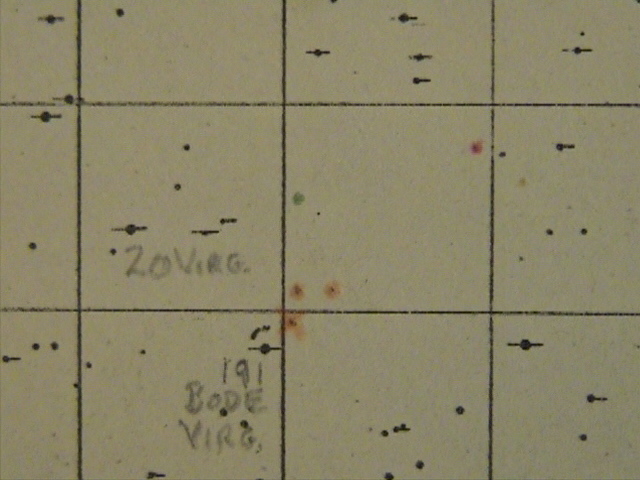 Dennis Rawlins (DR), preparing a 1966 ms
on the Brit theft of planet Neptune,
(see the planet-theft theory's ultimate vindication
at Scientific American 2004 Dec pp.98-99),
was amazed to find that Heinrich Wilhelm Olbers' 1802 recovery of Ceres
(asteroid #1: discovered by G.Piazzi 1801/1/1 [?],
but later lost for months),
as well as Olbers' discoveries of Pallas (1802) and of Vesta (1807),
ALL occurred in the same square degree of the sky.
(E&E 1800.0: Rt.Asc. 184°-185°, Decl. 11°-12°.)
Since the sky contains 41253 (129600/π) square degrees,
this is an ordmag billion-to-1 coincidence. Thus, it may help explain
the origin of Olbers' theory
(which he discussed even before capturing Vesta) that
the asteroids came from a destroyed planet between Mars & Jupiter,
since all fragments of an explosion or an encounter
would regularly return to the place of occurrence.
Dennis Rawlins (DR), preparing a 1966 ms
on the Brit theft of planet Neptune,
(see the planet-theft theory's ultimate vindication
at Scientific American 2004 Dec pp.98-99),
was amazed to find that Heinrich Wilhelm Olbers' 1802 recovery of Ceres
(asteroid #1: discovered by G.Piazzi 1801/1/1 [?],
but later lost for months),
as well as Olbers' discoveries of Pallas (1802) and of Vesta (1807),
ALL occurred in the same square degree of the sky.
(E&E 1800.0: Rt.Asc. 184°-185°, Decl. 11°-12°.)
Since the sky contains 41253 (129600/π) square degrees,
this is an ordmag billion-to-1 coincidence. Thus, it may help explain
the origin of Olbers' theory
(which he discussed even before capturing Vesta) that
the asteroids came from a destroyed planet between Mars & Jupiter,
since all fragments of an explosion or an encounter
would regularly return to the place of occurrence.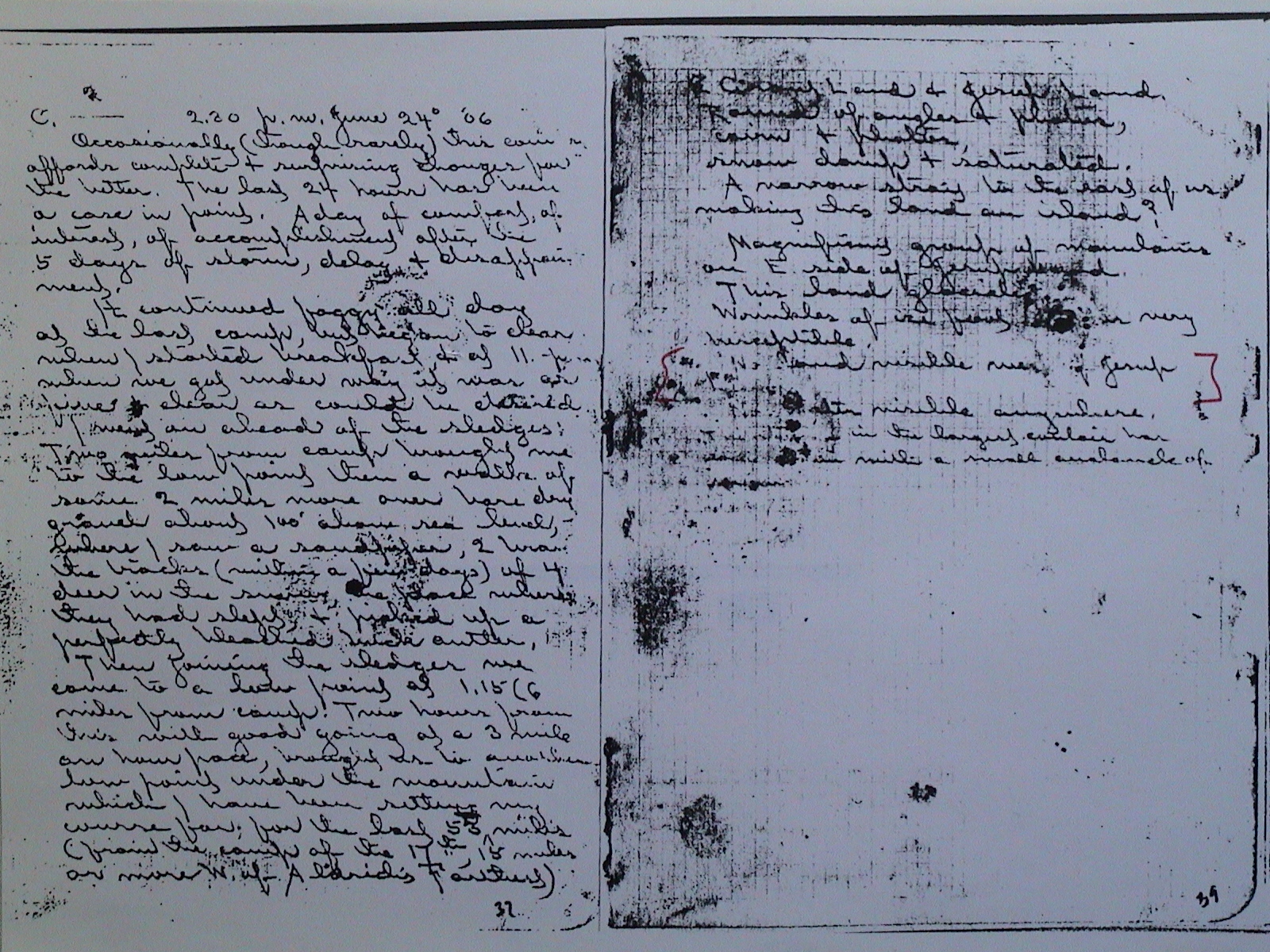
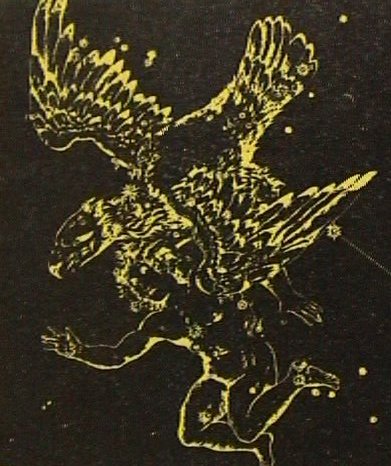 [See antique illustration here (relayed in S.Engelbrekston's
star-guide [1975] p.43), which depicts Aquila as Zeus
(Hadrian as predator?) & Antinoüs as Ganymede.]
[See antique illustration here (relayed in S.Engelbrekston's
star-guide [1975] p.43), which depicts Aquila as Zeus
(Hadrian as predator?) & Antinoüs as Ganymede.]

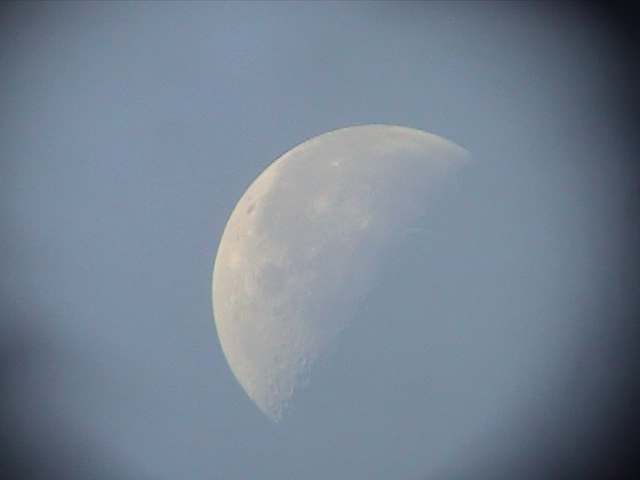 Regarding photo at right:
Is this a right-on half-Moon? Or slightly crescent? Or slightly gibbous?
Try estimating which — and then check the truth,
at this paragraph's conclusion.
Regarding photo at right:
Is this a right-on half-Moon? Or slightly crescent? Or slightly gibbous?
Try estimating which — and then check the truth,
at this paragraph's conclusion.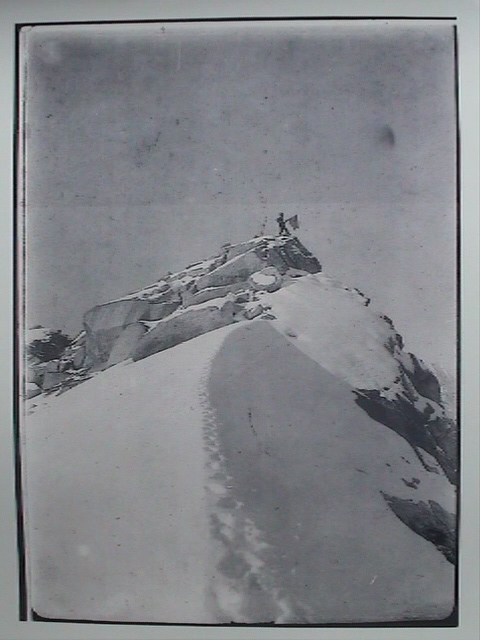
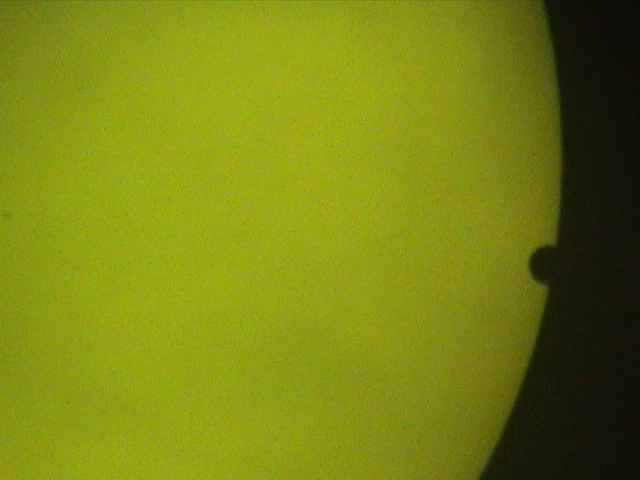 Issued public warnings just before the 2004/6/8 transit of Venus:
“
Issued public warnings just before the 2004/6/8 transit of Venus:
“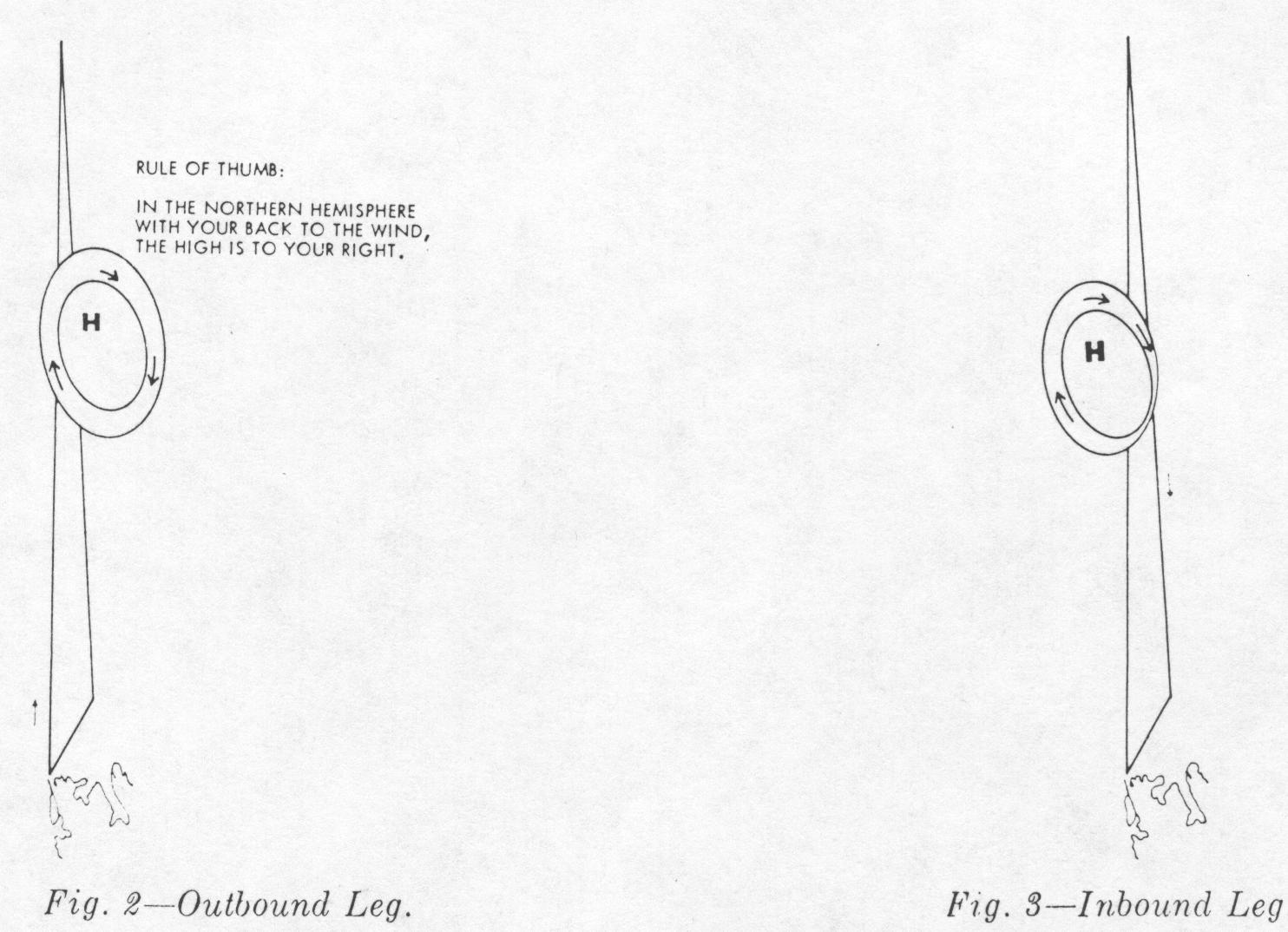
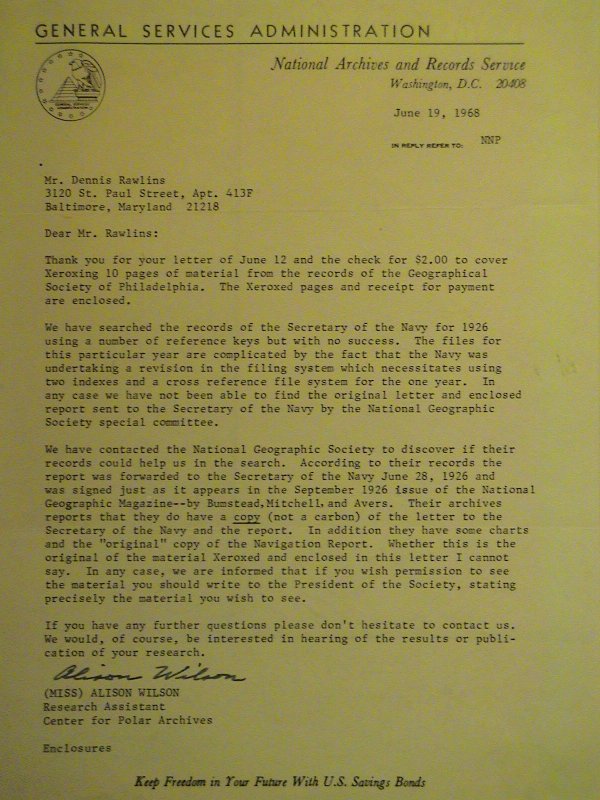 But when DR inquired (1968/7/11), NGS then told DR (1968/7/23)
that it had no such records. On DR's subsequent 1968/9/13 inquiry, Wilson said
that after NGS' admission of possession (reported in 6/19 letter), NGS had
phoned Wilson back, to find out who wanted to see the Byrd records.
But when DR inquired (1968/7/11), NGS then told DR (1968/7/23)
that it had no such records. On DR's subsequent 1968/9/13 inquiry, Wilson said
that after NGS' admission of possession (reported in 6/19 letter), NGS had
phoned Wilson back, to find out who wanted to see the Byrd records. The lighthouse method of Earth-measure ought to yield a result nearly 6/5
too high: 259200 stades. Which is not quite what previous historians have
taken to be Eratosthenes' finding, e.g., the Kleomedes exercise's value,
250000, which is c.4% lower than 259200.
The lighthouse method of Earth-measure ought to yield a result nearly 6/5
too high: 259200 stades. Which is not quite what previous historians have
taken to be Eratosthenes' finding, e.g., the Kleomedes exercise's value,
250000, which is c.4% lower than 259200.
 An 1165 AD direct measure (by Ibn al-Šayj) of the Pharos'
three sections (Proc Brit Acad 19:277-292 1933 pp.280 & 282-283)
states their heights as (explicitly in fathoms) 31, 15, & 4, ascending.
An 1165 AD direct measure (by Ibn al-Šayj) of the Pharos'
three sections (Proc Brit Acad 19:277-292 1933 pp.280 & 282-283)
states their heights as (explicitly in fathoms) 31, 15, & 4, ascending.